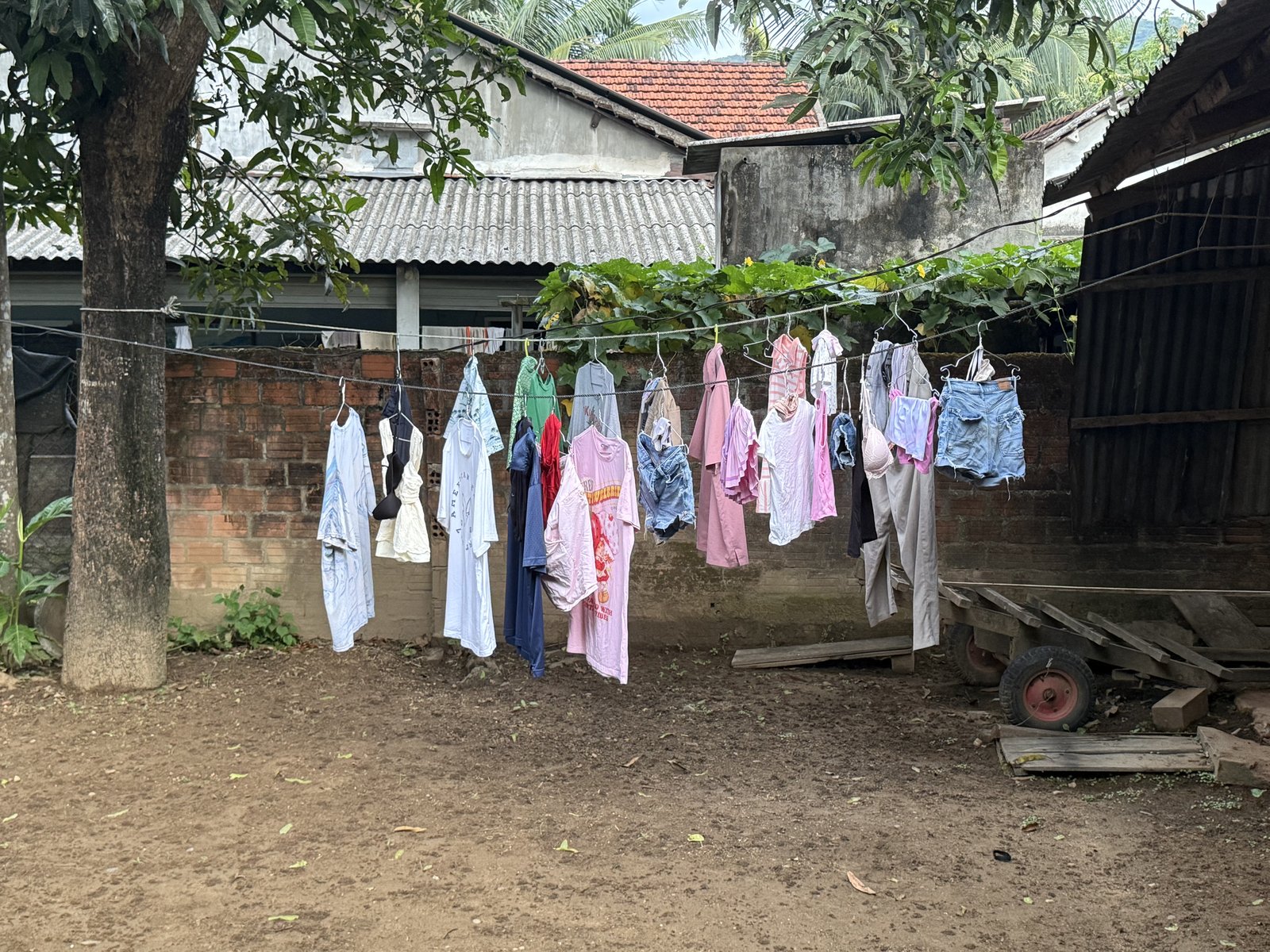
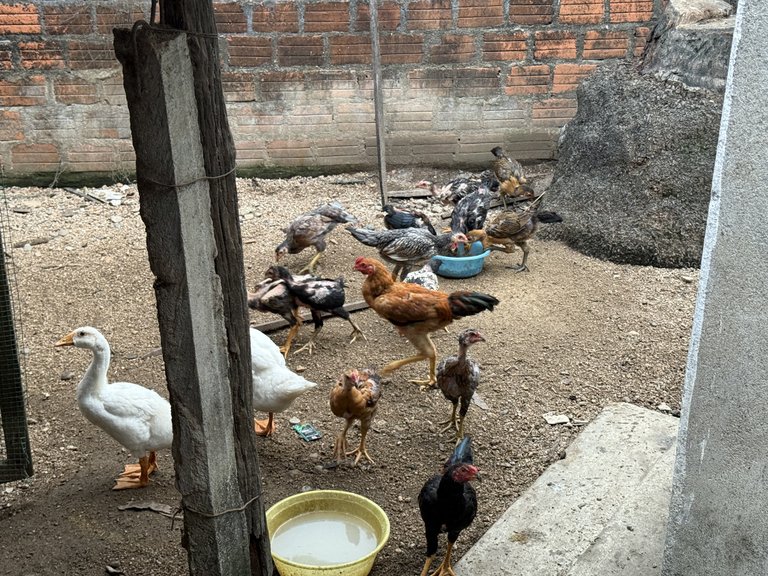
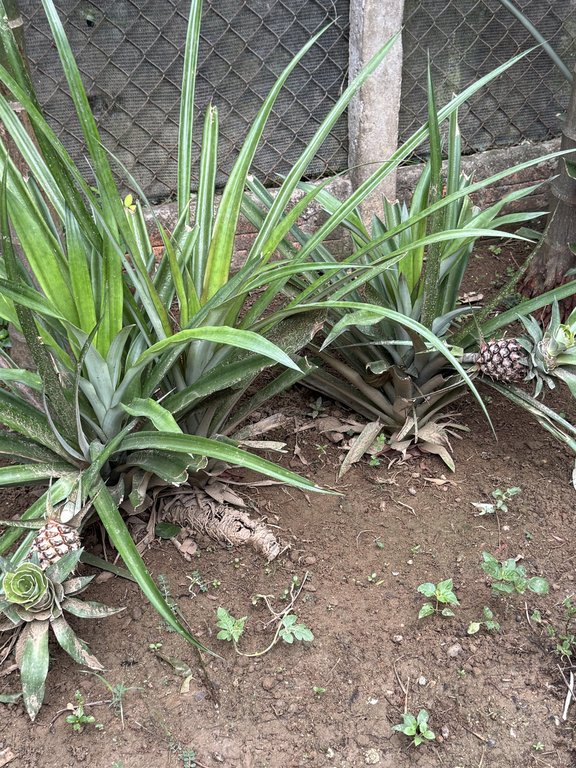
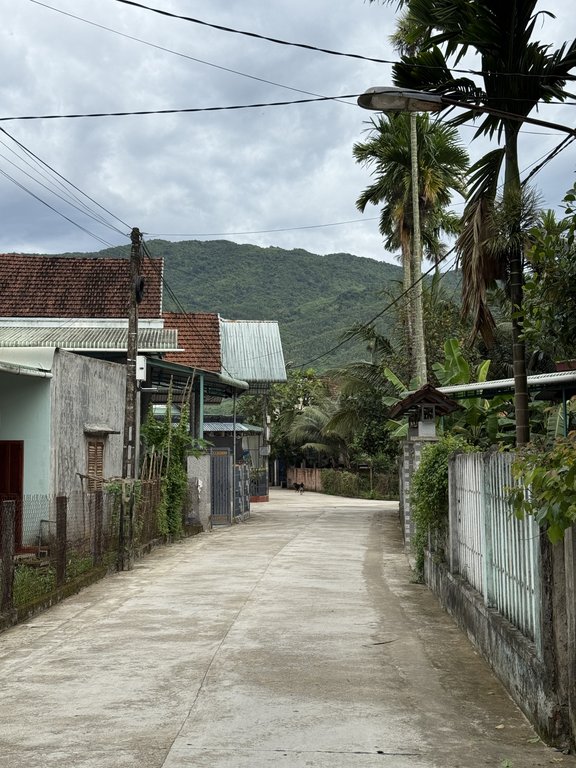
Jet lag has a sense of humor. It nearly drops you face first into the hotpot at dinner, then hands you back the morning at an hour when only the roosters are awake. By 5:30 on our first full morning in An Lão I was out in the yard, watching the valley wake up. The laundry was already on the line. The chickens and a white duck were working the dirt along the back wall. Pineapples were coming up out of the red clay by the fence, and down the lane the mountains sat under a lid of gray cloud.
The girls, I should say, had no such trouble. They slipped right back into it. Lisa remembers quite a bit, her old friends and places. Jennie's memory is less complete, but they FaceTime their cousins and friends regularly, so no one here has become a stranger. They had no problem adjusting back to the eating, the sleeping, and the sitting on hard surfaces. I have not. Lisa's biggest complaint so far is the lack of air conditioning. She prefers the beach, and therein lies the problem.
A Morning at the Market
We had no plans. That is the beauty of An Lão. But the coffee supply was beginning to look dangerously low, and that is the kind of emergency that gets a household moving. So off we went to the market at An Hòa.
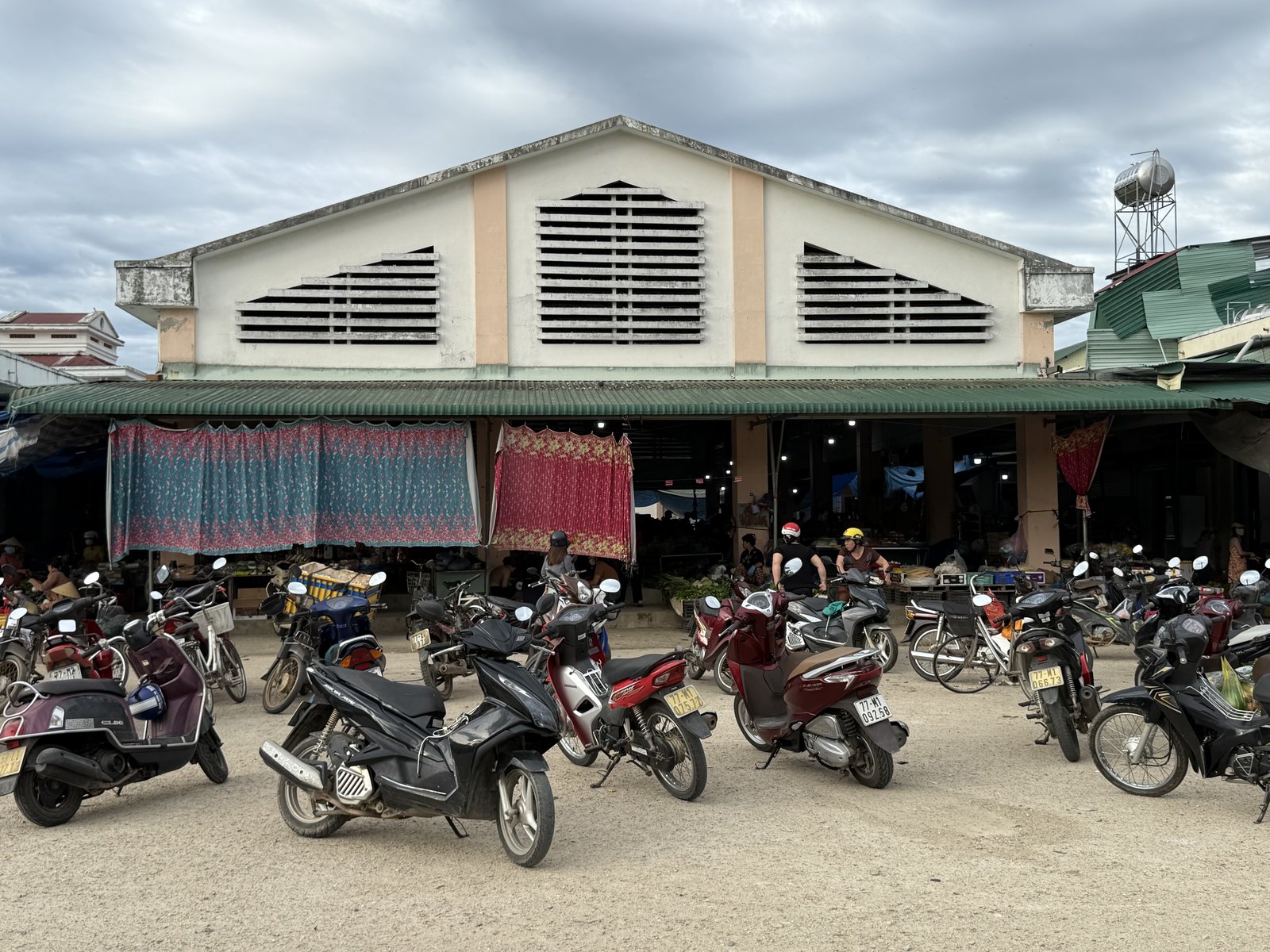
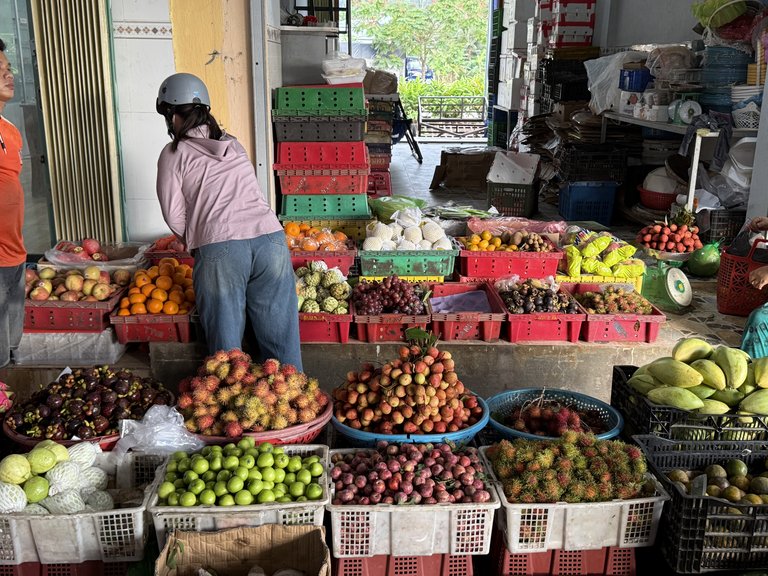
If you have been to a rural market anywhere in Vietnam, you know the building before you see it. A long concrete hall with tall louvered vents in the gables, a corrugated tin awning wrapped around the sides, and a dirt lot out front crowded with motorbikes. Bright patterned curtains hung along the front. Inside, the produce sat in heaps on low tables and on the floor itself. Long beans, cucumbers, carrots, corn, piles of greens and herbs, baskets of limes.
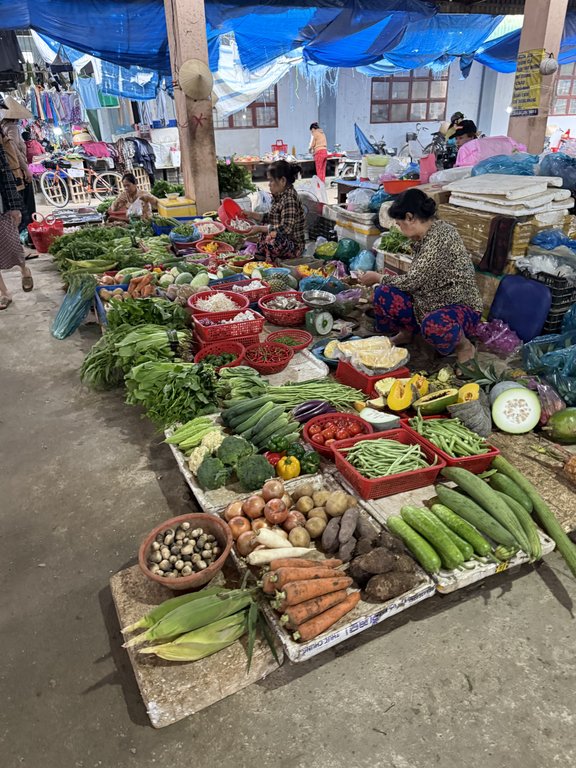
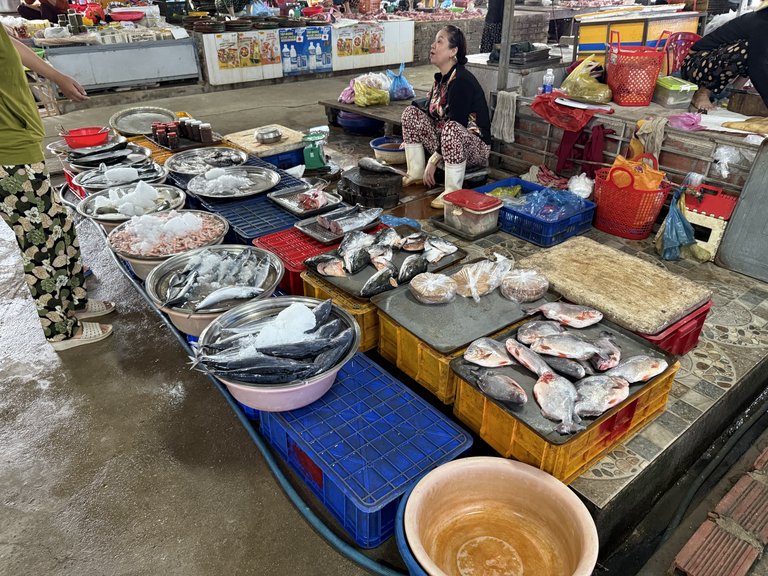
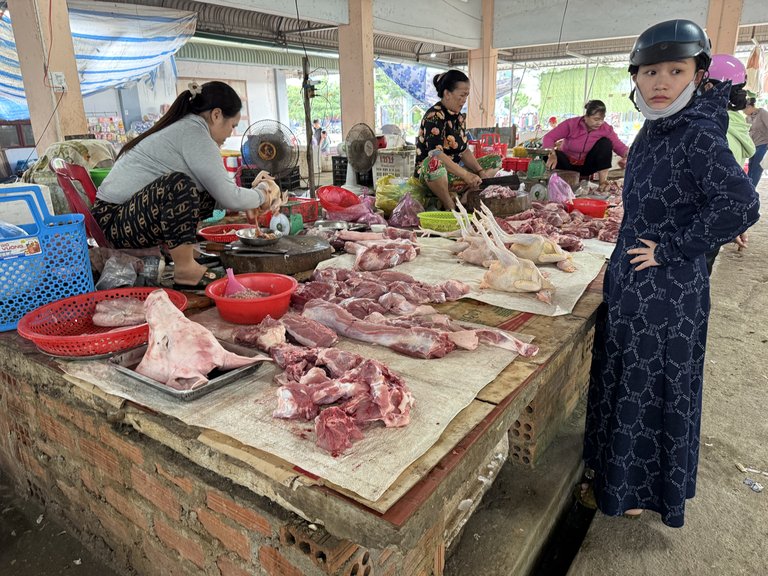
The fish sellers held down one corner, the morning's catch laid out in trays and basins on the wet concrete. Around the next pillar the pork was spread in great pink slabs across a tiled counter. No plastic wrap. No sell-by date. In the countryside, refrigeration is still something of a luxury, and most meat is bought fresh from the morning's slaughter, laid out in the open for inspection. It is called a wet market because it is, in fact, wet.
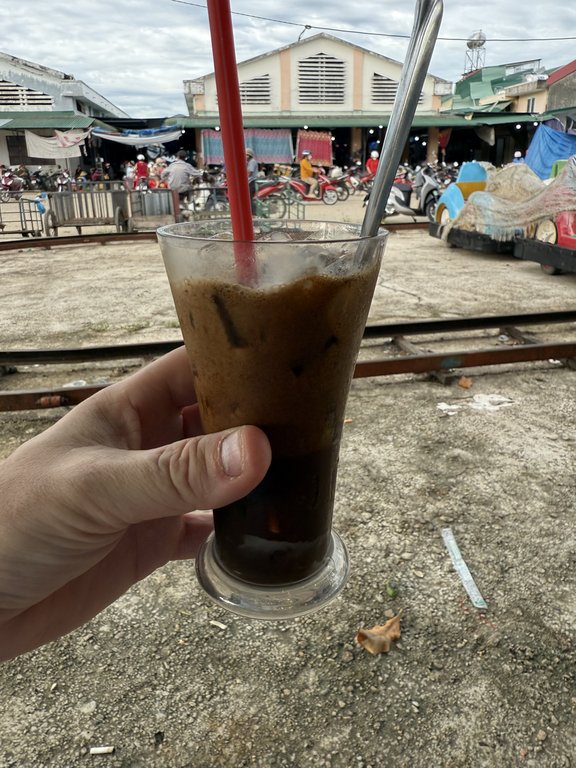
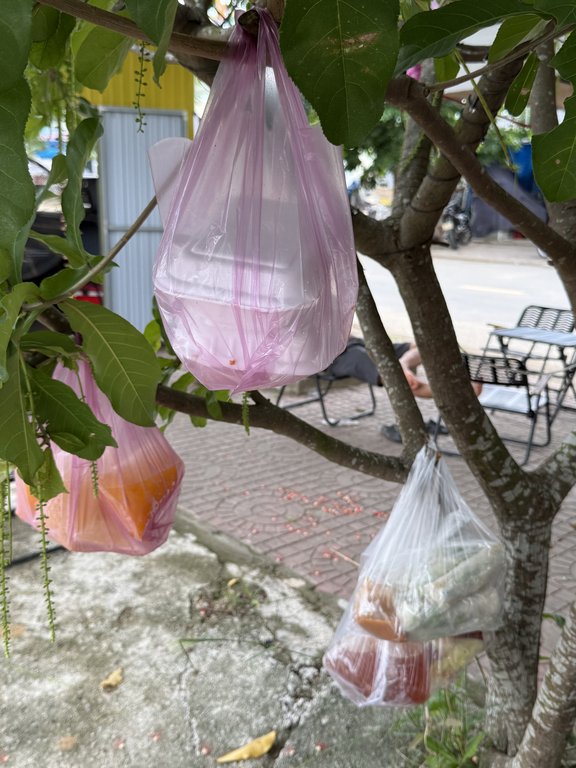
With the bags loaded, we retreated to a coffee stand at the edge of the lot. Its shade tree doubled as a pantry, the low branches hung with pink plastic bags of somebody's shopping. Across the dirt, the rails of an old children's ride rusted in the sun. The coffee came the way it should, cà phê sữa đá in tall tulip glasses, thick, strong and sweet over ice, with glasses of iced tea on the side. We drank it in silence. Nothing needed to be said.
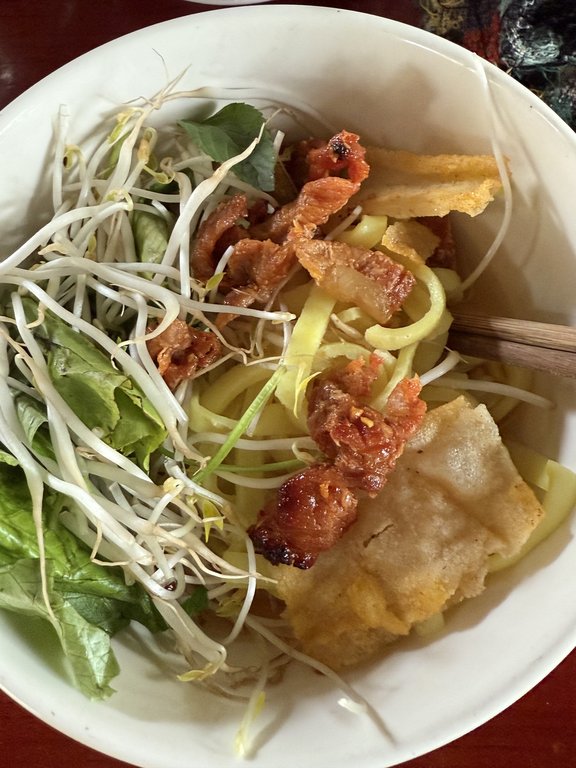
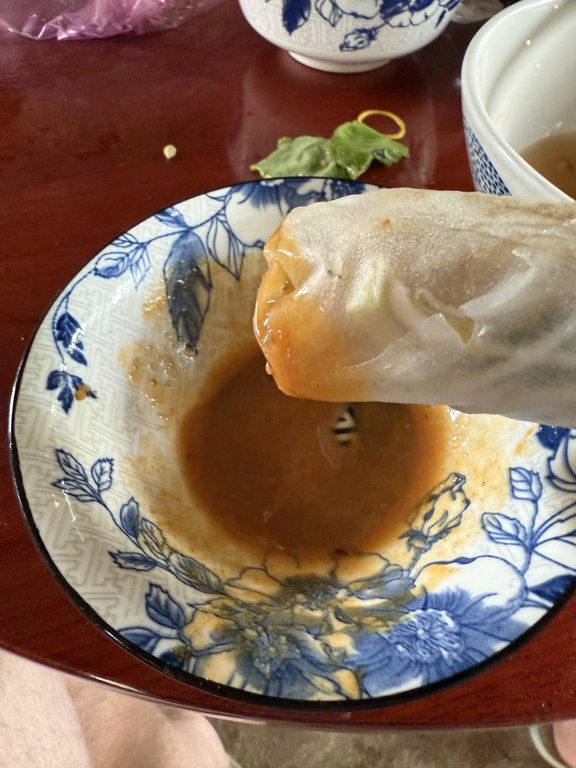
Back at the house, one of my sisters-in-law had already solved breakfast. She had picked up Mì Quảng from a street vendor, the turmeric-yellow rice noodles of Quảng Nam with pork, a broken rice cracker over the top, and a nest of bean sprouts and herbs. Then came fresh spring rolls with a thick peanut dipping sauce, the kind you scrape out of the bowl with the last roll because leaving any behind feels like a crime.
The Valley
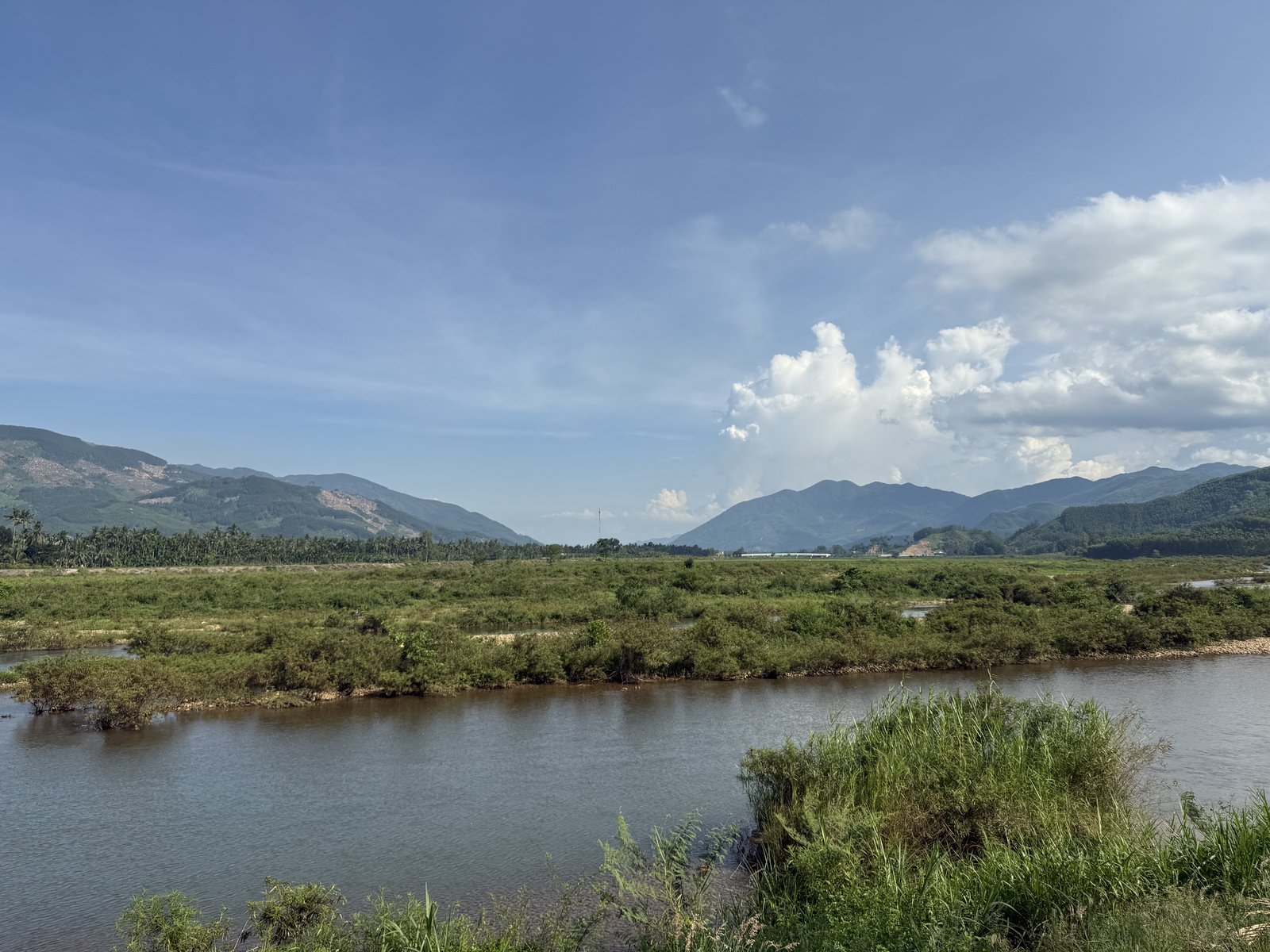
Diem's family lives in the hamlet of Thuận An, about four miles south of the old district capital, in a long green valley cut by the An Lão River. The river rises in the mountains toward the Quảng Ngãi border and runs down out of the valley to Bồng Sơn, where it meets the Kim Sơn and becomes the Lại Giang on its way to the sea. Through the villages it is lined with long, sloping concrete walls that hold it in place when the rains come down out of the mountains. In the dry months it shrinks to a few braided channels between sandbars and grassy islands. The district covers about 690 square kilometers of mostly mountain and is home to only around 30,000 people, Kinh families alongside the Hrê and Bana peoples of the highlands. The main road, provincial route 629, follows the river in from Highway 1, about 32 kilometers away. It is the valley's lifeline, and its distance from everything else is a large part of why An Lão feels the way it does.
It has not always been a quiet place. The valley is a natural corridor between the mountains of Quảng Ngãi and the coastal plain of Bình Định, and during the war both sides wanted it. In December of 1964, a communist regiment, with sappers and local forces, overran the district headquarters and held it for three days against South Vietnamese counterattacks. A little over a year later, in early 1966, the valley was swept again during the American offensive called Operation Masher, a name President Johnson had changed to the gentler White Wing. Marines blocked the northern end, South Vietnamese troops the southern, and the 1st Cavalry Division came in by helicopter. The enemy had already slipped away. The soldiers found caches of rice and defensive works. And about 4,500 of the valley's 8,000 residents left with them, roughly 3,000 of them flown out by American helicopters. Today it is difficult to imagine. The lanes are paved, the rice is green, and the loudest thing in the valley is a karaoke machine.
As for what is happening today, An Lão is changing faster on paper than it is on the ground. On July 1, just two weeks after we left, Vietnam redrew its map. Sixty-three provinces became thirty-four, and the district level of government was abolished altogether. Bình Định was merged with its western neighbor under the name Gia Lai, with the seat of government on the coast in Quy Nhơn. An Lão District no longer exists. Its town and communes were folded into four new communes: An Lão, An Hòa, An Vinh and An Toàn. So we came home from An Lão, Bình Định, and the next time we go back it will be to An Lão, Gia Lai. The roosters, I suspect, will not notice.
Lunch on the Floor
I am currently eating at a pace that might very well exceed the speed of light. That is what I told everyone back home that morning, and it was no exaggeration. After first breakfast, a snack, second breakfast, and, wait for it, another snack, we walked ten minutes down the lane to visit some cousins. The occasion? A feast, which I will label here as lunch, though it was not yet 11 in the morning. The sun had already climbed to full intensity.
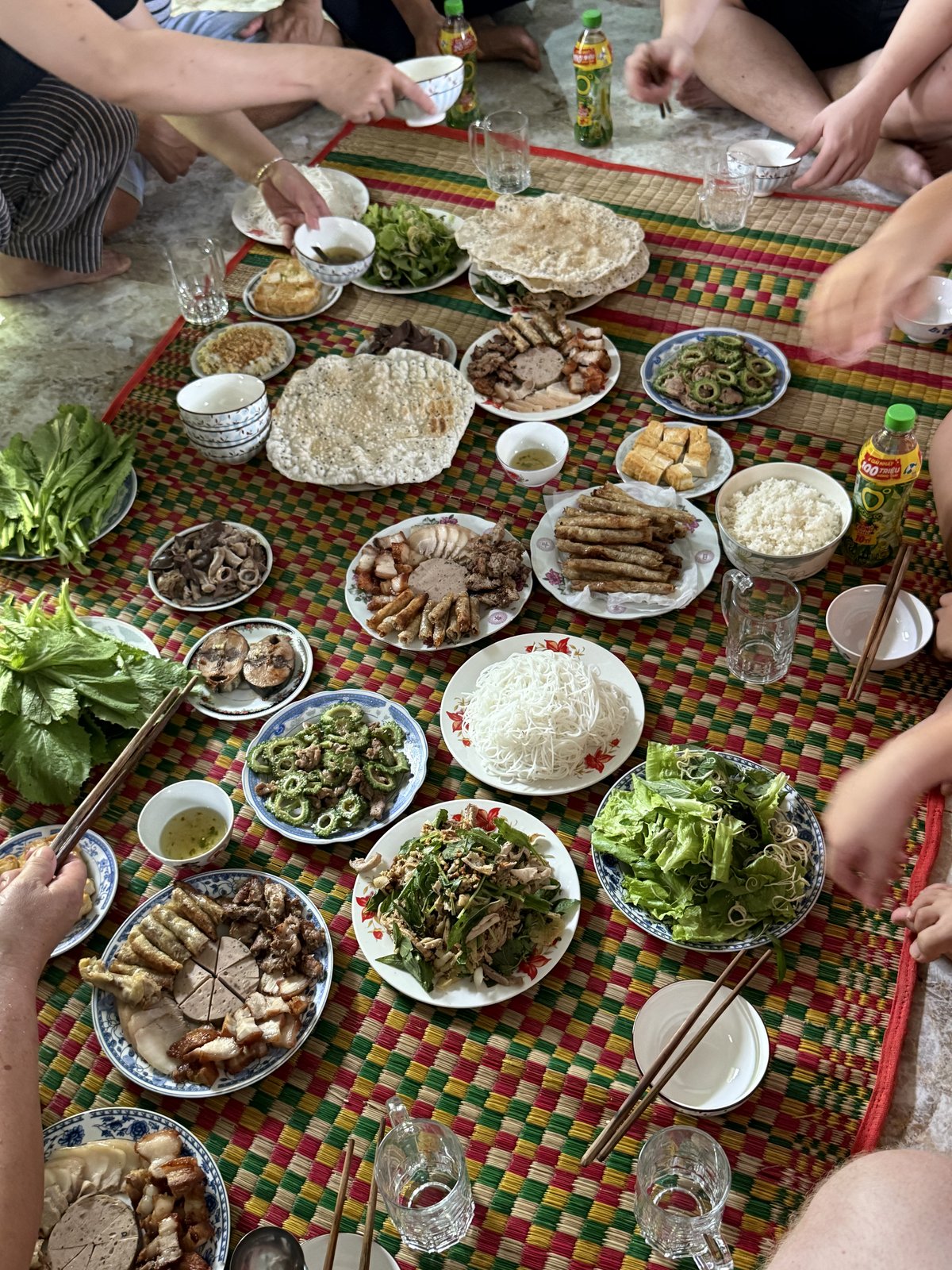
There was no table. A woven bamboo mat was rolled out across the tile floor, red and green, and the dishes were set down one by one, and sometimes five at a time, until you could no longer see the mat. Lemongrass beef. Grilled chicken. Crispy fried spring rolls, with mustard greens to wrap them in. Bitter melon sautéed with pork. Braised catfish. Pork belly at least three different ways. A pork hock stew with carrots and corn. Sticky rice with wheat berries. Steamed organs, liver, intestines and heart. Pork roll. Fried tofu. And of course rice, noodles, rice crackers, and an assortment of sauces for dipping.
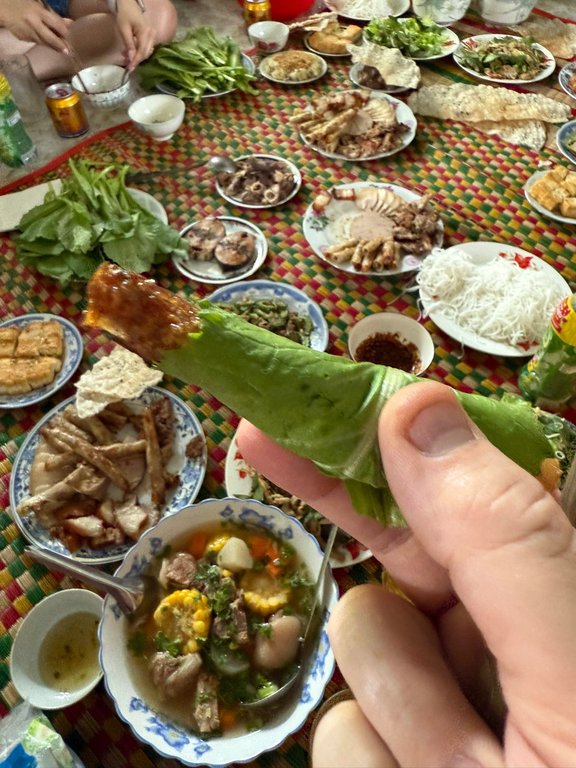
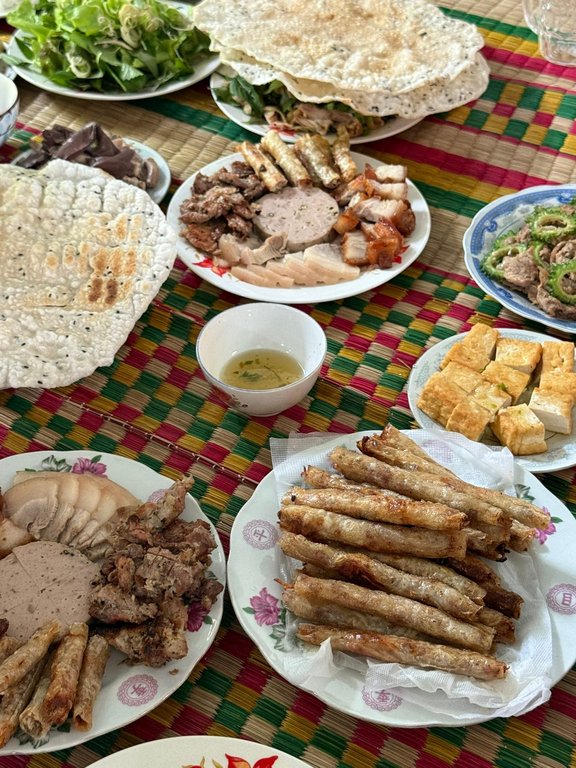
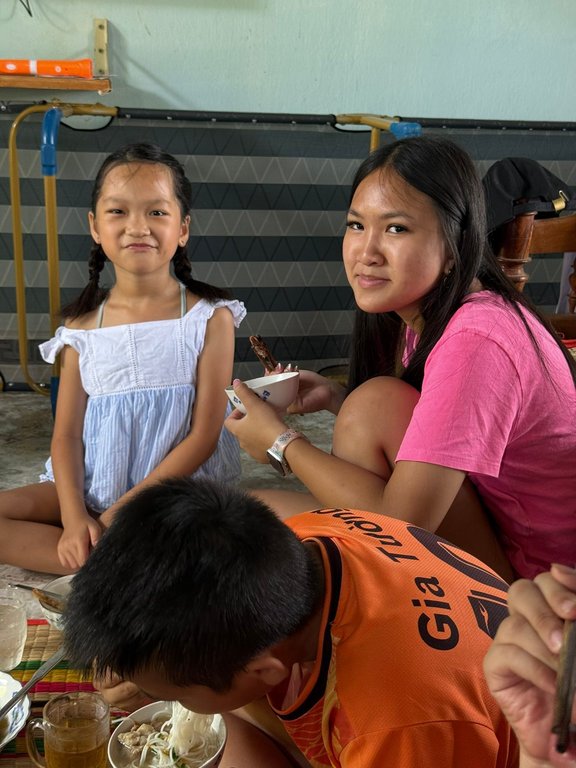
As is the custom, everyone sits on the floor around the mat, and then the meal is called to begin. The eldest always sits highest among those in attendance. I am usually given a variance in the form of a low chair. I am not conditioned to sit for long periods on hard tile, and everyone is kind enough to accommodate the soft American. The Vietnamese are natural communal eaters. Everything goes in the middle, and you reach for what you want.
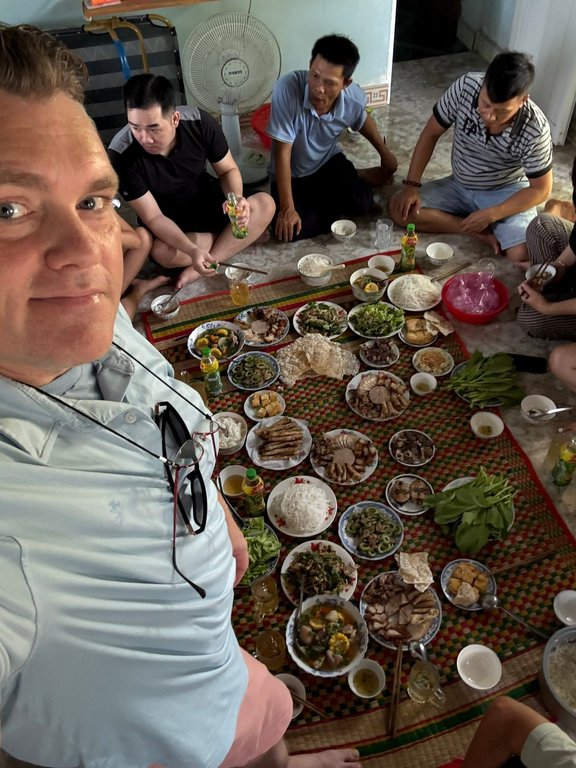
I've said it before and I'll say it again. I am the only person who visits Vietnam and gains weight.
Bánh Xèo and Balut
Jet lag took most of the afternoon. When it is time to sleep, there is not much one can do to stave it off. When I woke, Diem had sent out for bánh xèo and balut.
Bánh xèo is one of my absolute favorites, and a dish I make regularly at home. Mine are a distant second to the real thing. The name comes from the sound, xèo, the sizzle when the batter hits the hot pan. The batter is rice flour, turmeric and coconut milk, poured thin so the edges go crisp and lacy. Down south in Saigon they make them big enough to cover a plate. Here on the central coast they are small, and in Bình Định they are traditionally filled with small local shrimp, then rolled up in rice paper with fresh greens and herbs and dunked in a sauce. Ours came home in plastic bags, with more bags of lettuce, herbs, sliced cucumber and bean sprouts, and a bright orange dipping sauce.
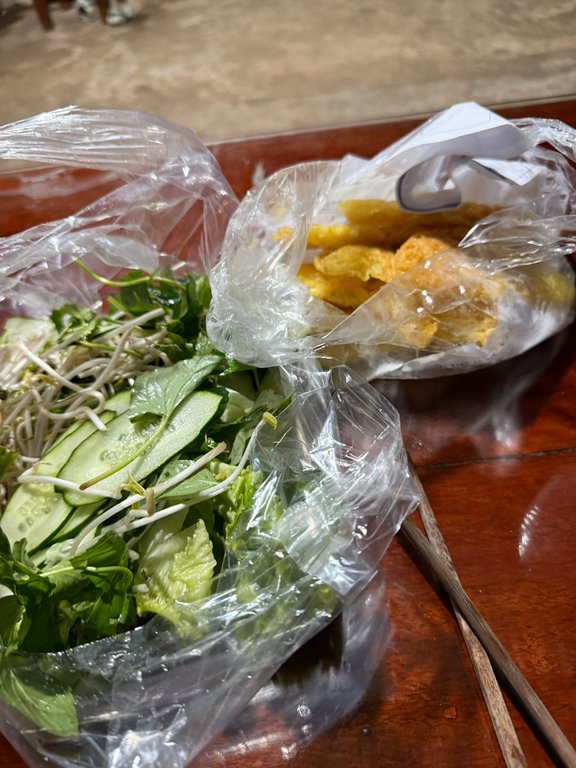
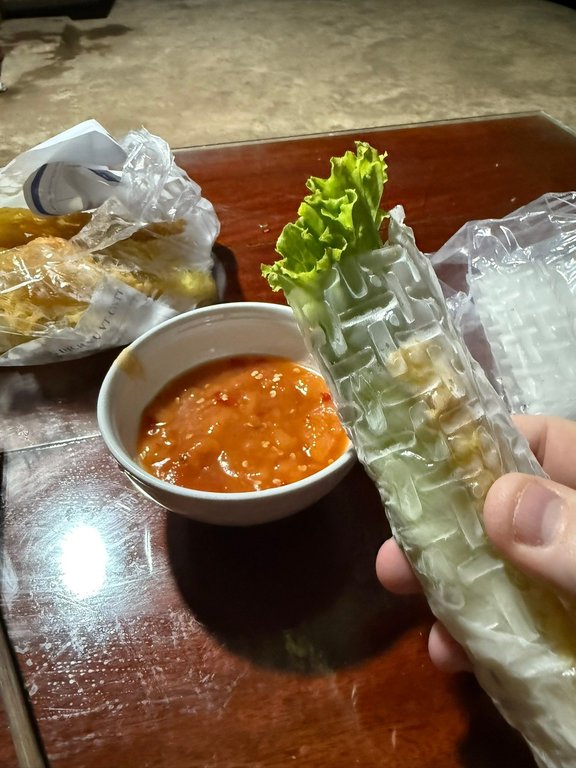
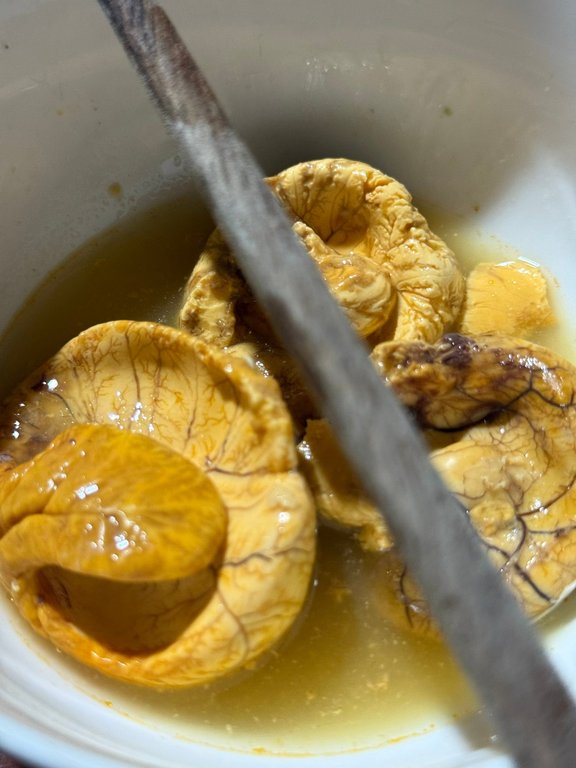
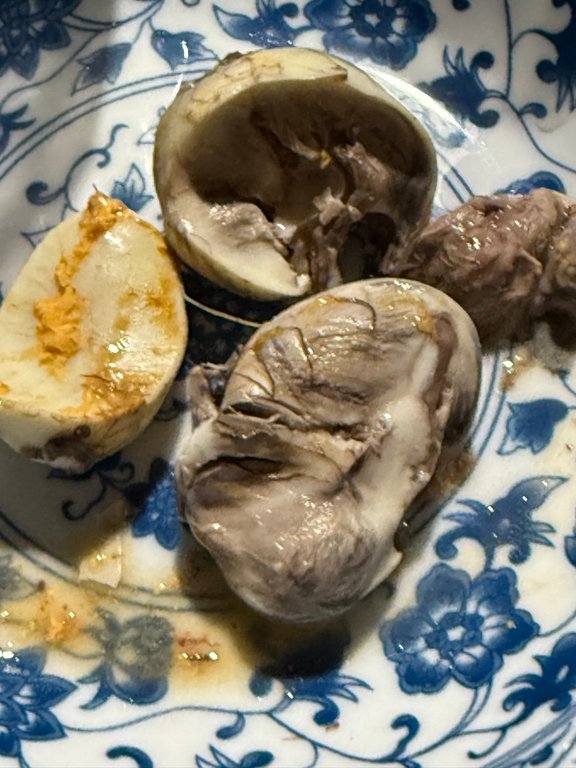
Jennie joined me on the back patio for her favorite, the balut. In Vietnamese it is hột vịt lộn, a fertilized duck egg incubated until the duckling has begun to form, then boiled. For most Americans, it is an acquired taste. You crack the top, sip the broth inside, then eat the rest with a little salt, pepper and lime and a sprig of rau răm, the peppery Vietnamese coriander that always comes with it. The Vietnamese like theirs a bit further along than in the Philippines, where it is also a national institution. It is sold everywhere, from breakfast noodle shops to the night carts, and it is considered good, restorative food. For the record, yes, that big golden thing in the picture is the yolk.
I went back to bed. A few more days, I told myself, and I should be fully adjusted.
Breakfast at the Woodshop
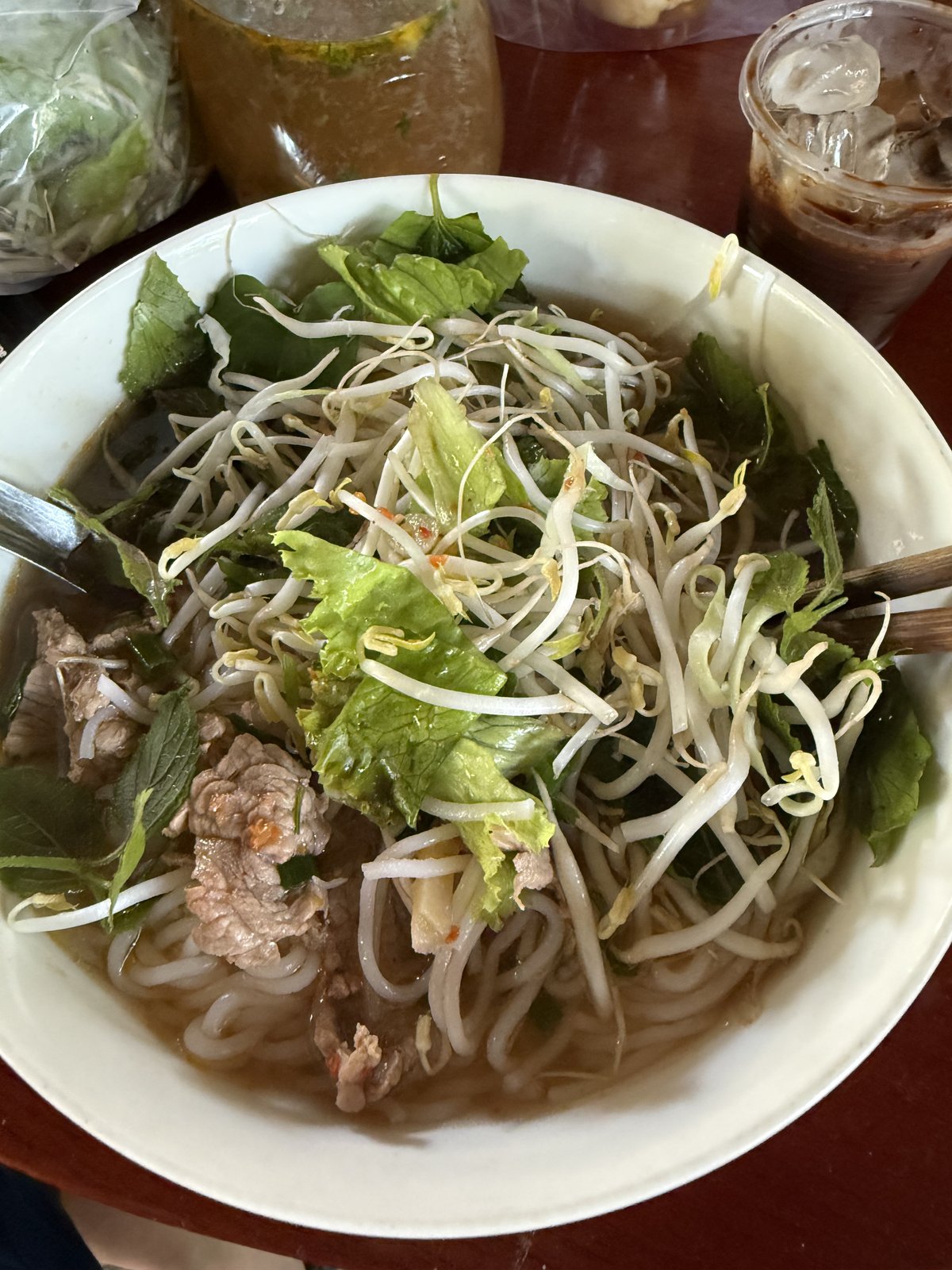
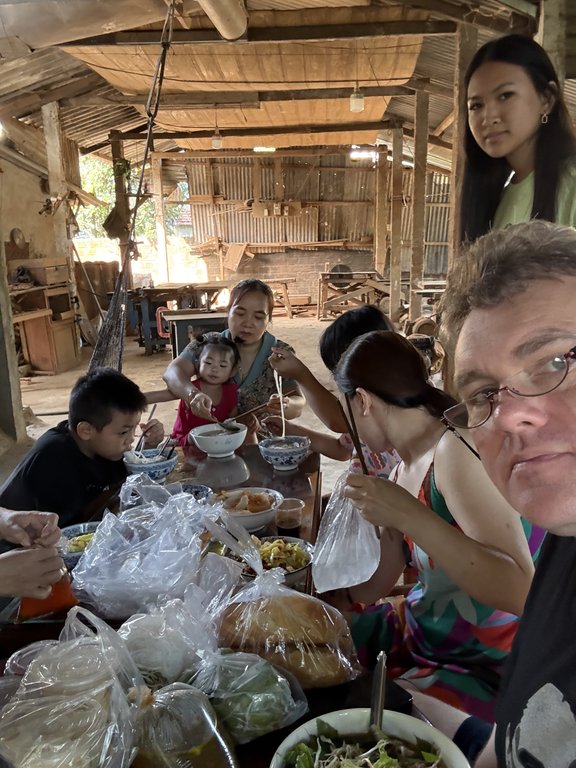
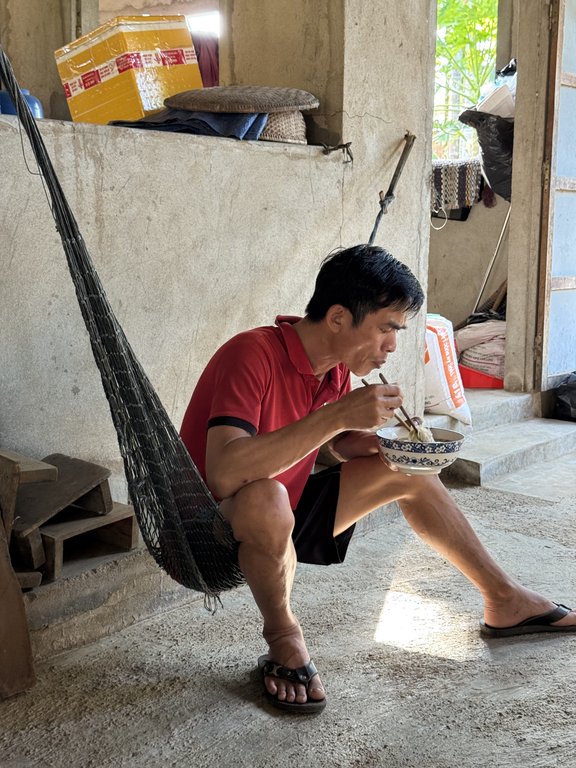
The next morning, breakfast was served out back in the woodshop, the same open shop I wrote about on our last long stay, with lumber stacked up in the beams. A hammock hung nearby. The table filled with plastic bags of herbs and bread and big bowls of beef noodle soup, bean sprouts and lettuce piled high. One of the men took his bowl to the hammock and ate there, which may be the most An Lão thing I have ever seen.
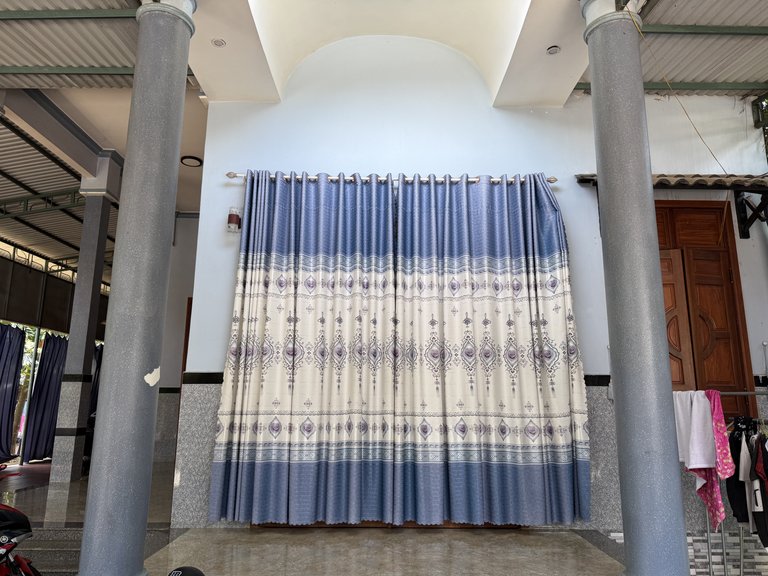
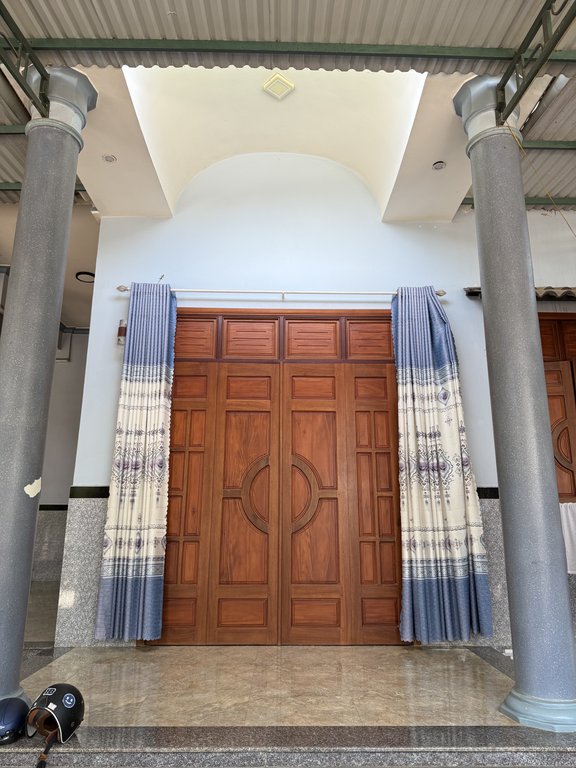
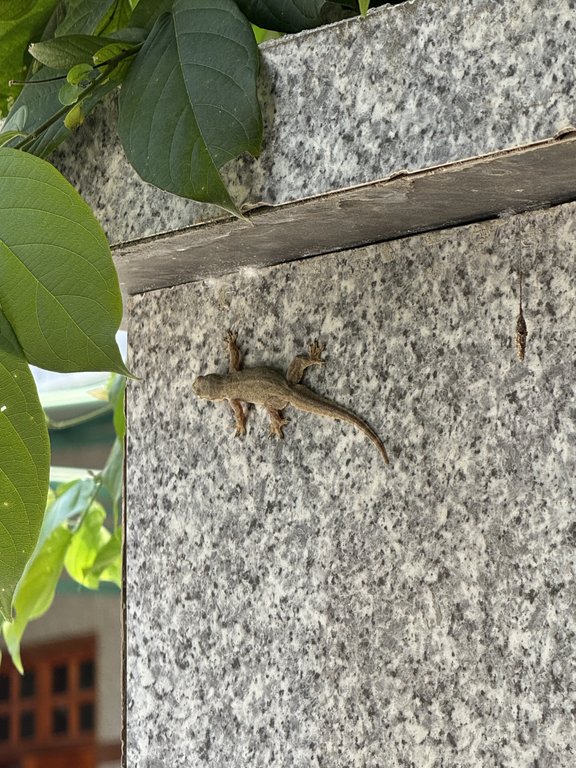
Time moves so quickly when you know it is limited. We would push north to Da Nang the next morning, and it felt like we had only just arrived. I spent the late morning wandering around the house. Blue and white curtains hung between the pillars of the front porch. The great carved wooden front doors, which open onto the family altar, stood tall in the shade. A gecko held perfectly still on a slab of granite by the front of the house, convinced I couldn't see him. Another hunted along the wall under the eaves. I could have sat there all day.
A Housewarming on the River
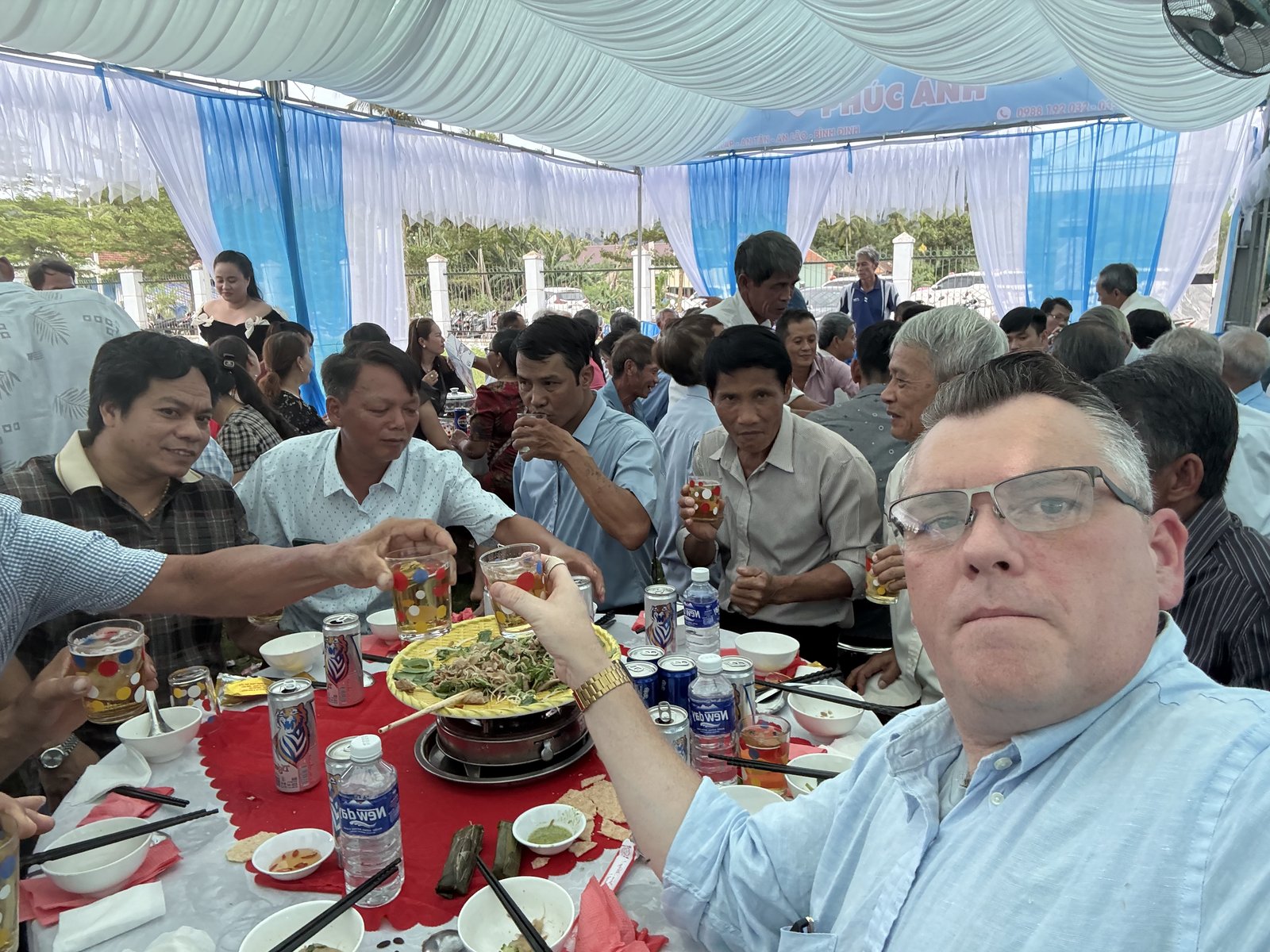
It never seems to end. That afternoon there was a housewarming party for a new home recently completed in the village. Like almost anything in Vietnam, a new house calls for a celebration. Here you do not simply move into a new home. The family chooses a lucky day, makes offerings to the ancestors and to the spirits of the land the house now sits on, and then throws open the doors to relatives and neighbors, who come to bless the place with food, drink and noise. And, of course, my presence was requested.
That afternoon there was a housewarming party for a new home recently completed in the village.
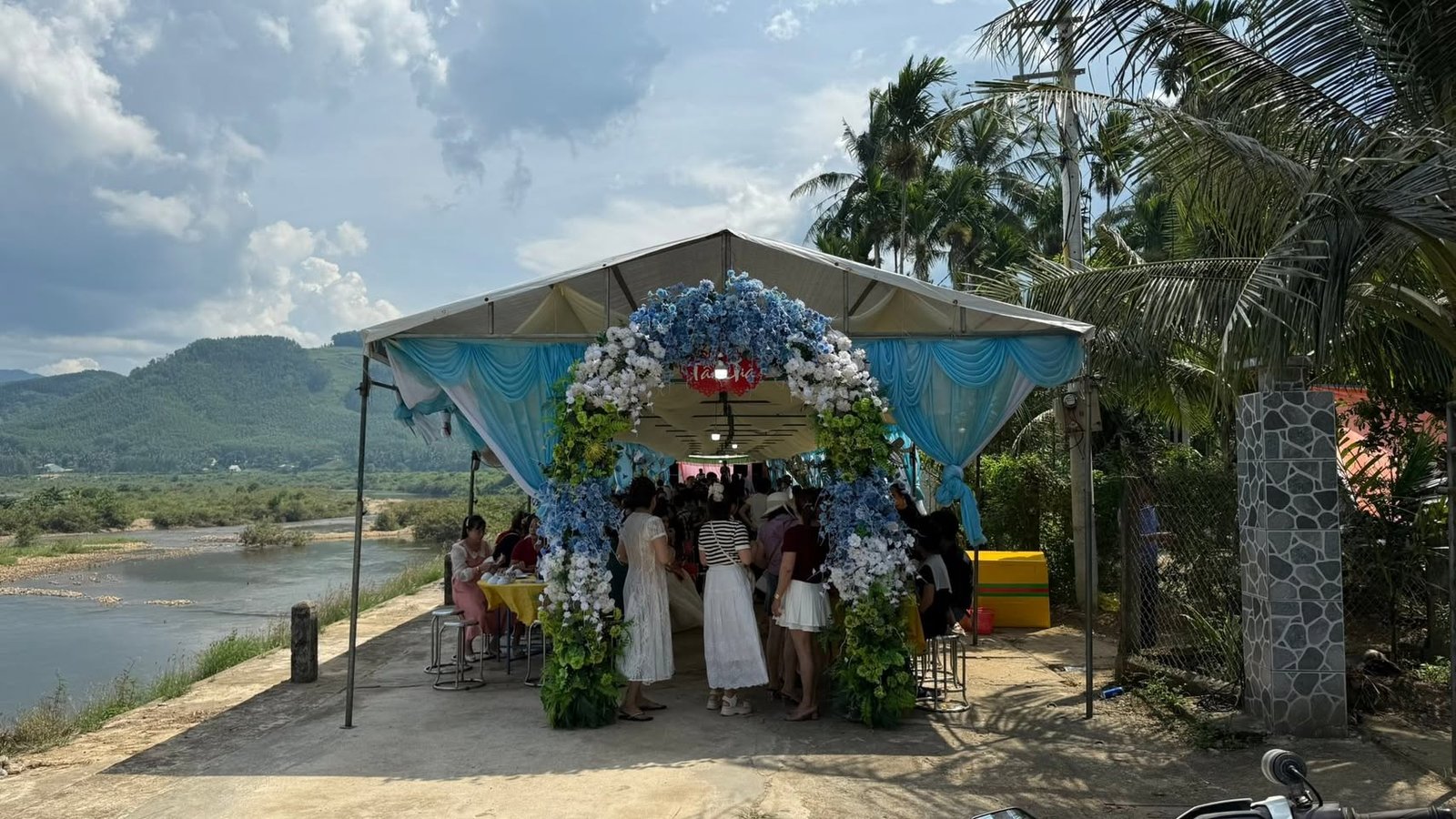
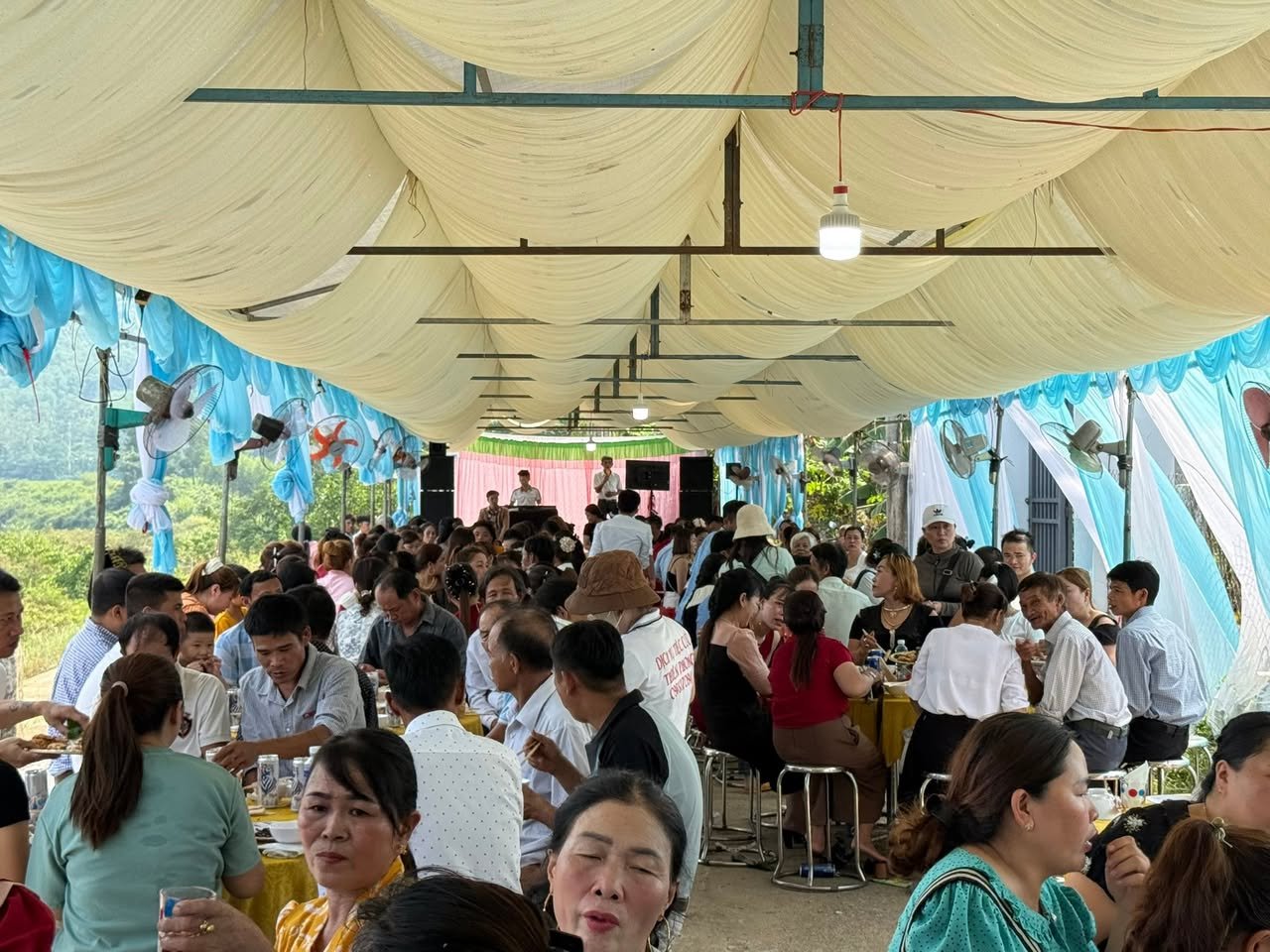
The party was set up under a long cream-colored tent along the top of the river wall, draped in blue and white, with an arch of blue flowers at the entrance and fans on poles every few tables. Beyond the tent the An Lão River wound off toward the mountains. A menu card sat on our table. Across the top it read Dịch Vụ Tiệc Cưới, wedding banquet service, from a caterer called Thiên Phong 2 in nearby An Tân. Two days earlier I had crashed a wedding. In An Lão, apparently, a housewarming gets the wedding treatment.
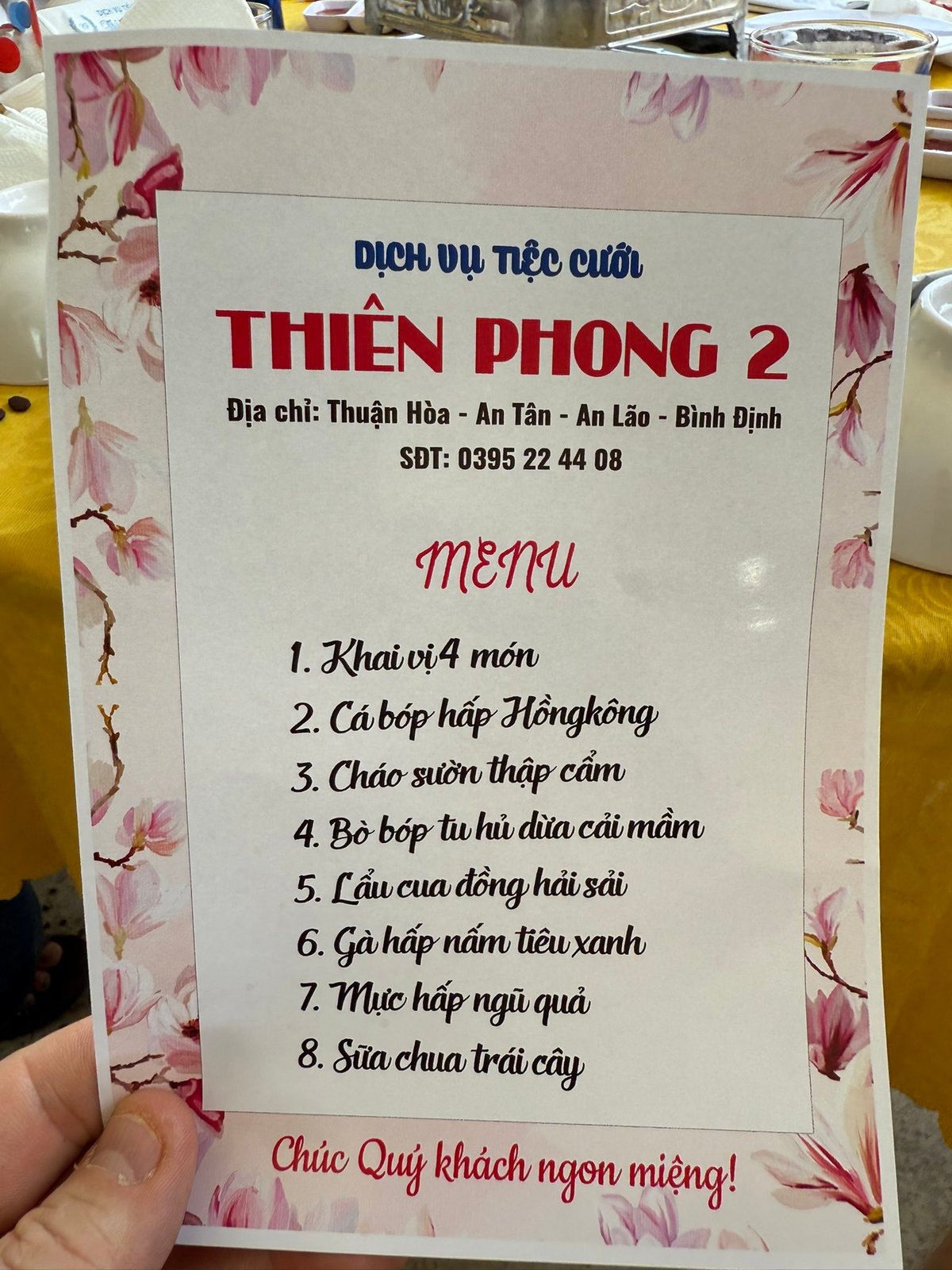
Eight courses, it promised. Of which I made it through seven, I think. I lost count. It started with a four-dish appetizer tray, a woven platter of banana leaf parcels, fried spring rolls, slices of chả, and translucent dumplings glossed in chili sauce. Then, the card said, fish steamed Hong Kong style. A rice porridge with ribs, carrots and fried shallots. Beef tossed with shredded coconut palm heart and sprouts. A field crab and seafood hotpot that bubbled away in a clay pot on a burner in the middle of the table, with a mountain of greens for the pot and rice paper for rolling. Then, if the card is to be believed, steamed chicken with mushrooms and green peppercorns, and steamed squid. The eighth course, according to the card, was fruit yogurt. I never saw it. I suspect it was a very nice yogurt.
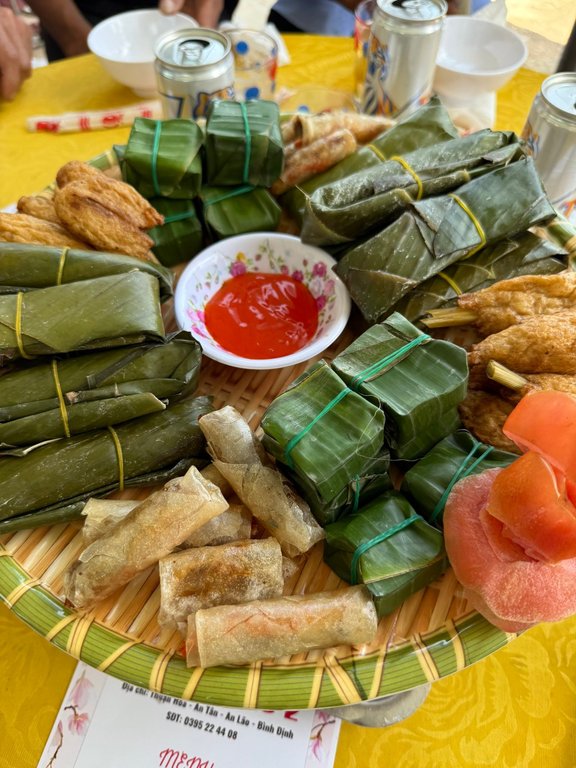
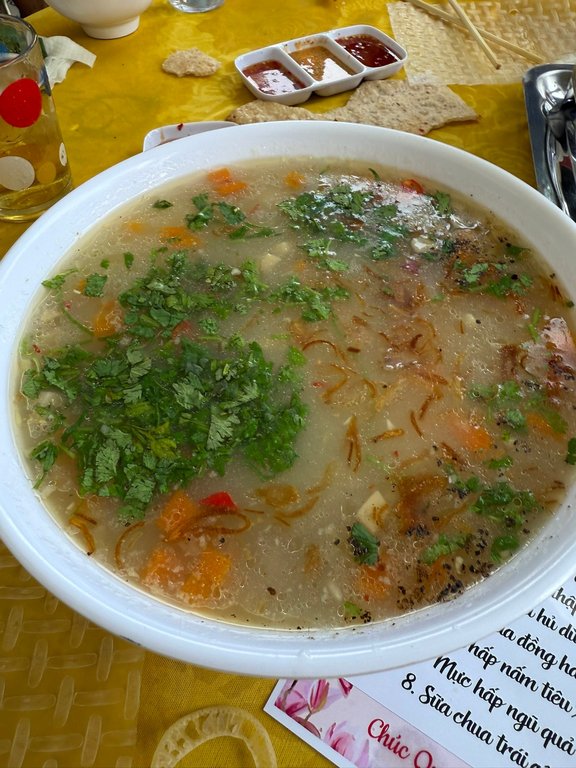
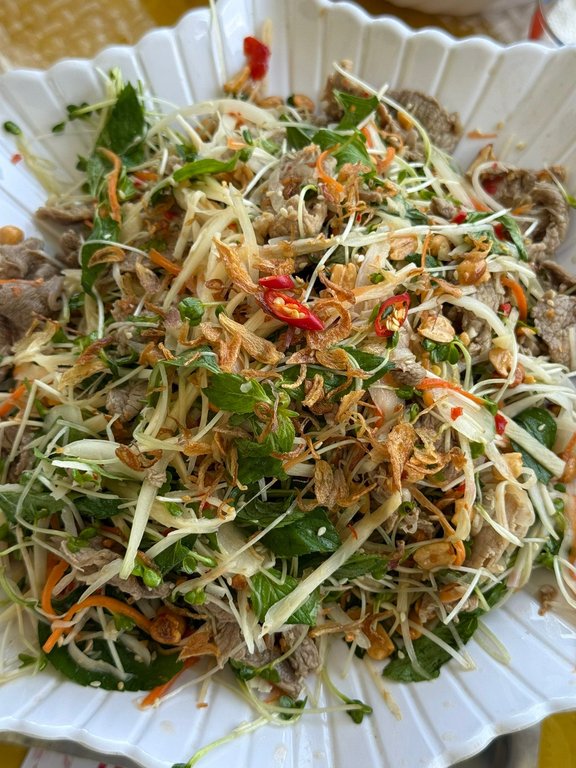
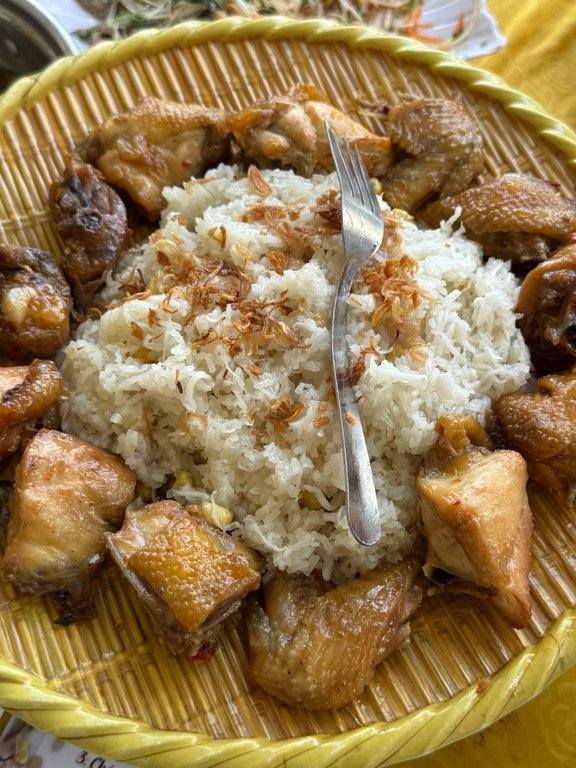
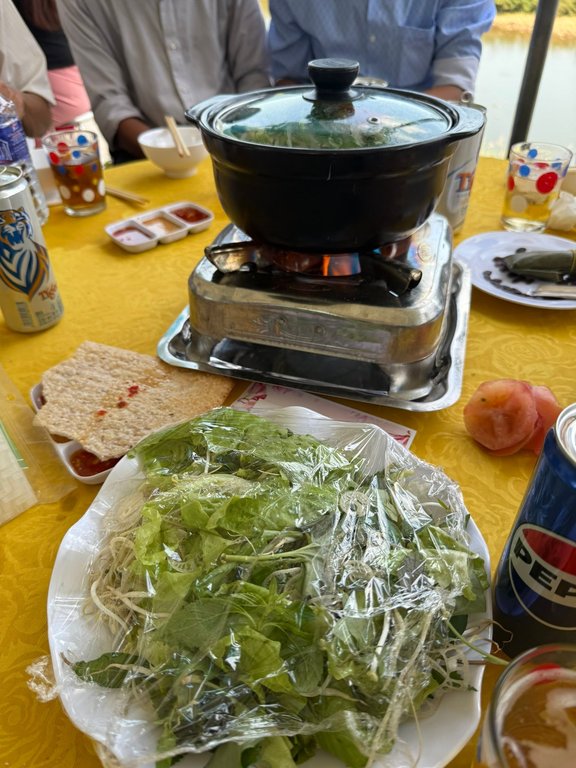
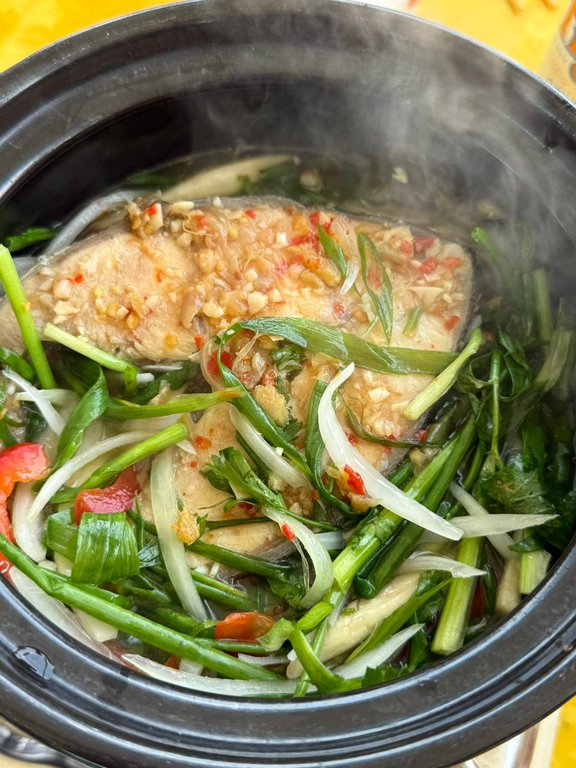
It was again a conveyor belt of people coming to the table wanting to clink glasses and cheer the American. Một, hai, ba, dô! One, two, three, drink! It rang out continuously against the backdrop of the river.
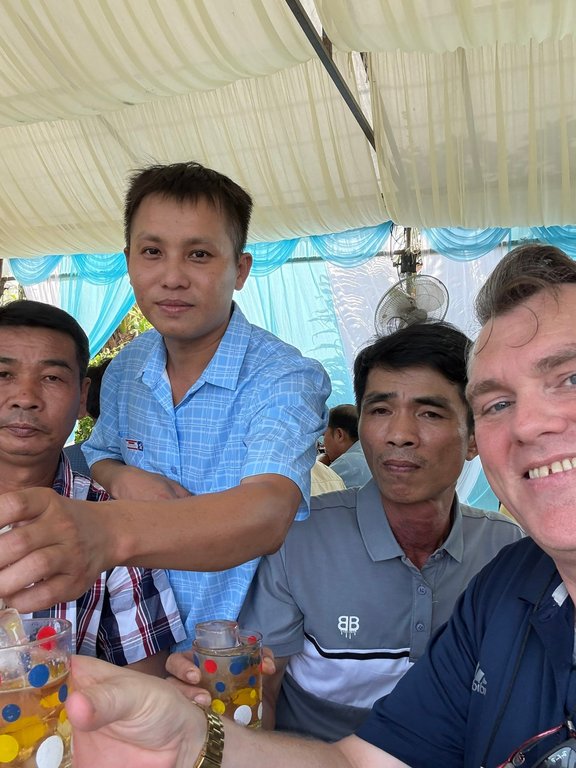
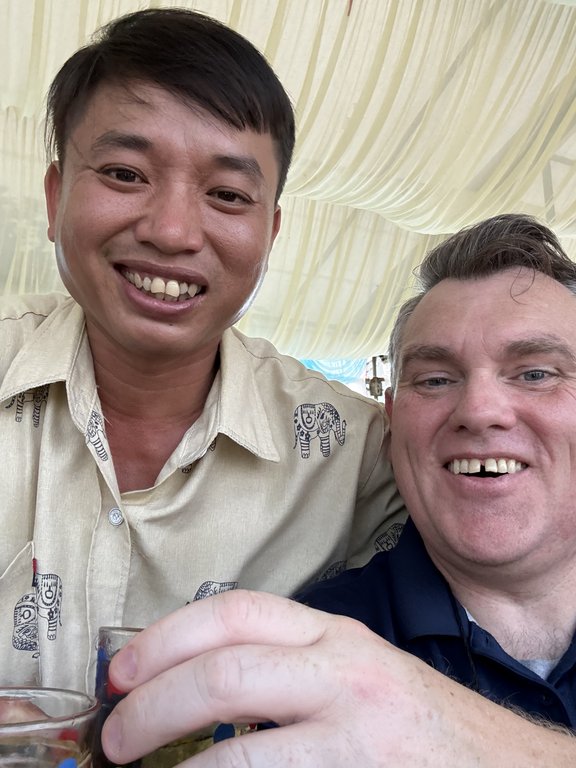
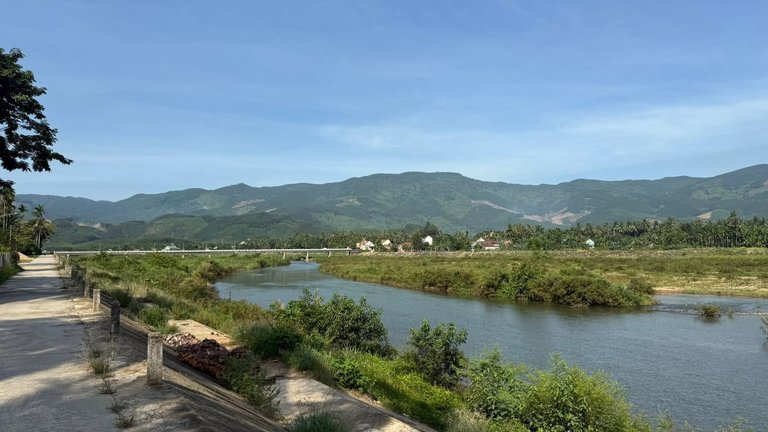
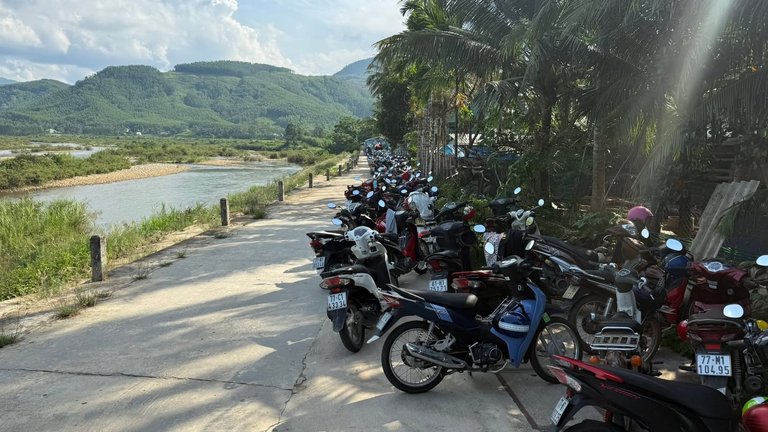
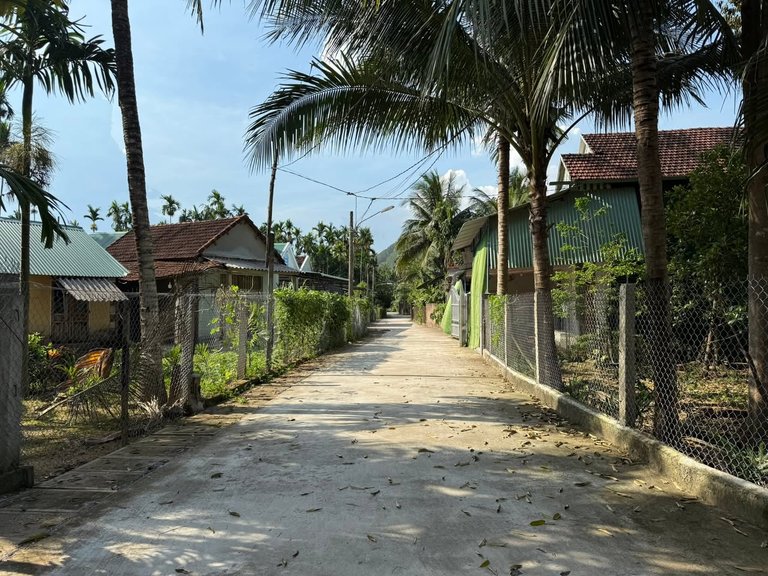
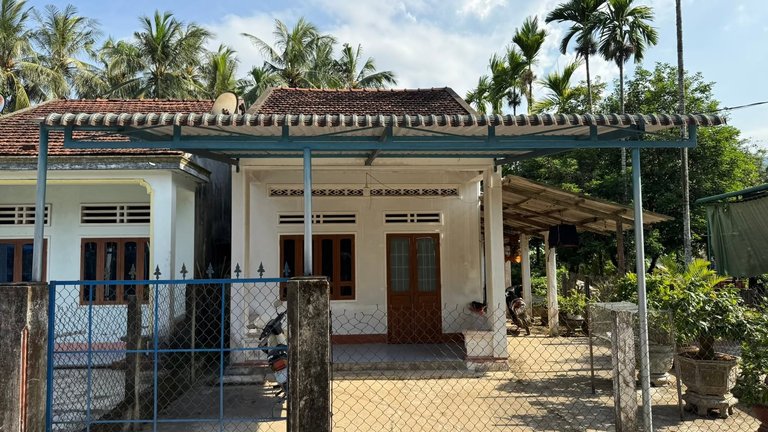
I withstood as much as I could. The heat was intense, and eventually I quietly retreated down the river bank and made my way home. It was a beautiful walk. The river bent away through green marsh toward a line of blue mountains, the clouds piled high above them, and the guests' motorbikes stood parked in a long row along the wall. Then back into the village, down the narrow concrete lanes under the coconut palms, past little houses with tile roofs and blue gates. These lanes still remind me more of an English hamlet than anything you would expect to find in the mountains of Vietnam. Except for the palms, of course.
Dinner at Dốc Đá Mòn
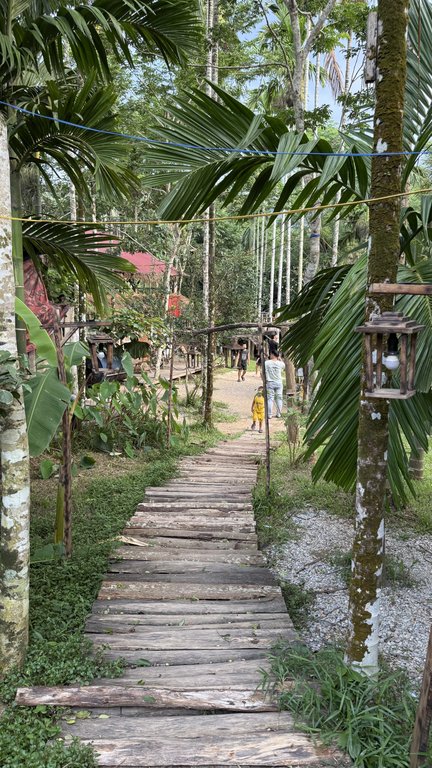
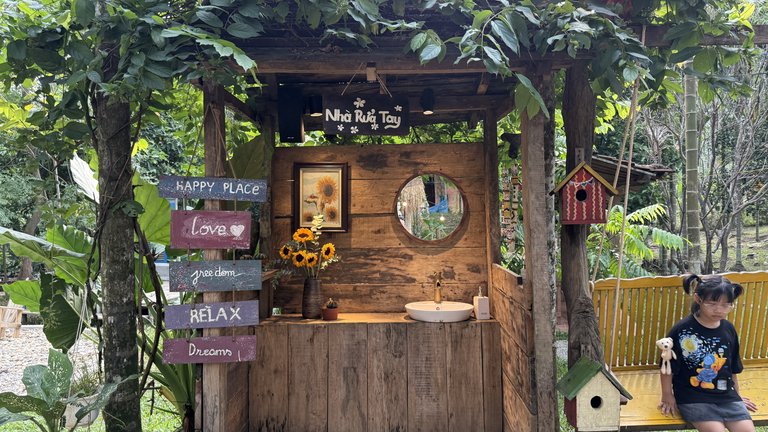
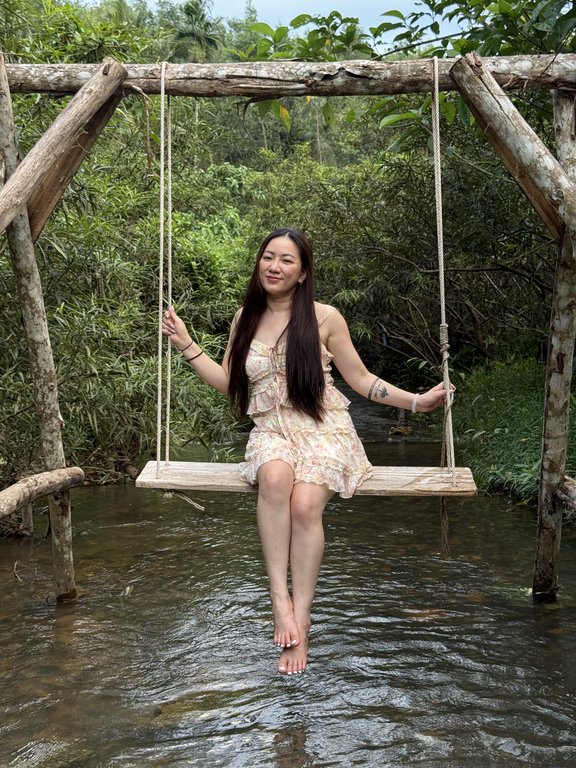
You would think that would be enough for one day. You would be wrong. That evening the family gathered at a garden restaurant called Dốc Đá Mòn. We arrived in the late afternoon. A wooden plank walkway wound through a grove of tall, slender palms. Even the hand-washing station had a name, Nhà Rửa Tay, the hand-washing house, with a vase of sunflowers by the sink, a round mirror, a birdhouse, and a stack of hand-painted signs: Happy Place, Love, Freedom, Relax, Dreams. Nearby, a clear, shallow stream ran over the stones, and the kids waded right in. Someone had set a small table with a vase of flowers right in the water. There was even a swing hung over the stream, which, of course, had to be photographed.

We ate at a long wooden table under a wooden pavilion with lanterns hanging from the beams, a server in a nón lá setting out the dishes. We ordered the gà nướng, grilled chicken, split and flattened and grilled until the skin goes golden and crisp, served on leaves with coconut sticky rice, xôi dừa. We had two. There were two earthenware crocks of cháo nấm lòng gà, rice porridge with mushrooms and chicken giblets, and two extra orders of the coconut sticky rice. To drink there were Pepsis and Thai Red Bulls, which the Vietnamese call Bò Húc, the butting bull, and a bottle of rice wine for the grownups. Ice cream finished it off.
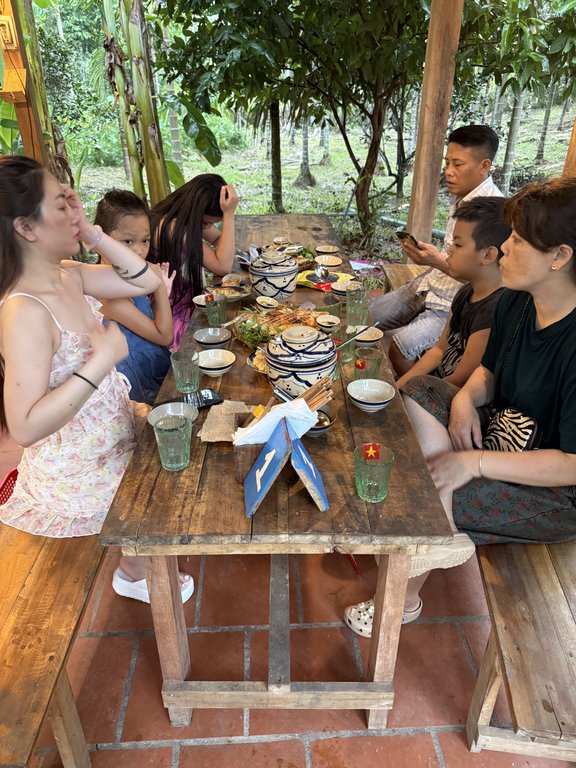
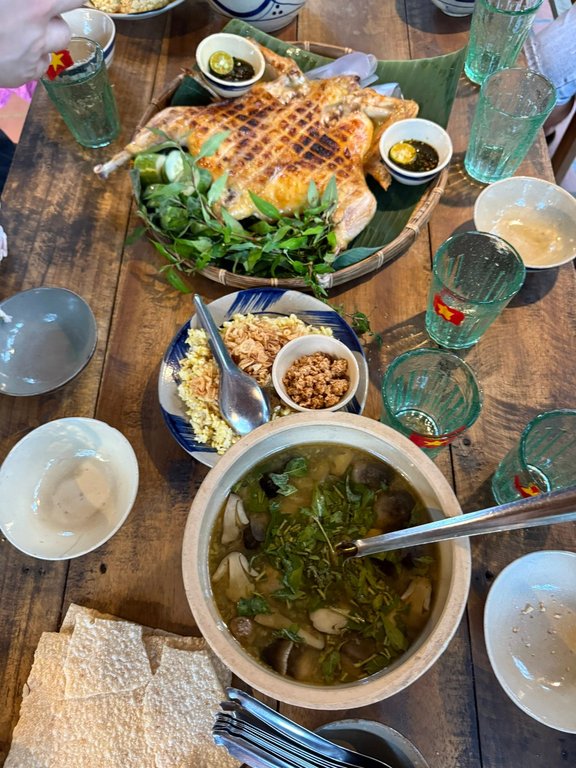
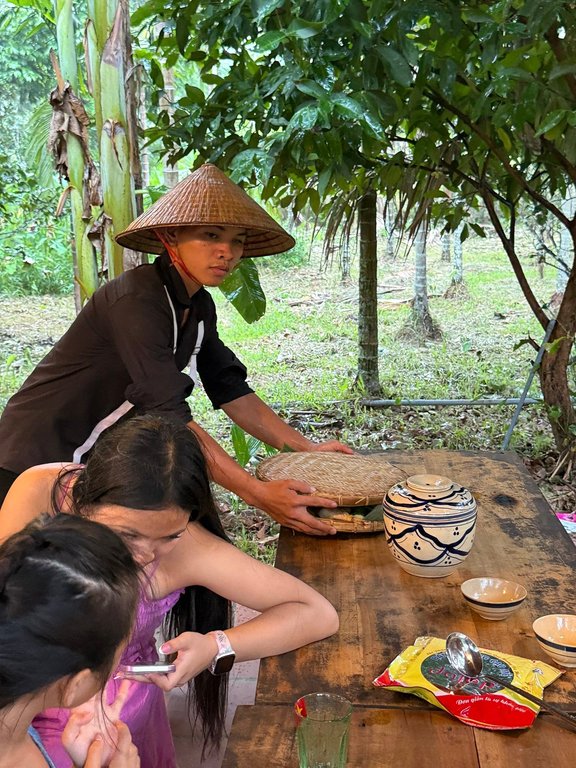
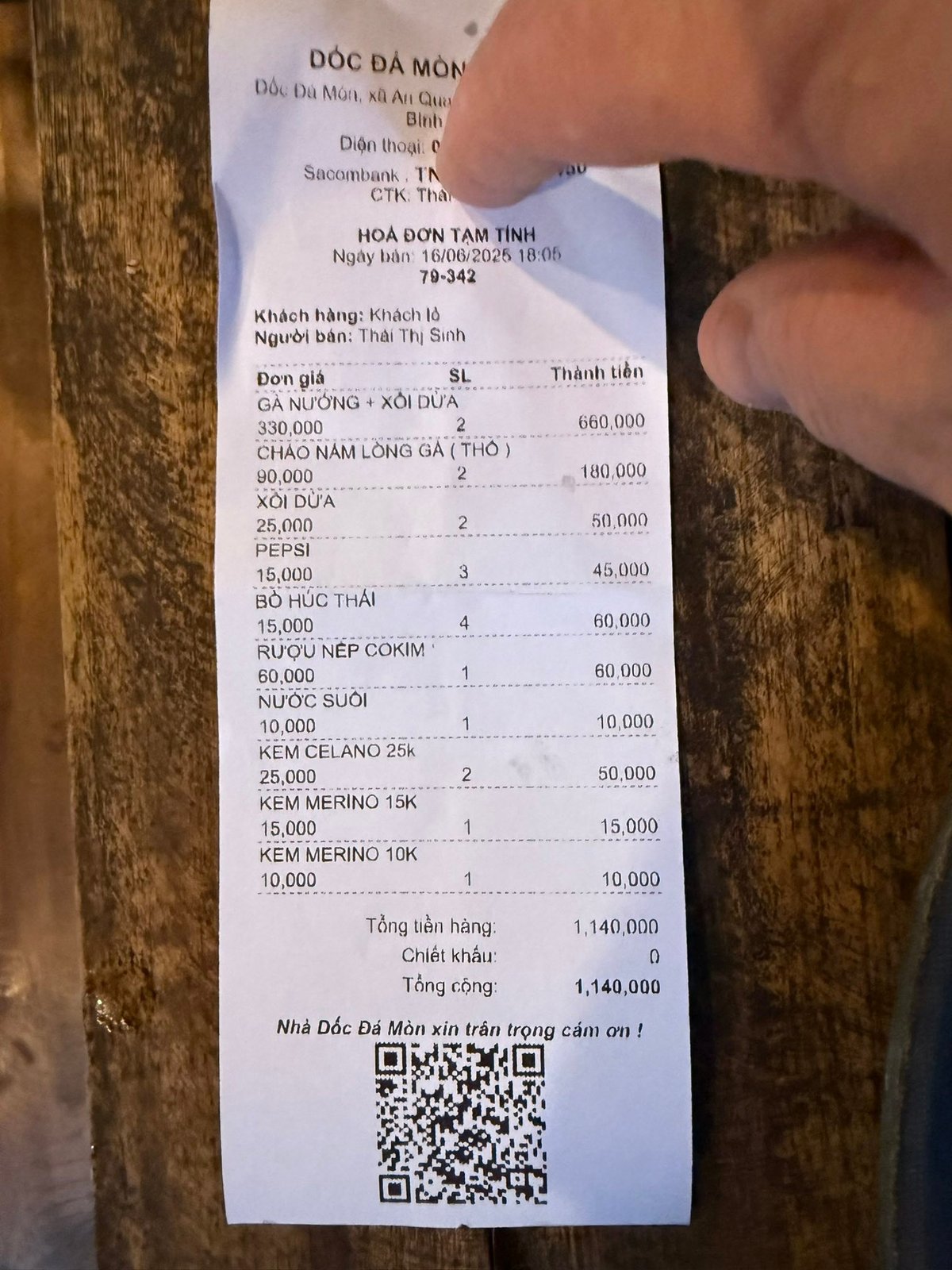
The bill came to 1,140,000 dong. Say it out loud and it sounds like a ransom demand from a movie villain, and I couldn't resist saying so to everyone back home. It worked out to about $44, for the whole family.
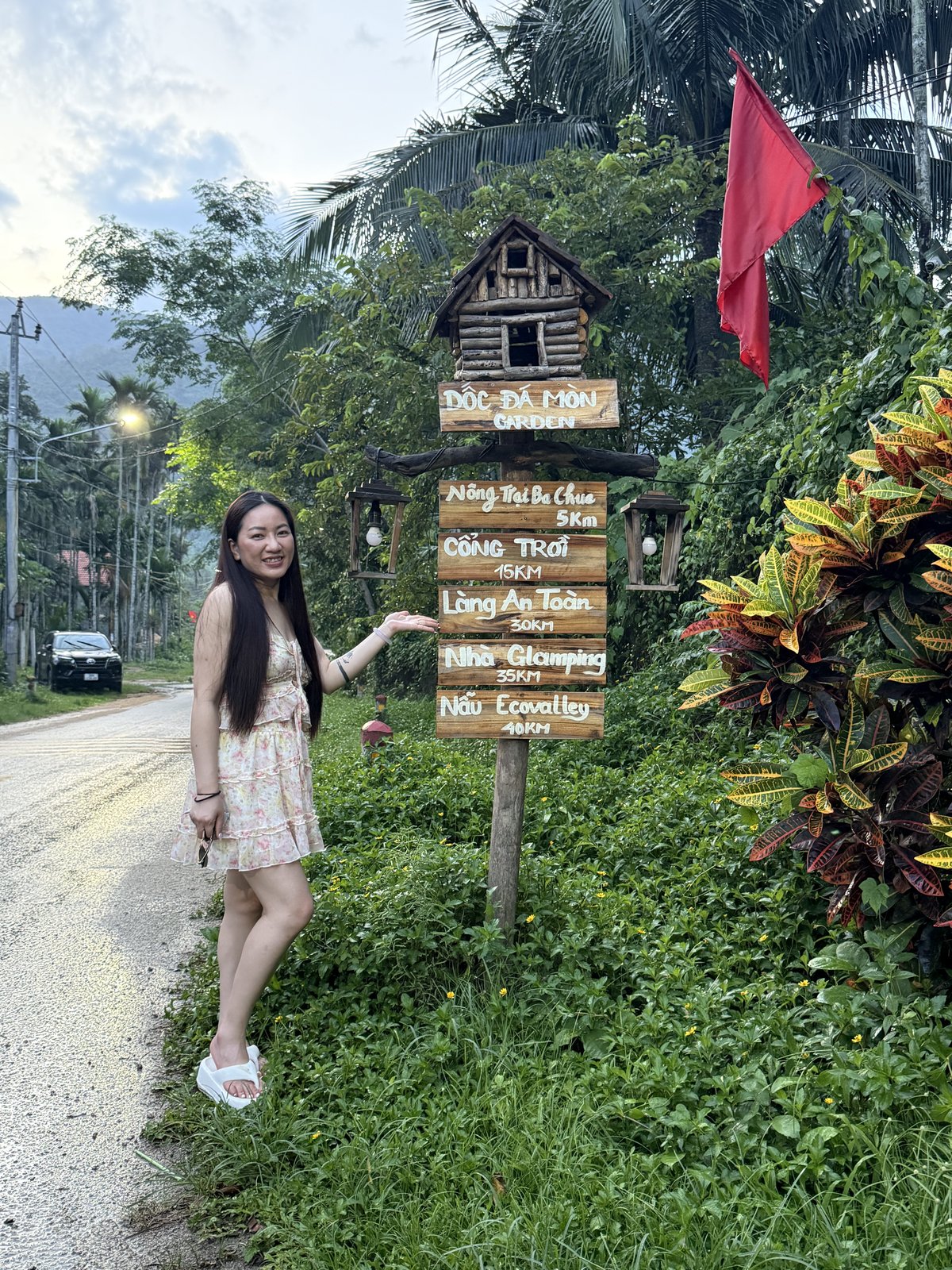
On the way out we stopped for a picture at the signpost by the road. It says a lot about where An Lão is headed. Under the restaurant's name, the boards list what lies farther up the road. Nông Trại Ba Chua, a farm, 5 kilometers. Cổng Trời, the Gate of Heaven, 15. Làng An Toàn, the village of An Toàn, 30. Glamping, 35. An eco-valley, 40. Cổng Trời is a pass up on the An Toàn highland, more than a thousand meters above the sea, near the An Toàn Nature Reserve. Not quite sixty years ago, this valley was a place people were flown out of by helicopter. Today it has glamping. There is something in that I like very much.
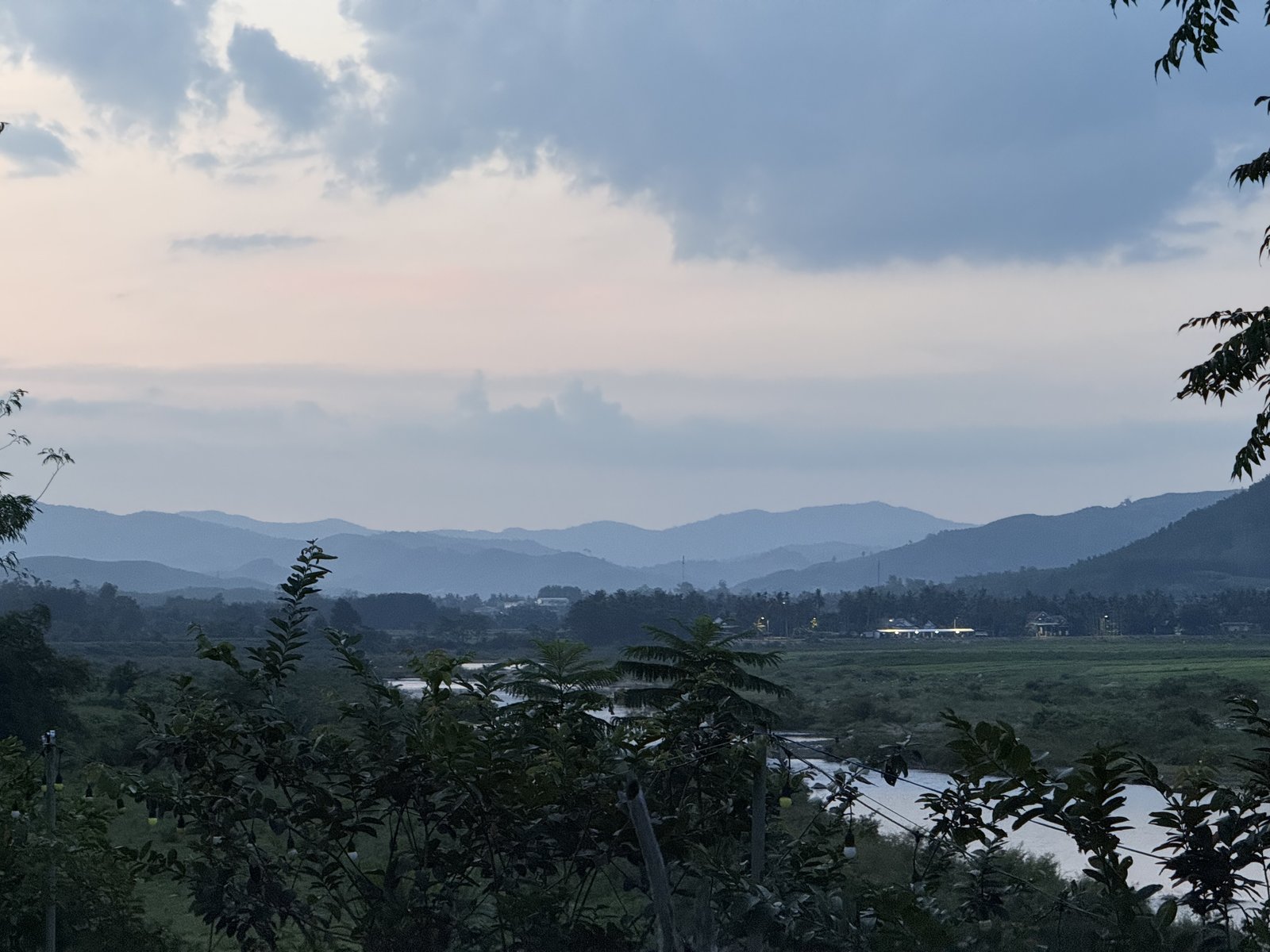
The sun went down behind the mountains and left the valley in that soft gray-blue that comes just before dark. It has been an incredible, and exhausting, few days in the An Lão River valley. Tomorrow we would be up before the sun again, our bags at the roadside, waiting on Trieu Vi and his 5:30 van to Da Nang. It always seems to come too soon.
Previously: Return To A Place Beyond Time
More from An Lão: A Place Beyond Time and A Walk In The Valley - The Beauty Of An Lao