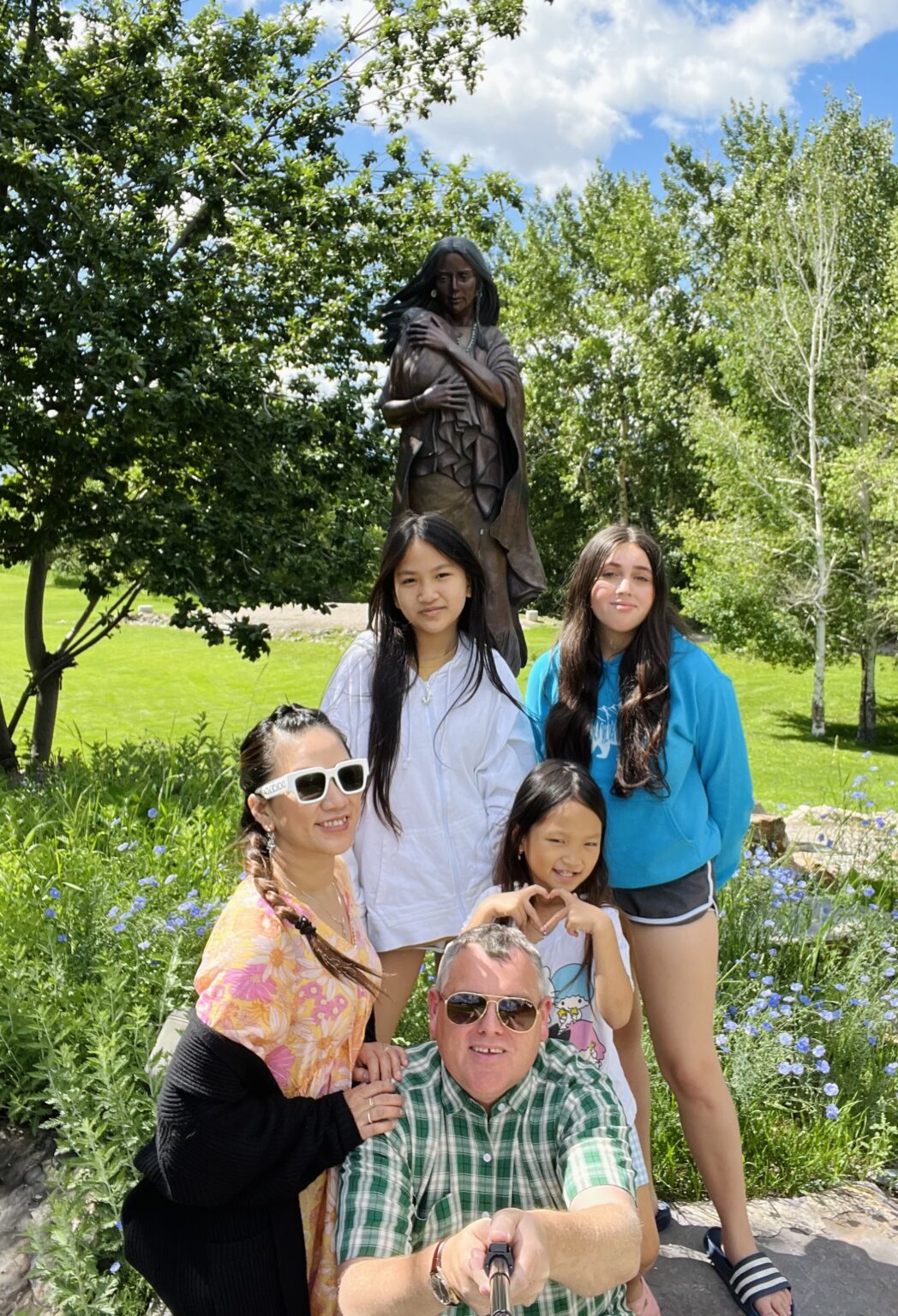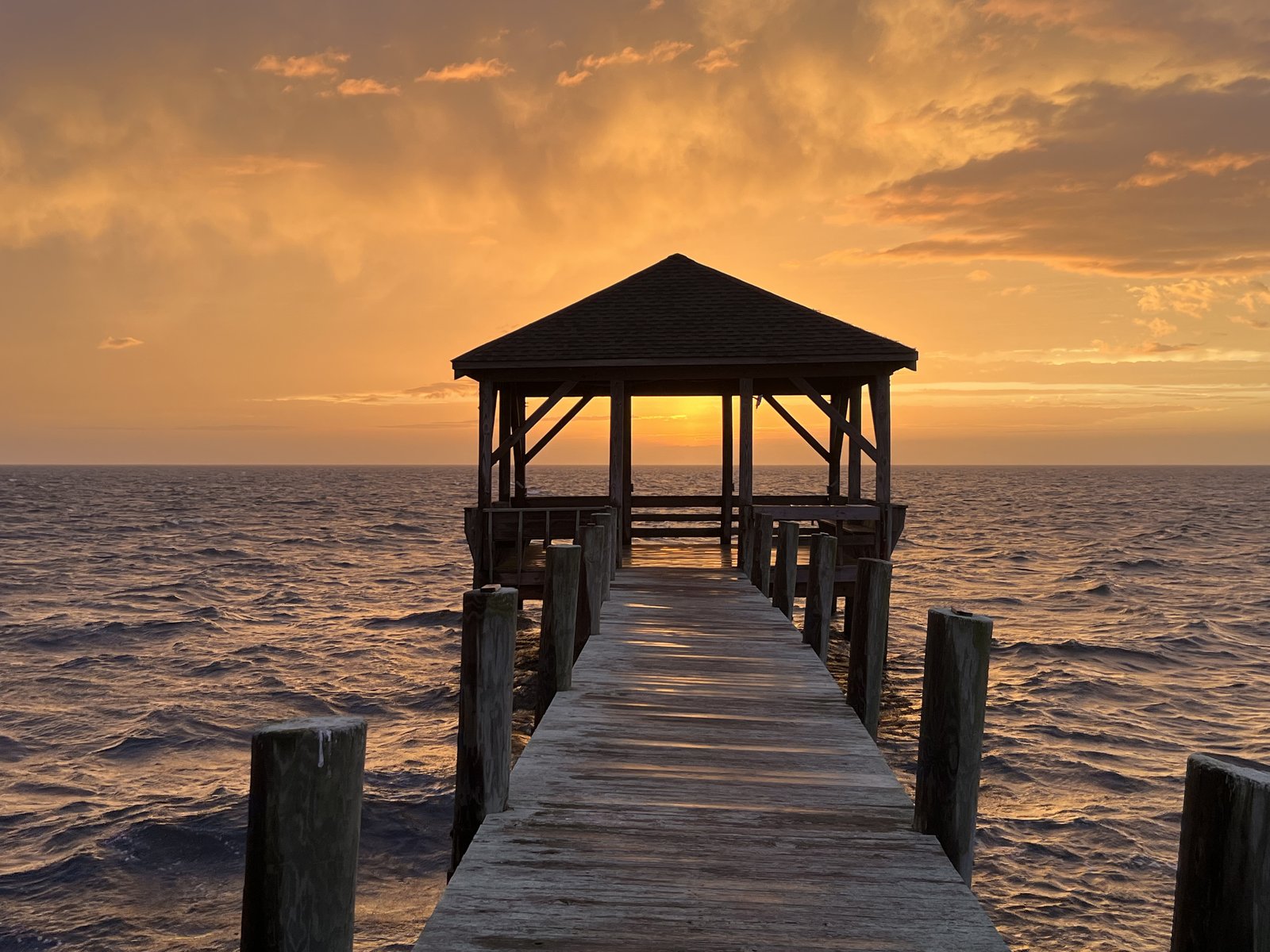
Covington, Georgia, to Charleston, South Carolina
Several months before Diem's birthday, I knew something special had to be done. I started my usual search for a place for us to go. Something new, something old, and most importantly, something close. My mind went straight to Savannah. We had yet to explore anything from the colonial period in America, and I thought it would be a great place to show Diem some of the history our two countries share. After all, we were both, at one time, colonies of European powers with a ravenous appetite for overseas possessions.
Then I looked at the calendar. Diem's birthday falls on St. Patrick's Day weekend, and Savannah on St. Patrick's Day is its own animal. Hotel prices doubled, rooms were scarce, and thousands of people would be descending on the city. That would not do. Charleston took home the prize.
If you can't have Savannah, Charleston is, let's face it, an equal substitute. I was maybe 20 the last time I visited, and the more I read, the better the prospects became. Open markets, old churches, parks along the water, and some of the best seafood restaurants in the South. As the day grew nearer, I became giddy with the idea of picking up a lone South Carolina highway and riding into the Lowcountry.
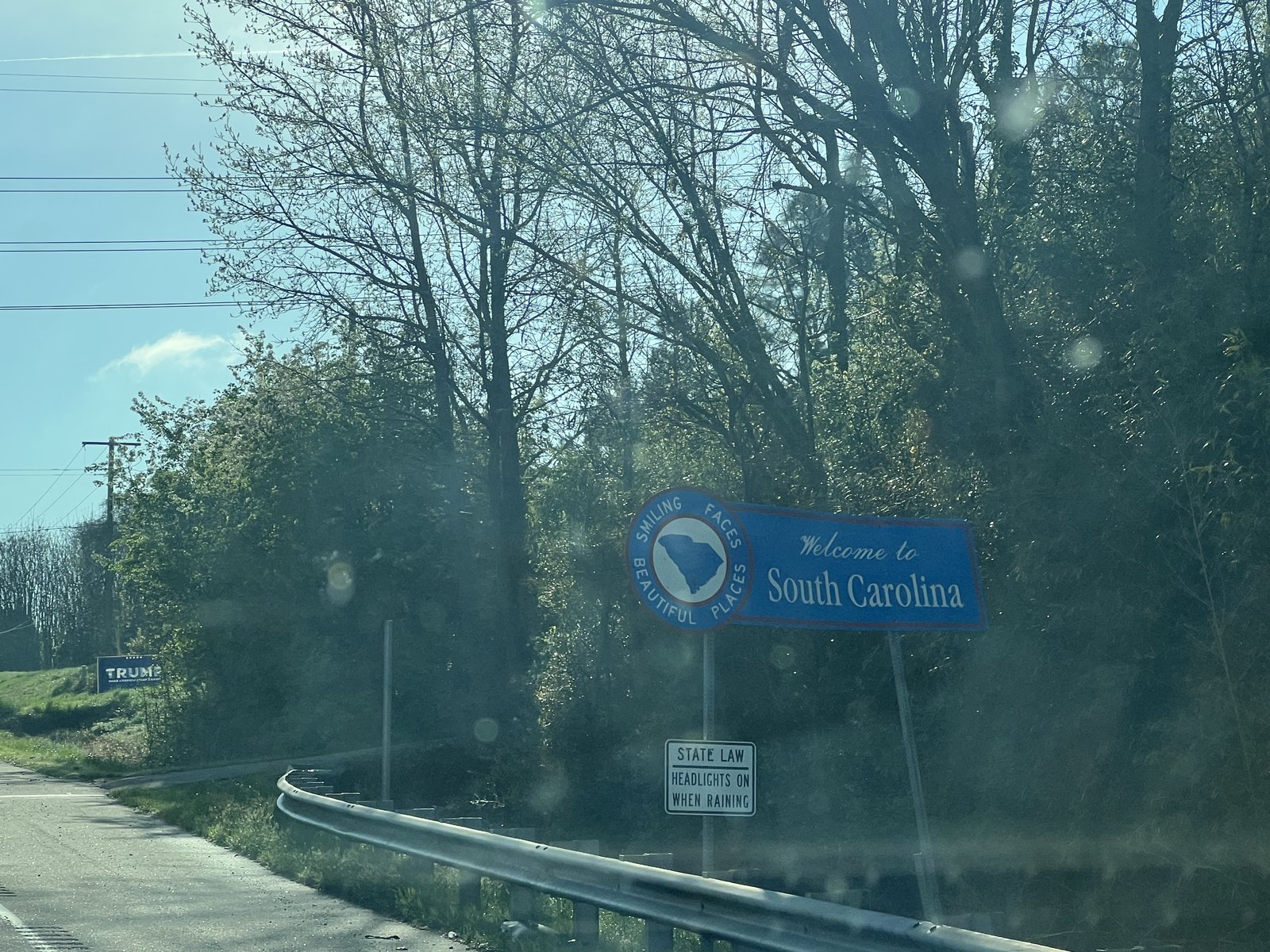
We left Covington early Saturday morning. At Augusta we crossed the Savannah River, and Diem officially entered South Carolina, her 27th state since arriving in the U.S. late in 2021. That is an impressive number, I must say. We picked up Highway 78 and followed its long, straight, and increasingly flat path toward the coast. One by one, the small towns of rural South Carolina rolled by. Williston, Elko, Denmark, Bamberg. Each one a little quieter than the last, the shells of a once busy farm country slowly emptied by the pull of the coast. By noon we had reached the Lowcountry.
The Lowcountry is the flat coastal plain of South Carolina, a world of tidal creeks, salt marsh, and sea islands that runs from roughly Georgetown down to the Savannah River. Rivers coming down out of the Piedmont slow to a crawl here and spread into marsh before they reach the Atlantic. The tide rises and falls twice a day, pushing salt water miles inland and pulling it back out again. In the 1700s, the tidal swamps along these rivers were cleared, diked, and flooded for rice. Carolina Gold, as it was called, made the planters of the Lowcountry some of the wealthiest people in colonial America.
It was not their skill that grew it. The knowledge of how to grow rice in tidal swamps came from West Africa, from the rice-growing coast of what is now Senegal, Gambia, Sierra Leone and Liberia, and it came in the minds and hands of enslaved people. Planters sought out captives from those regions for exactly that reason. The dikes, the canals, the wooden floodgates called trunks, and the fields themselves were built and worked by enslaved Africans. Their descendants, the Gullah Geechee people, still live along this coast today, with their own language, food, music, and crafts. Congress recognized the region as the Gullah Geechee Cultural Heritage Corridor in 2006, stretching from North Carolina to northern Florida. Charleston's story starts there.
Magnolia Plantation
Our first stop was Magnolia Plantation on the Ashley River, one of the oldest romance gardens in the United States. I had picked it for one reason. It was supposed to be in full bloom for Diem's birthday, and it was.
Magnolia has been owned by the Drayton family since the late 1600s, and they still manage the property today. Like everything else on this river, it began with rice. The gardens came later. Finding beauty in the natural flora of the Lowcountry, Rev. John Grimké Drayton began work on them in the 1840s, to lure his uncooperative new wife from her luxury home in Philadelphia. The gardens would become world famous in the years after the war.
It is called a romance garden because of how it was planted. The focus was less on removal and layout, and more on enhancing what was already there. Flowering plants were brought in to accompany the live oaks, cypress, and other native plants and trees. They are said to be the first azaleas planted in the U.S., and the azaleas blooming in Magnolia today are those very same plants. The paths and grassy areas are kept cut and clear. Otherwise, everything is allowed to grow and spread naturally.
The war was not kind to Magnolia. The plantation house was burned near the end of the Civil War, and the family, like most of the old rice planters, came out of it nearly broke. What saved them was the garden. The Draytons opened it to paying visitors around 1870, making it one of the oldest public gardens in America. Tourists came by steamboat up the Ashley River from Charleston to see the azaleas. They still come, though most of us drive now.
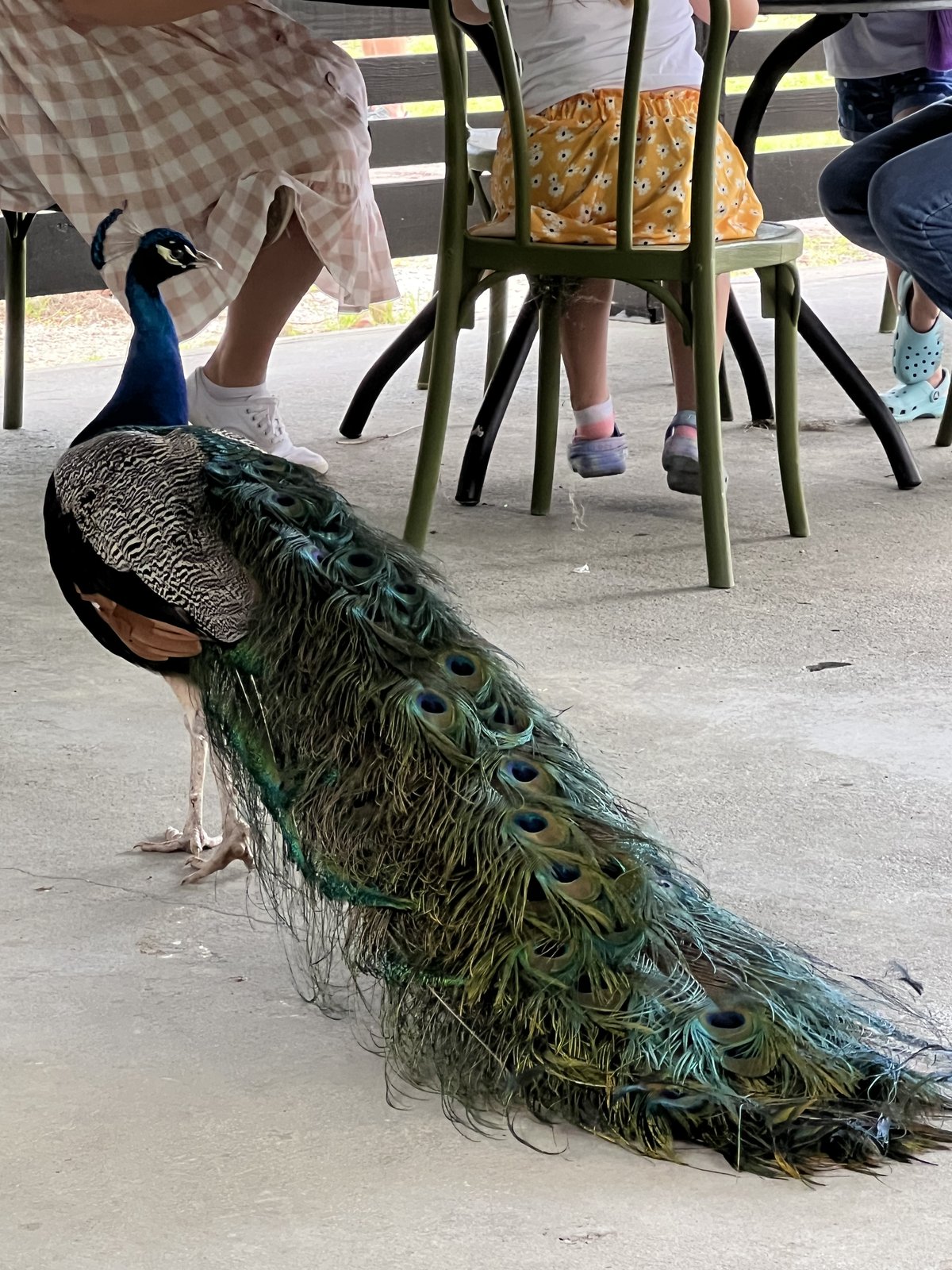
We parked, bought our tickets, and stopped at the café pavilion before setting out. A peacock strolled between the tables to see what we had, past a can of Edmund's Oast, a Charleston beer.
Then we stepped out into the azaleas. Pink. Everywhere you looked, pink, magenta and red, under live oaks dripping with Spanish moss. Diem took a seat at a stone table under one of the big oaks, and I took the obligatory birthday photo.
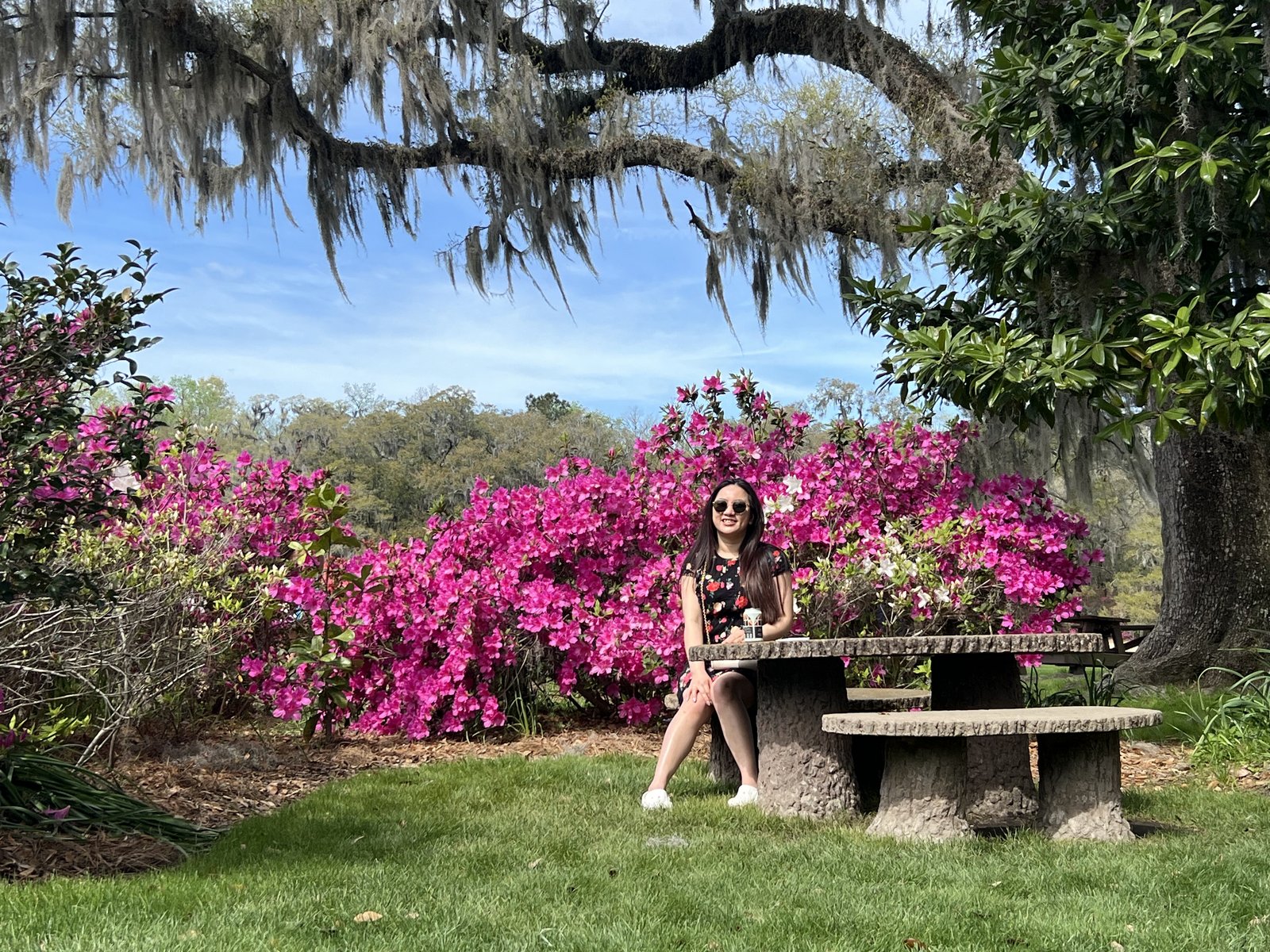
A word about the moss, since it will be in nearly every picture from here on. Spanish moss is neither Spanish nor a moss. It is a bromeliad, a cousin of the pineapple, that lives on air and rain and hangs from the oaks without harming them. The early French and Spanish explorers apparently each named it after the other as an insult. It hangs from every live oak in the Lowcountry, and it is what makes this landscape look the way it does.
The Tram Through the Swamp
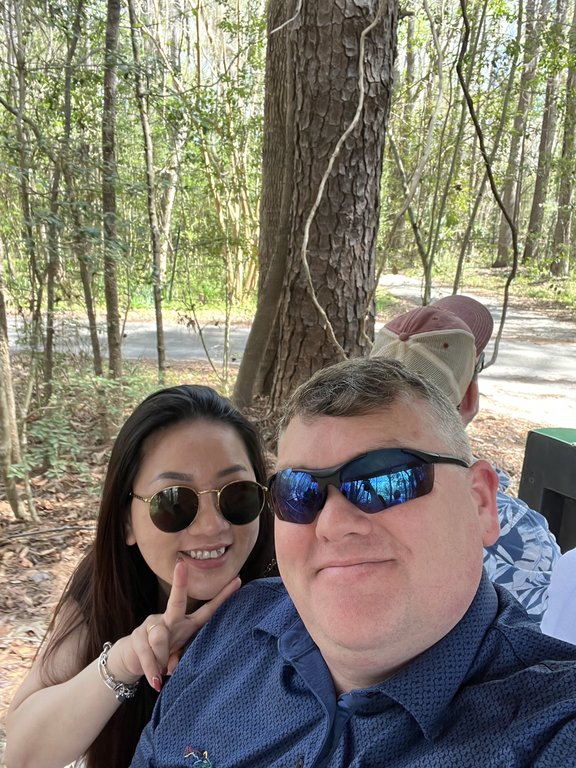
We caught the open-air tram that loops the property. It winds out of the gardens, through the old rice fields and along the edge of the swamp, through blackwater ponds and stands of cypress standing in their own reflections.
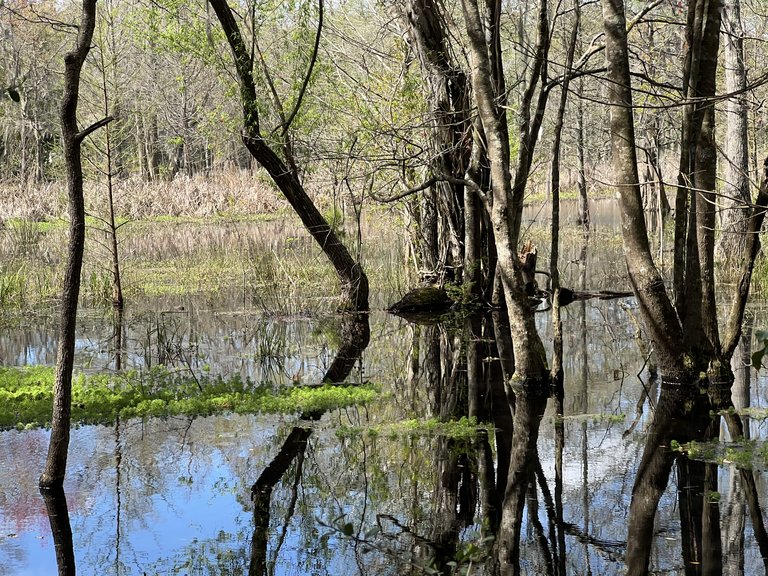
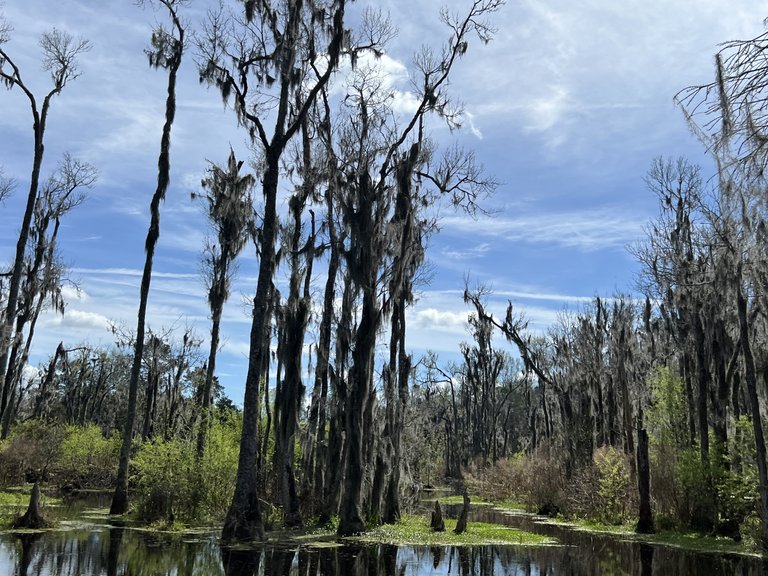
Several prominent figures in American history have connections to Magnolia. John James Audubon visited, and lent his name to the untouched section of the plantation that today showcases the area's natural flora and fauna. It's called the Audubon Swamp Garden. Audubon spent a good deal of time in Charleston in the 1830s, working on The Birds of America with his friend the Rev. John Bachman, and the swamps around the city gave him many of his subjects.
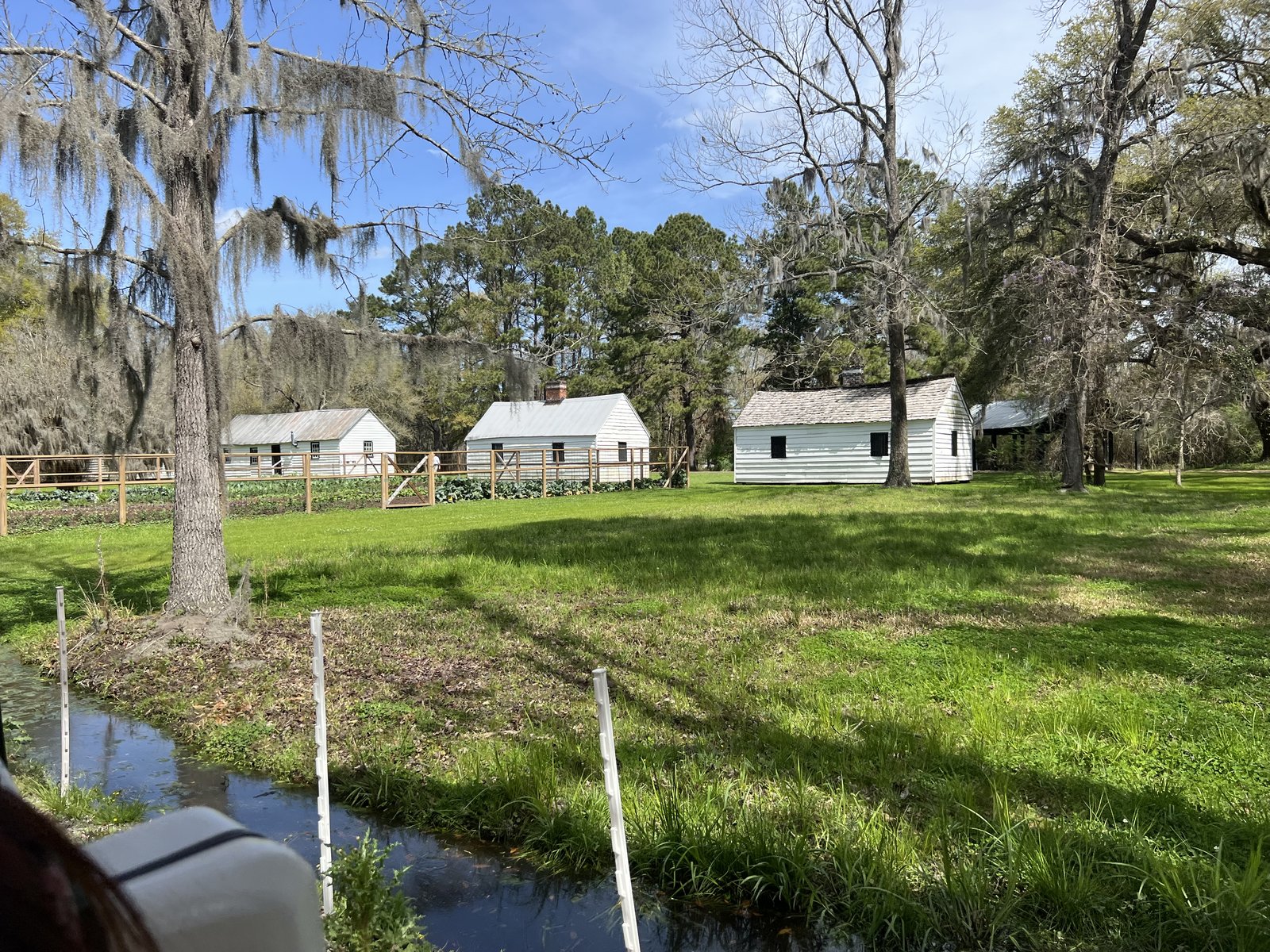
Along the way, the tram passed a row of small white wooden cabins behind a garden plot. These are the cabins where enslaved people, and later freed families, lived on the plantation. Some of them were lived in well into the twentieth century. Magnolia has restored them, and today they are the setting for a tour of their own on the lives of the people who built this place.
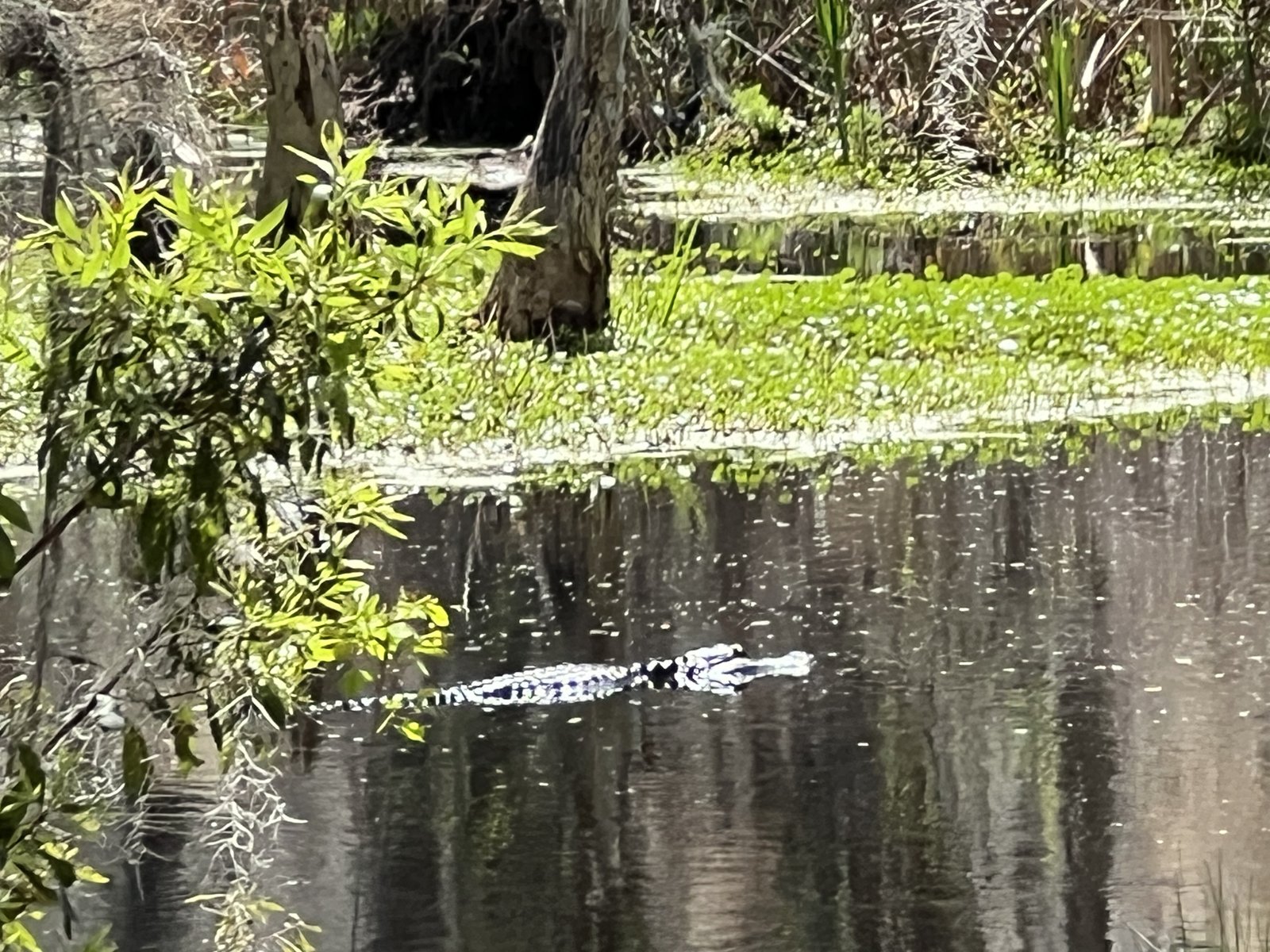
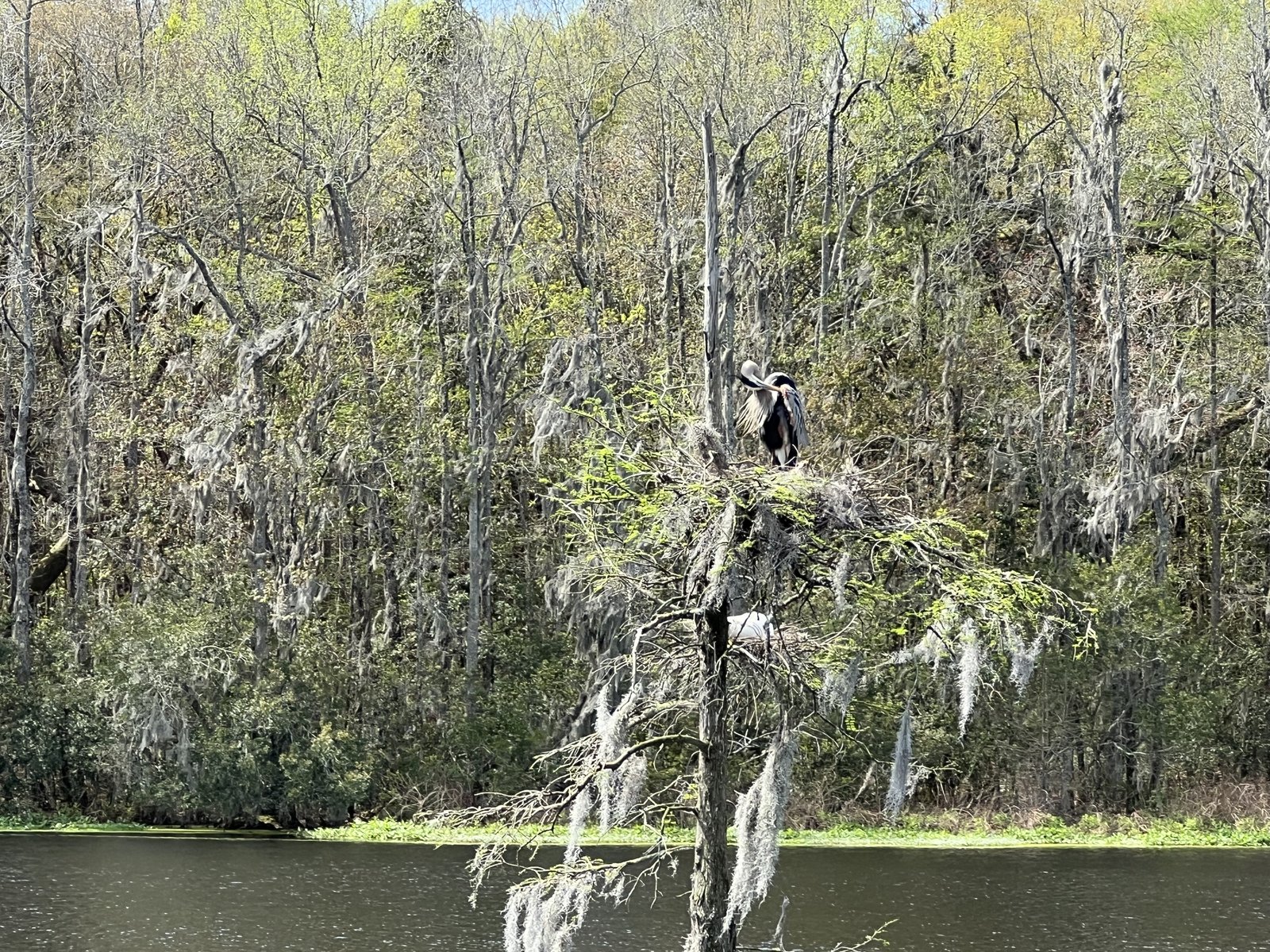
The swamp had residents. A pond so covered in duckweed it looked like a lawn, with a little wooden ramp sitting in the middle of it. Someone's working on their tan. An alligator cruising the black water beside the tram road. And in the trees over the water, birds nesting with their young.
Back on foot, we found the oaks. The southern live oak grows out more than up. Its limbs grow out and down until they touch the ground, then keep going, long enough to sit on, and Diem did. One arched clean over a bed of red azaleas like a doorway.
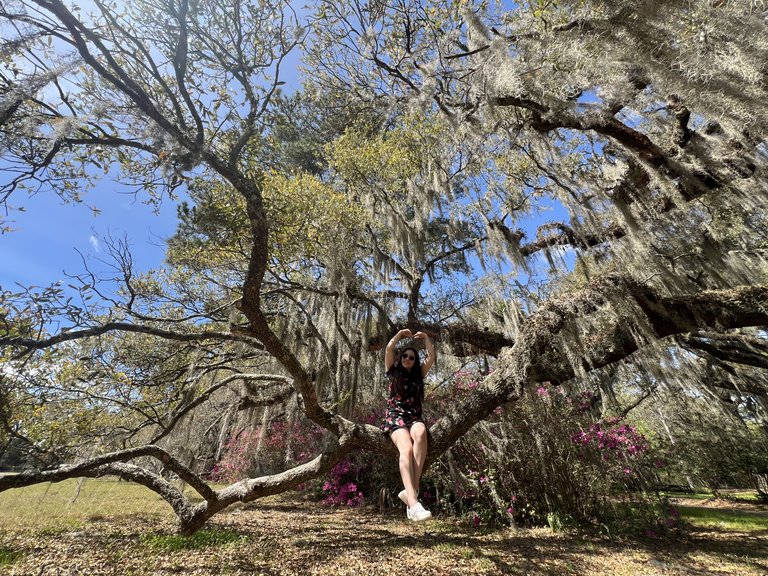
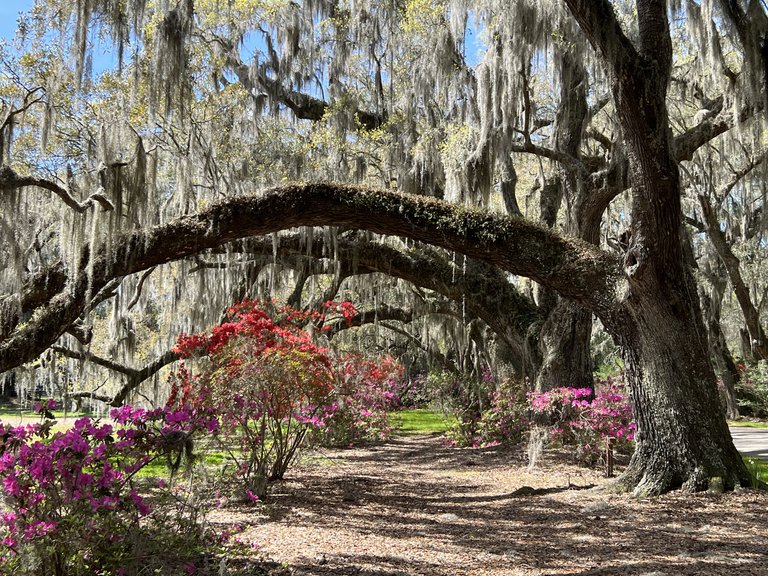
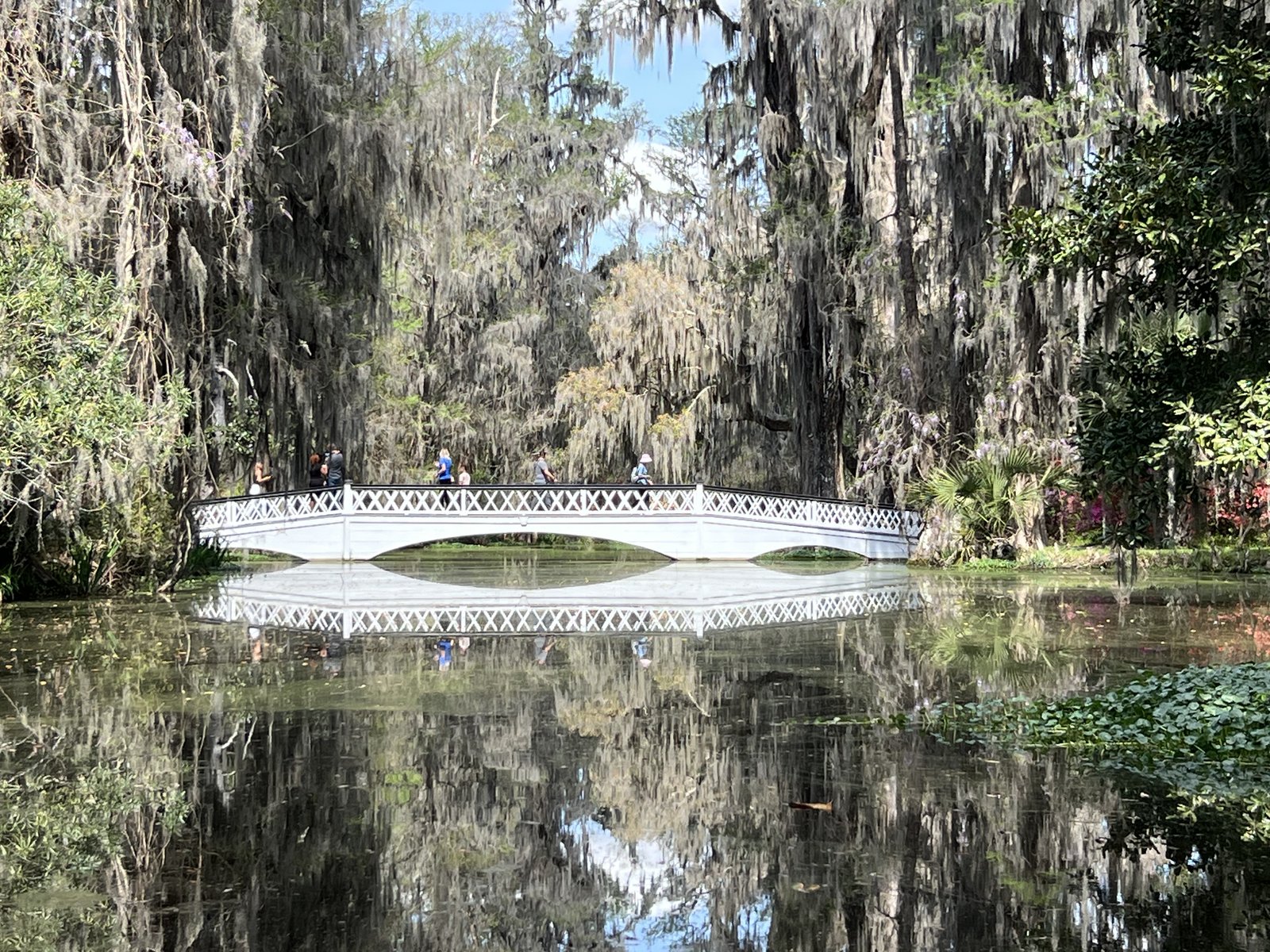
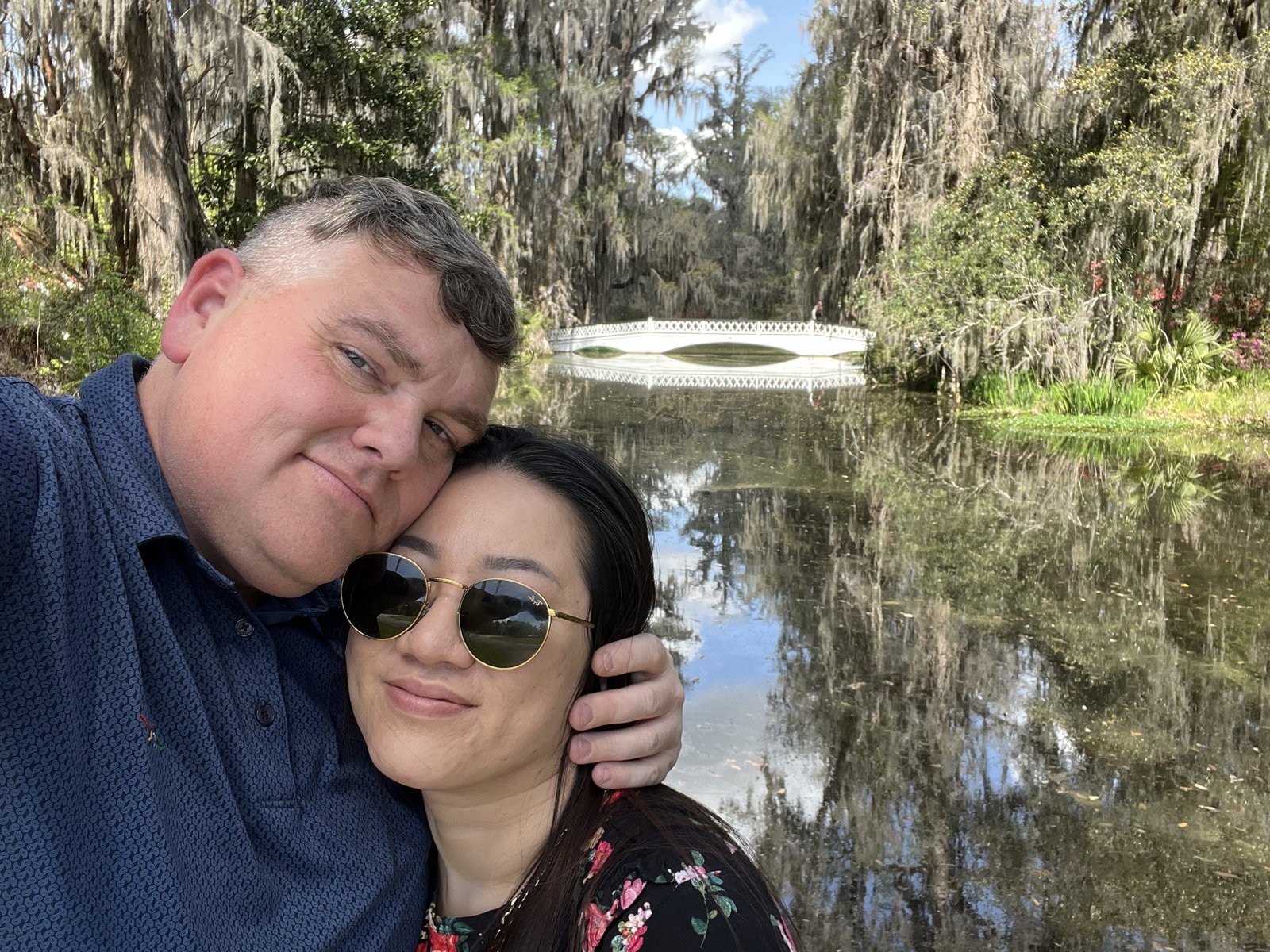
And then the white bridge. If you have seen one picture of Magnolia, it is probably this one: a white arched footbridge over still black water, the moss hanging all around it, the whole thing reflected perfectly underneath. It's a stunningly beautiful property.
The Jasmine House
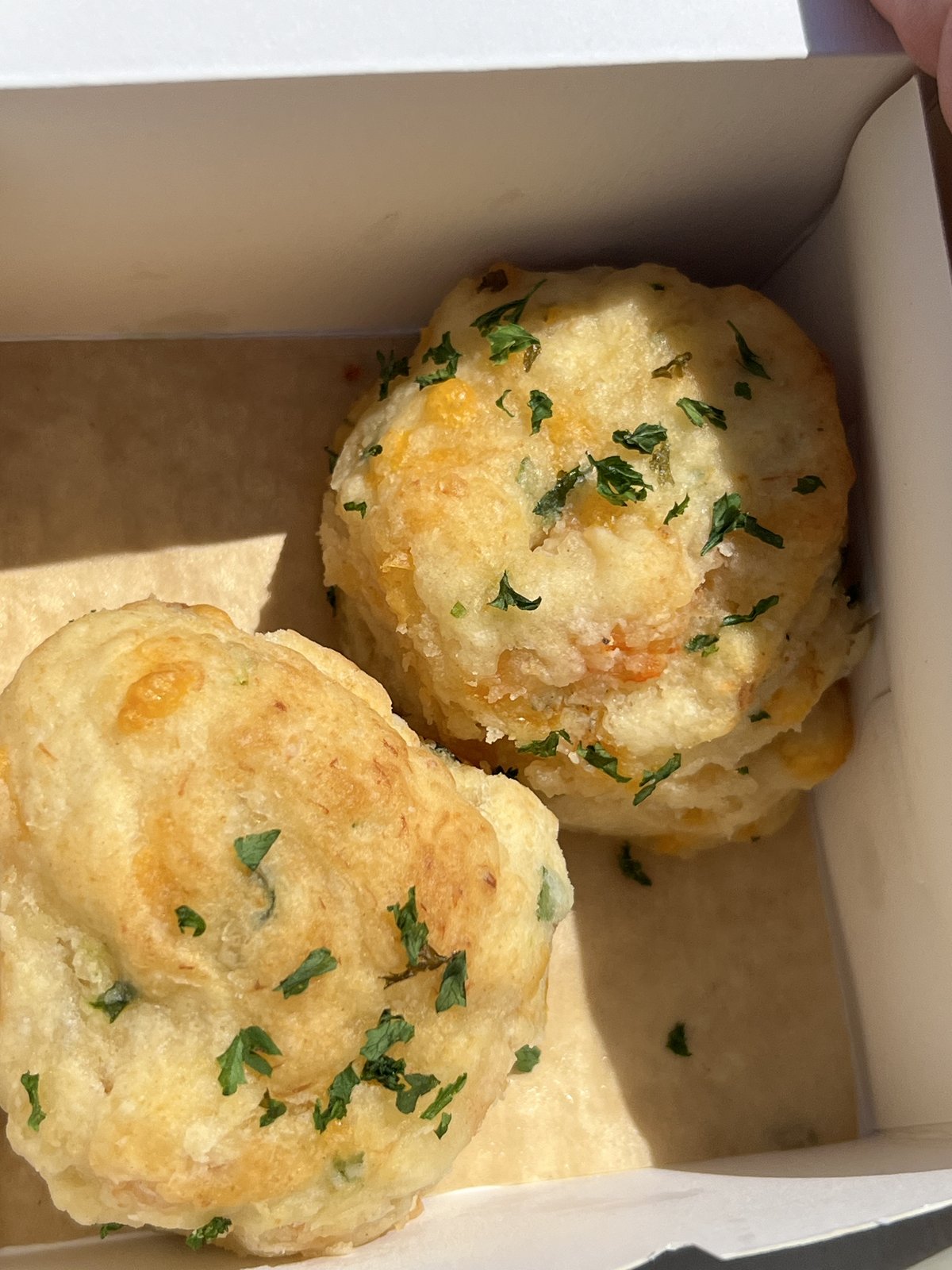
From Magnolia we drove into the city along the Ashley River and over the peninsula onto King Street, where a bright blue trailer reading "It's All On The Biscuit" sold us two cheese biscuits, flecked with herbs. Then it was on to the Jasmine House on Hasell Street to check in.
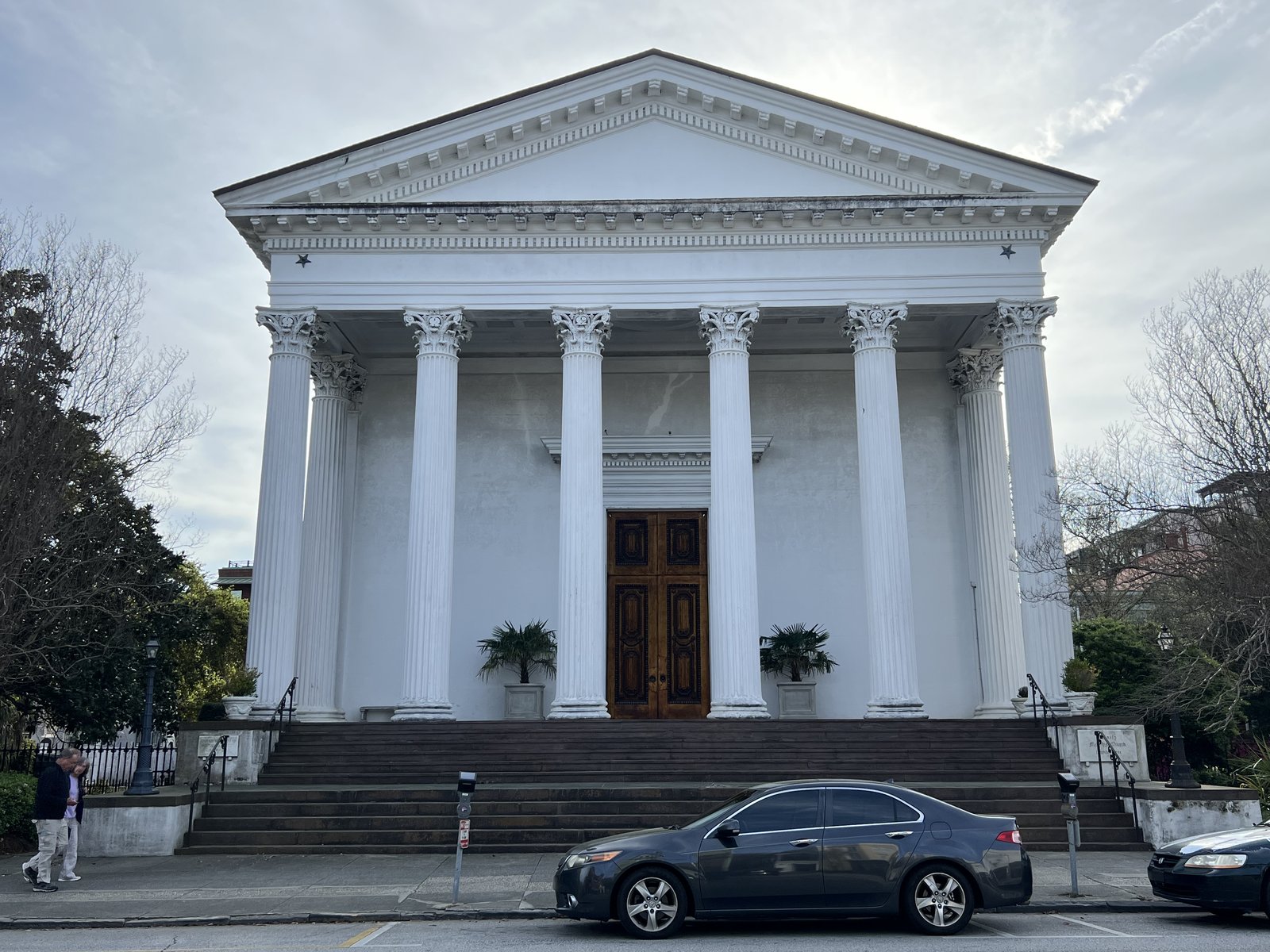
The Jasmine House is an old Greek Revival mansion turned inn, and Hasell Street is a good street to stay on. A few doors down stands Kahal Kadosh Beth Elohim, a white Greek Revival temple with six tall columns. The congregation was founded in 1749, and the synagogue was built in 1840, which makes it one of the oldest synagogues still standing in the United States. It is also where Reform Judaism began in America. Charleston has been called the Holy City for a long time, for its skyline of steeples and for the religious tolerance written into the colony's Fundamental Constitutions of 1669, which drew French Protestants, Jews, Baptists and Quakers to the city when most of the world would not have them. We would see a lot of steeples over the next two days.
Hyman's Seafood
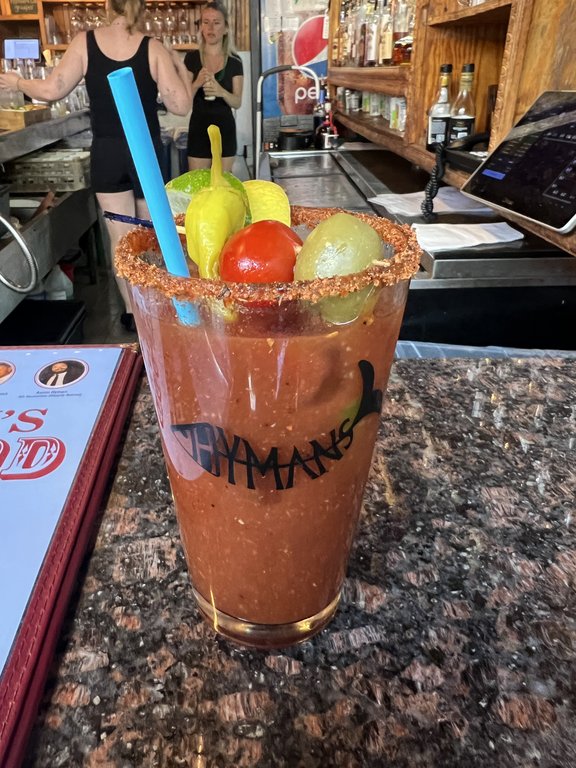
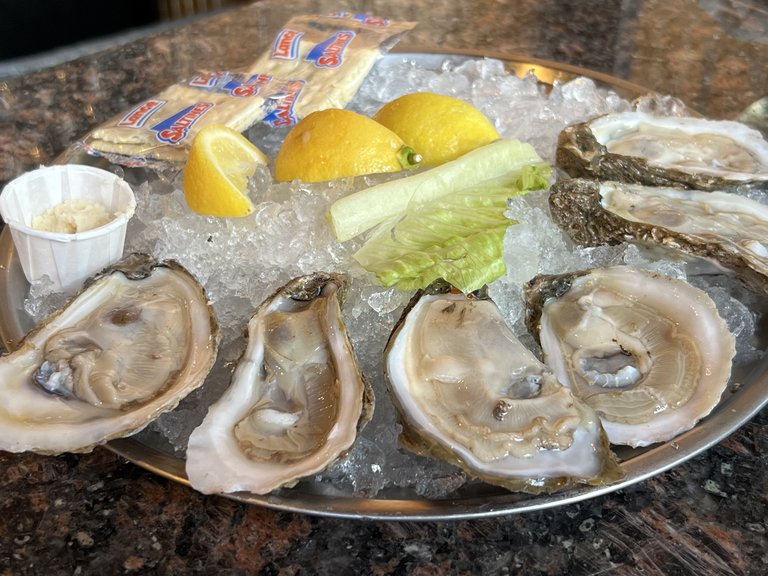
Our first sit-down meal in town was at Hyman's Seafood on Meeting Street, a family seafood house whose menu is covered with photographs of the Hyman family. We sat at the bar. We started with a Bloody Mary, served in a Hyman's cup, rimmed in spice and loaded with a pepperoncini, a cherry tomato and olives. Then a half dozen oysters on ice, and a bowl of she-crab soup.
She-crab soup is Charleston's own. It is a rich, creamy soup of blue crab meat, finished with the orange roe of the female crab, which is what makes it a she-crab soup, and usually a splash of sherry at the table. As the story goes, it was invented in the early 1900s by William Deas, the cook for Charleston's mayor, R. Goodwyn Rhett, who was asked to dress up an ordinary crab soup for a visit from President William Howard Taft. He added the roe, and the dish stuck. A little appetizer, you might say, before the real event.
The City Market
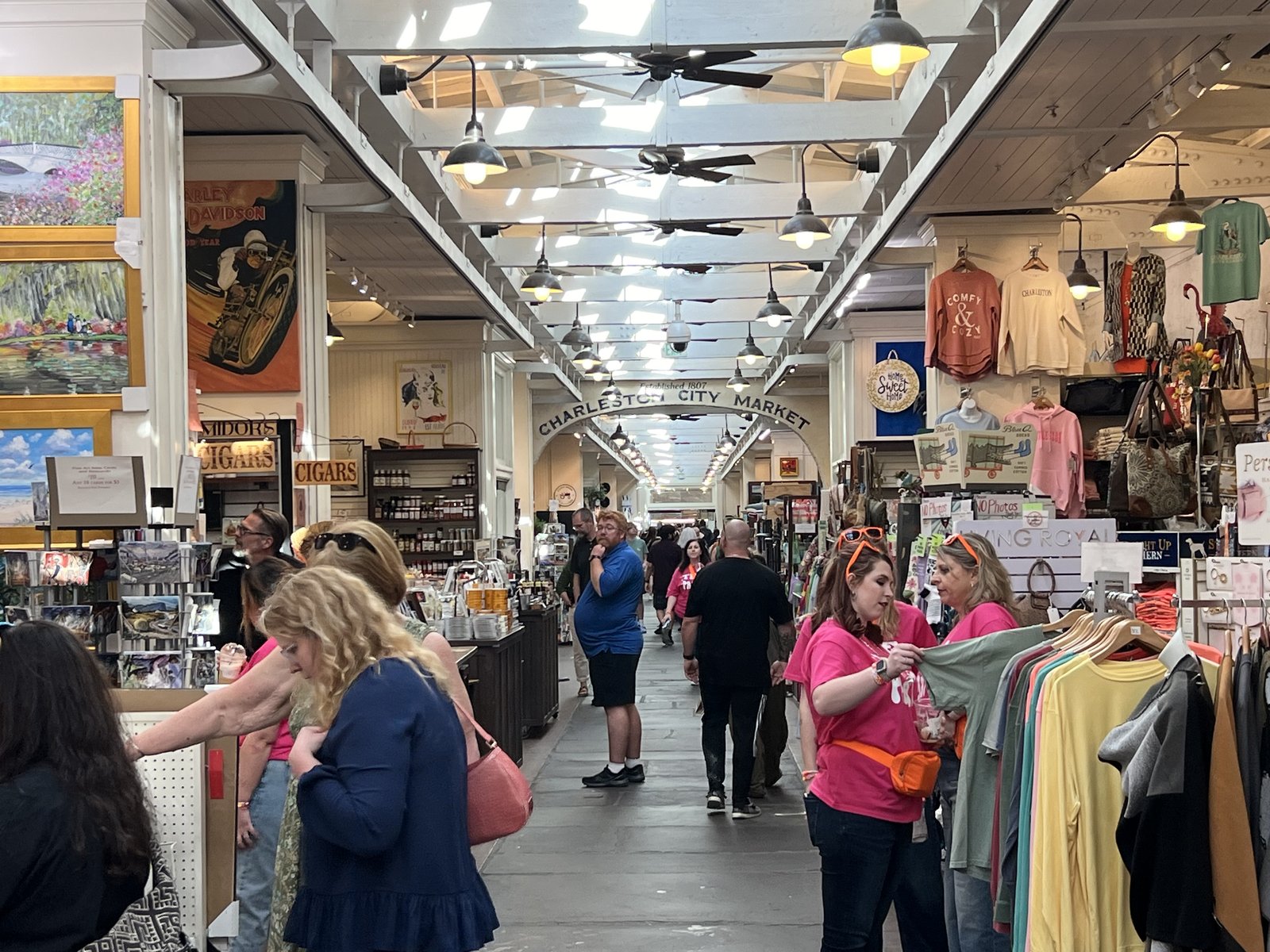
From Hyman's we walked to the Charleston City Market. Charles Cotesworth Pinckney, one of the signers of the Constitution, gave the land to the city in 1788 on the condition that it always remain a public market, and the market has operated here since 1807. It still is. The long, low market sheds run four blocks down the middle of Market Street, from the Greek Revival Market Hall on Meeting Street nearly to the harbor, all under white trusses and ceiling fans, stalls of clothes and art on both sides.
A lot of people believe enslaved people were sold here. They were not. This was a market for meat, fish and vegetables. Charleston's slave auctions were held elsewhere, in the open and later in buildings like the Old Slave Mart on Chalmers Street a few blocks away, which is a museum today. The confusion is understandable, though. Charleston was the largest port of entry for enslaved Africans in North America. Historians estimate that as many as four in ten of all the Africans brought to what became the United States came through this harbor. The International African American Museum opened in 2023 on Gadsden's Wharf, where many of them first stepped ashore.
The market is also home to many of the Gullah sweetgrass basket makers, who sell their work in the sheds and along the street. The craft came from West Africa with the rice. The first Lowcountry baskets were wide, flat fanners used to winnow rice, and the coiling technique, sweetgrass bound with strips of palmetto, has been passed down through Gullah families for more than 300 years.
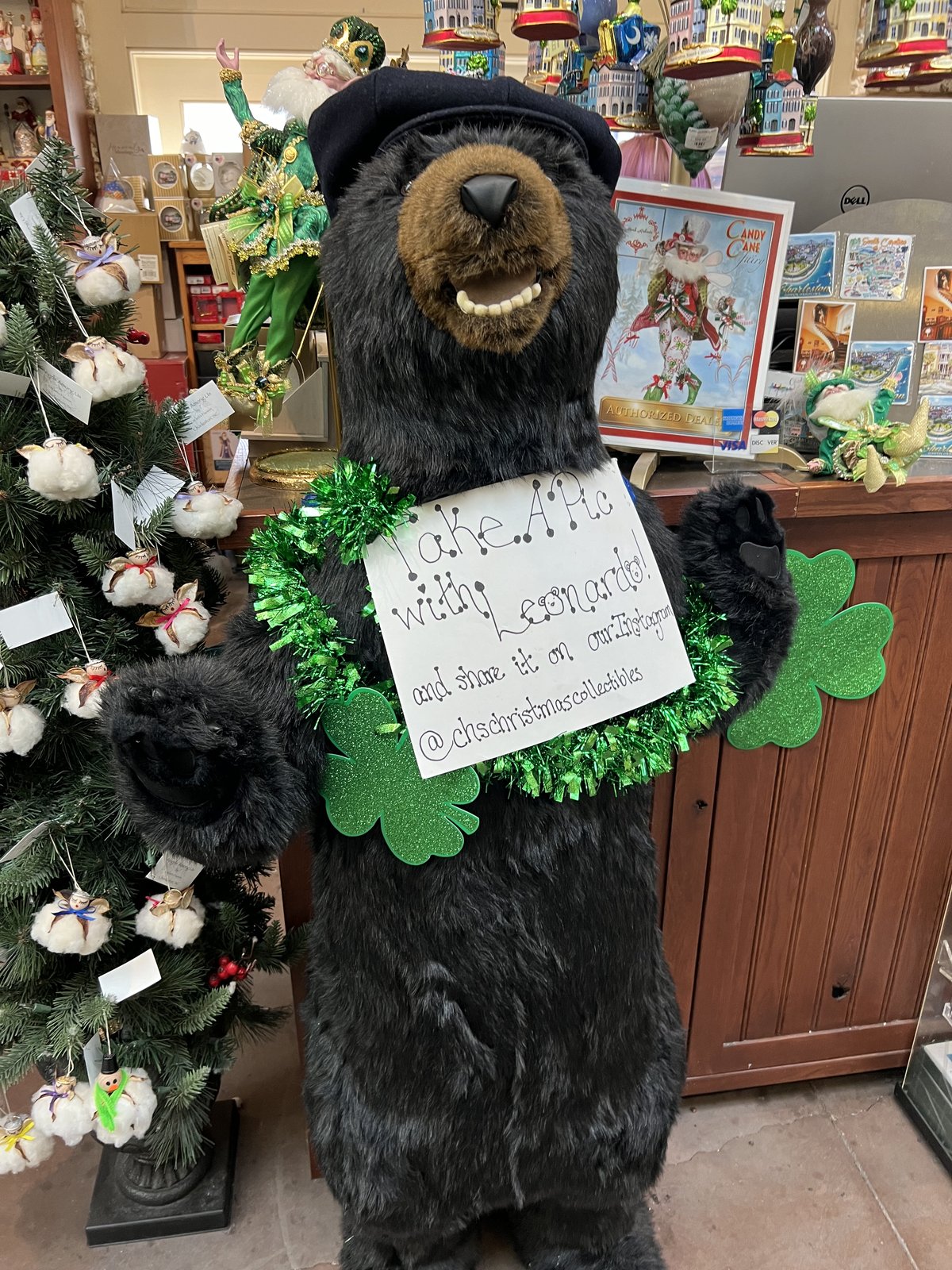
St. Patrick's Day had found its way into the market. One shop had a stuffed black bear in a beret, draped in green tinsel and shamrocks, standing next to a Christmas tree. In March. Somewhere nearby was a box advertising the world's hottest gummy bear.
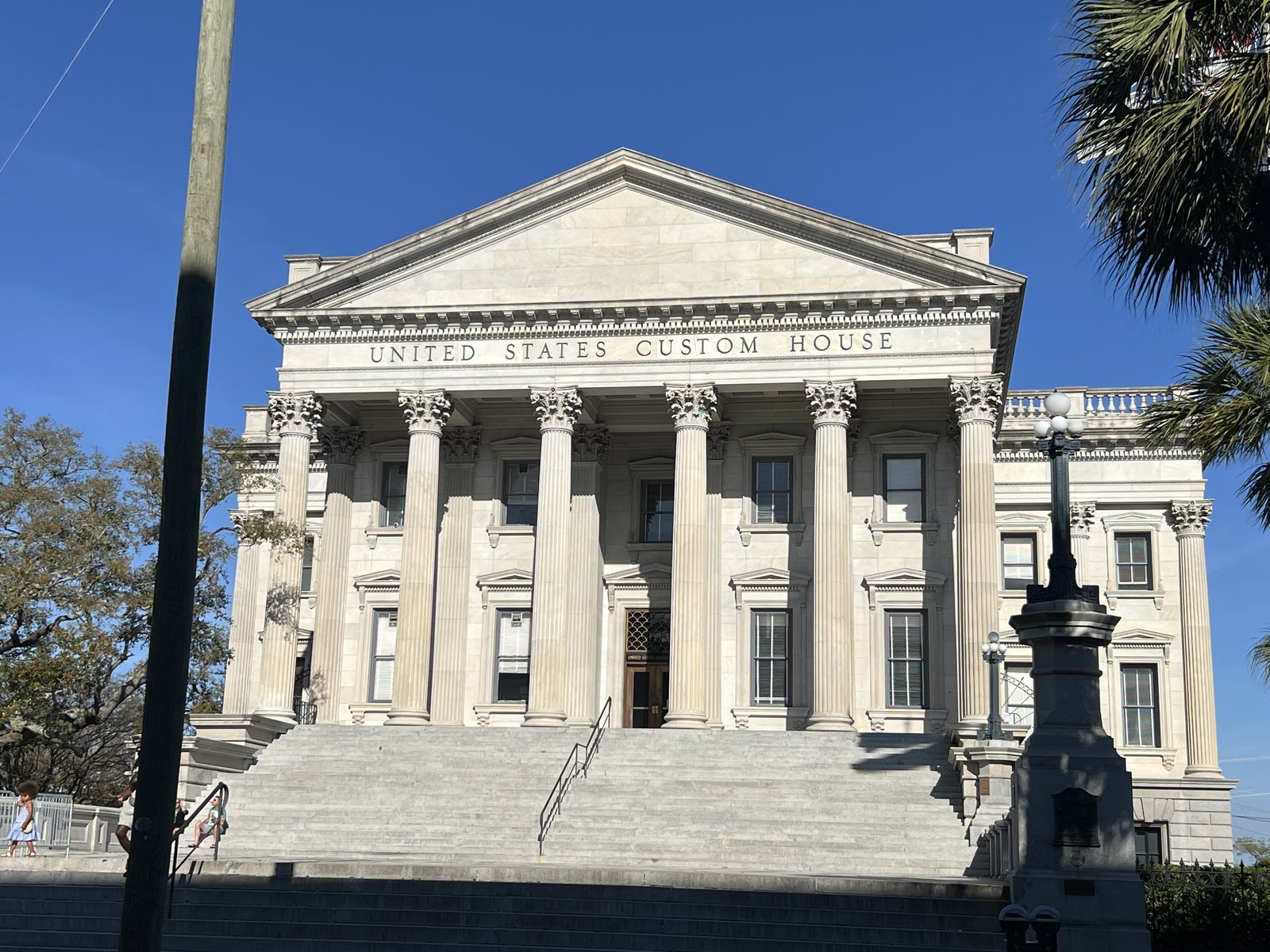
A short walk away stands the United States Custom House, a massive white columned building that looks like it was lifted out of Rome and set down on East Bay Street. Construction started in 1853, stopped for the Civil War, and was not finished until 1879.
Gingerline
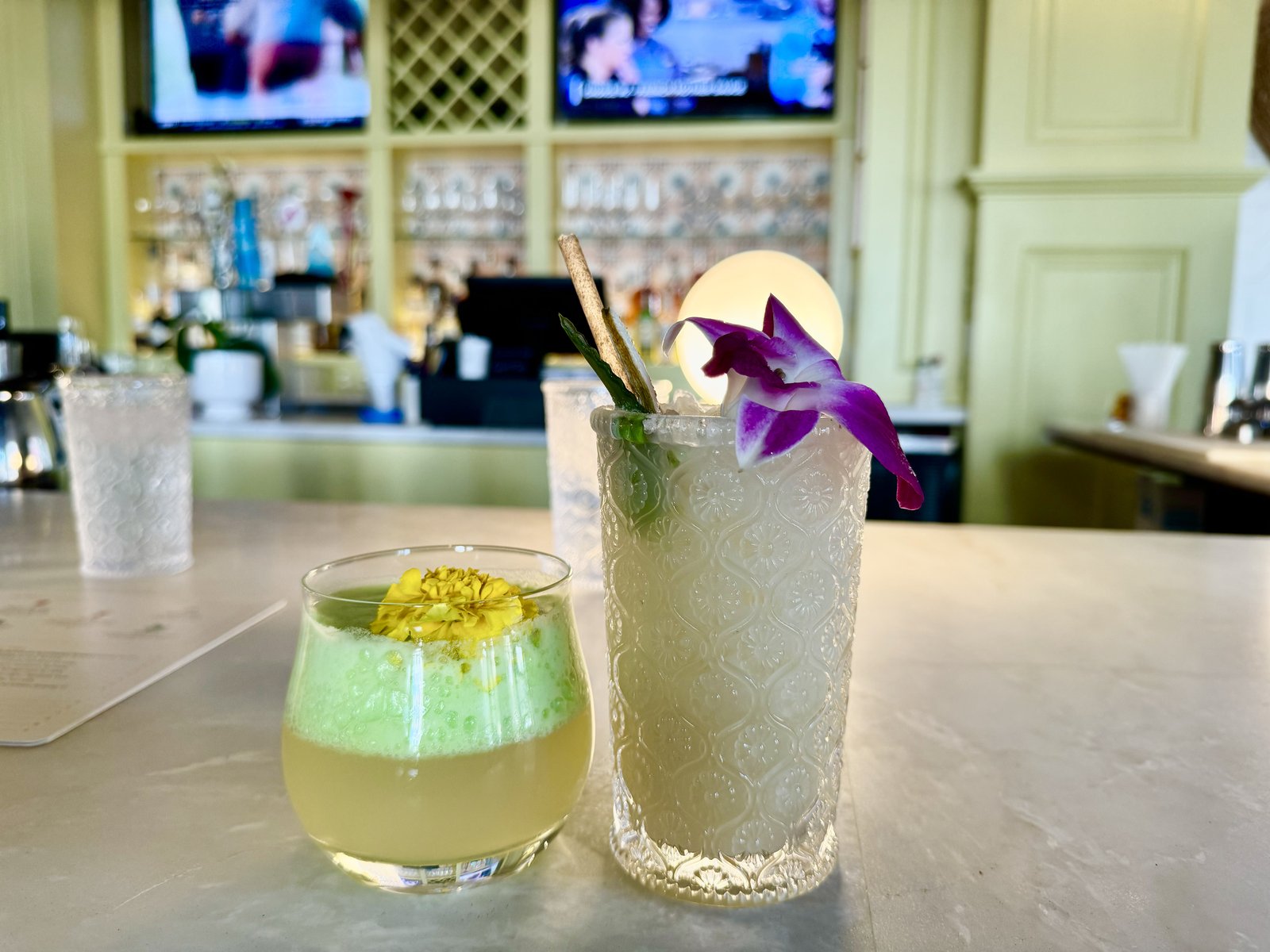
Before dinner we stopped at Gingerline on South Market Street for our first cocktails of the evening. Diem had the Coco Piña: Don Q coconut rum, banana, crème de coco, pineapple and lime. I had the Honey Bee: Hat Trick gin, lemon, honey foam and lavender.
The Honey Bee was amazing. As you draw the tart, ginny concoction from underneath, the foam coats the palate in an effervescent, lavender softness that subdues the vibrant gin. It's magic on the senses. The glass itself conjures images of sweeping meadows with newly bloomed wildflowers, coaxing the freshly emerged forager bees from their winter slumber. Cheers!
The Ordinary
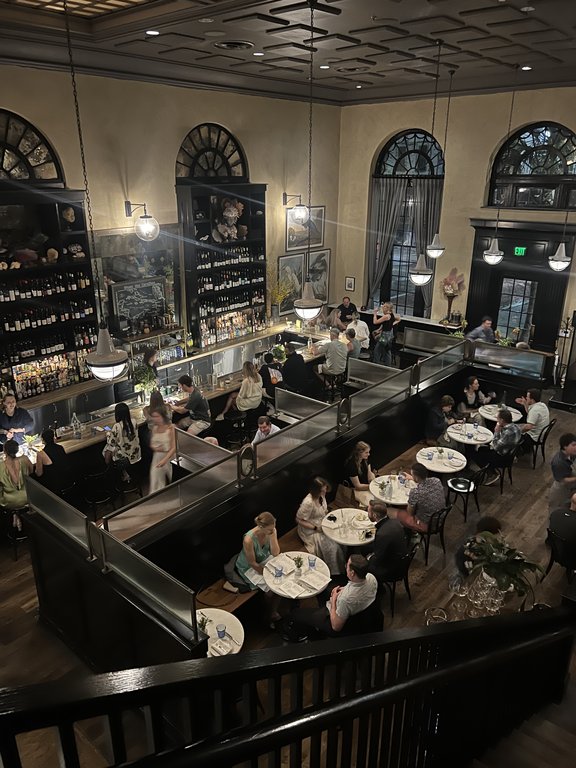
For Diem's birthday dinner we went to The Ordinary on upper King Street, chef Mike Lata's oyster hall, set in a grand old bank building with tall arched windows, a coffered ceiling, and a long raw bar where the cooks shuck all night.
I don't know if Diem enjoyed her birthday dinner, but I sure did. The Ordinary is top notch. We had the seafood tower. Please pray we don't get hepatitis. I alone ate at least three pounds of raw shellfish.
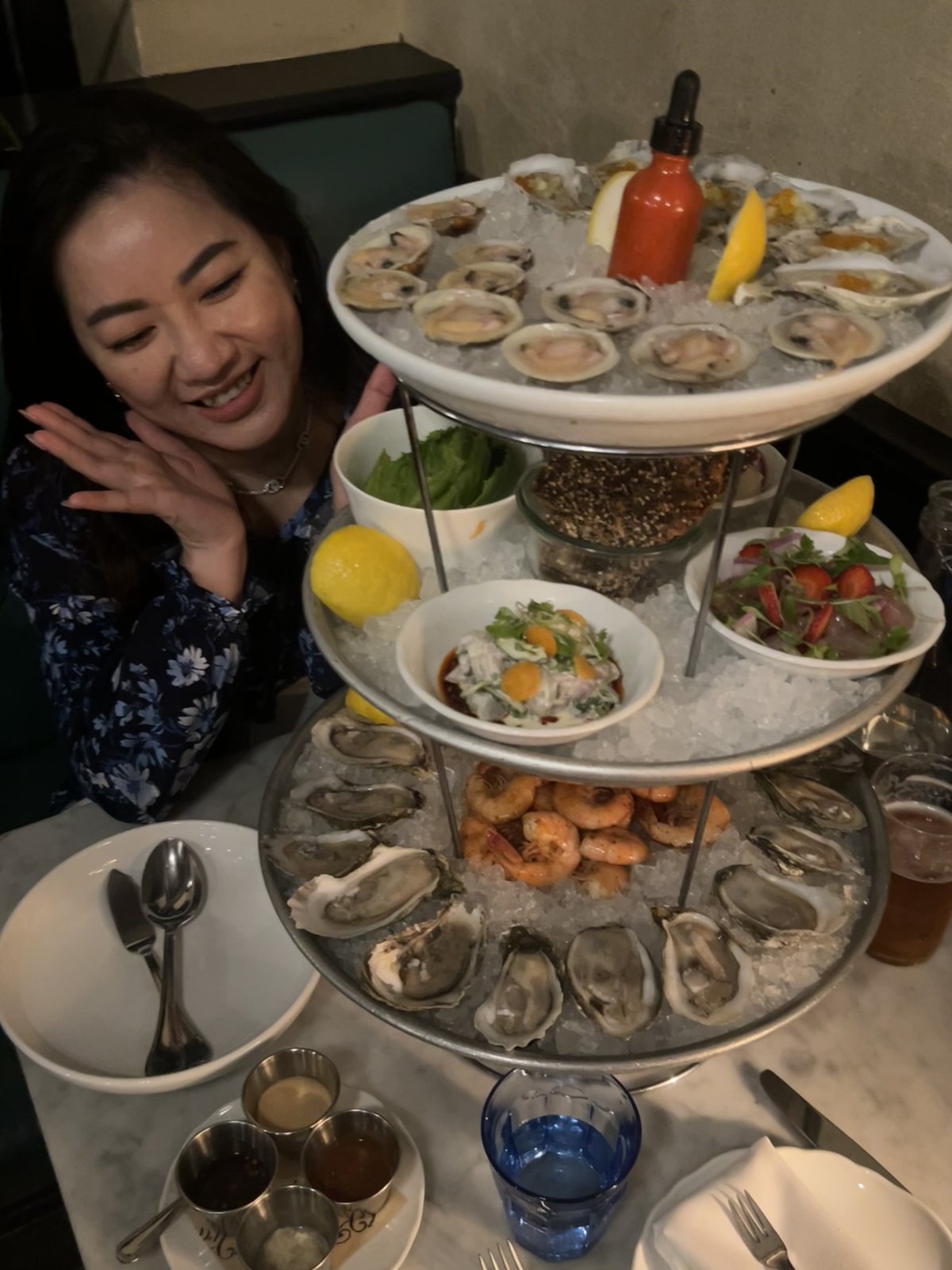
Everything on the tower was locally sourced, including a few species of wild oysters. Harvested from the Edisto River south of Charleston, the Edisto cups were briny, buttery and delicious. The tower included Capers Blades oysters from South Carolina, dressed with cucumber-lime mignonette and trout roe. Peel-and-eat Tarvin shrimp. B-liner snapper ponzu. Flounder larb, our favorite. Clammer Dave's littleneck clams. And a smoked corvina mousse with watermelon radish and sesame lavash. The oyster varieties included Sea Clouds, Edisto Cups and Bird Islands. Again, all sourced locally. It was all simply divine.
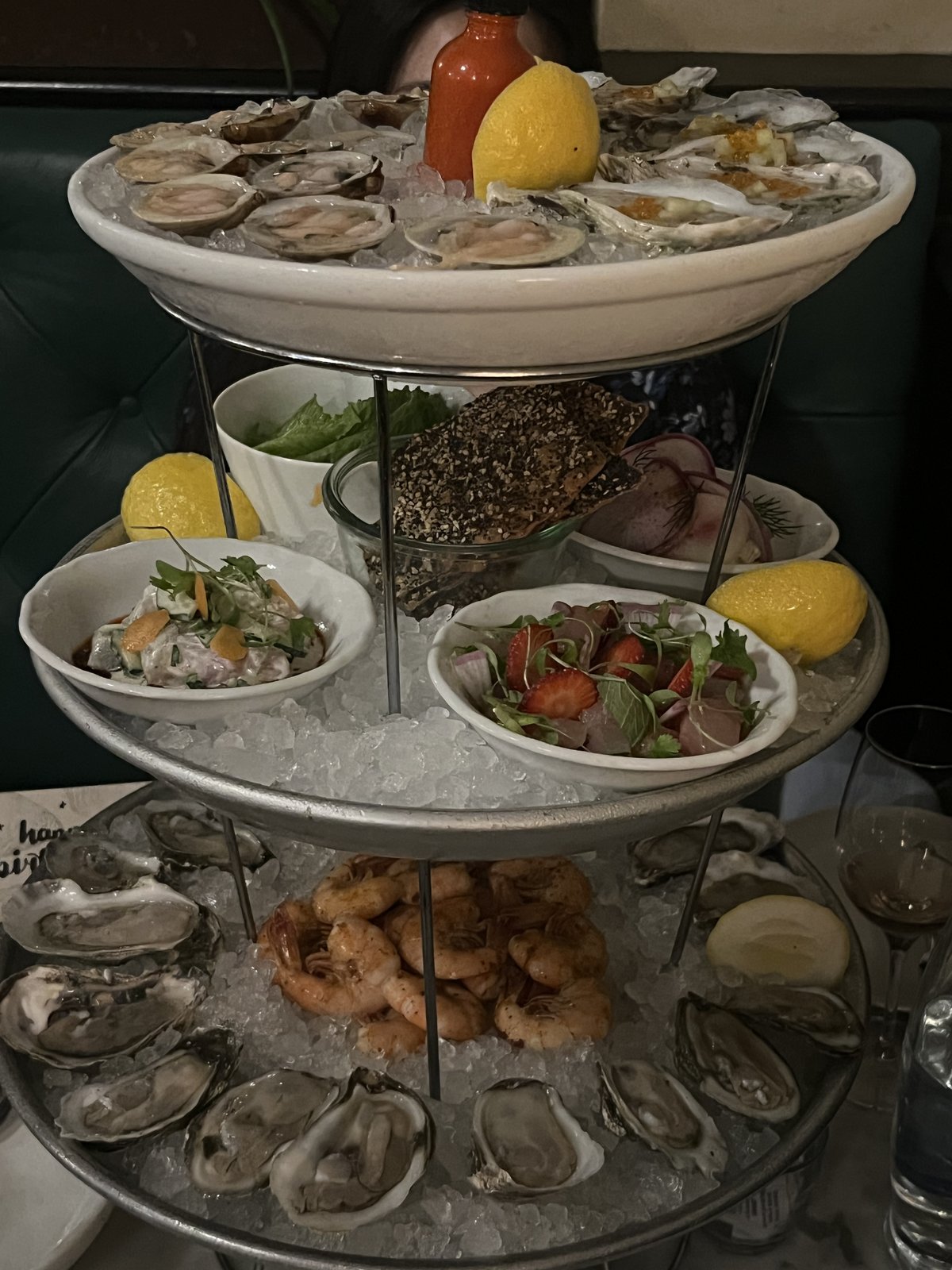
South Carolina oysters are a different animal from the big, single oysters of the Gulf. Most of them grow wild in clusters on the intertidal mud flats, exposed to the air twice a day at low tide, which keeps them small, salty and sharp-edged. For generations they were shoveled up by the bushel and steamed at oyster roasts. Today a handful of small outfits along the coast break the wild clusters apart and finish them as singles for the half shell, and a few have started farming them, which is how oysters like these end up on a tower in a King Street dining room. The Edisto River the Edisto cups come from is one of the longest free-flowing blackwater rivers in North America.
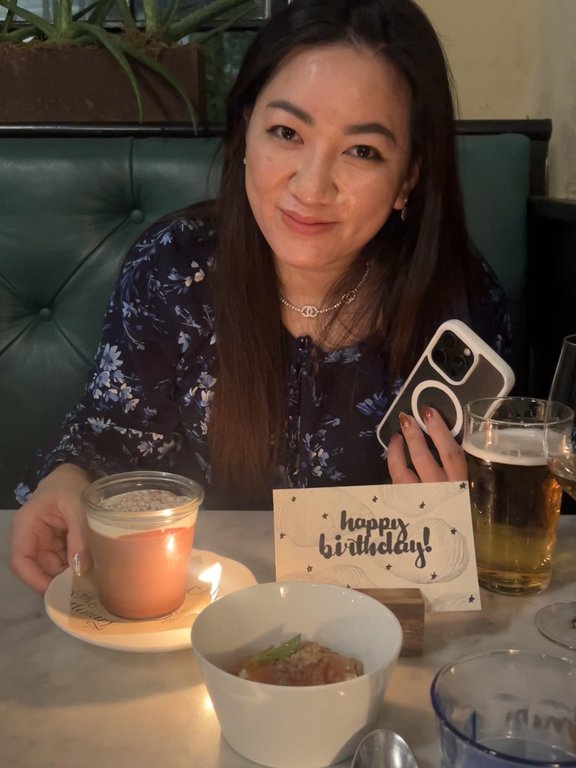
There was a card on the table that said happy birthday, and dessert came with a candle. Happy birthday to my love!
Sunday, St. Patrick's Day
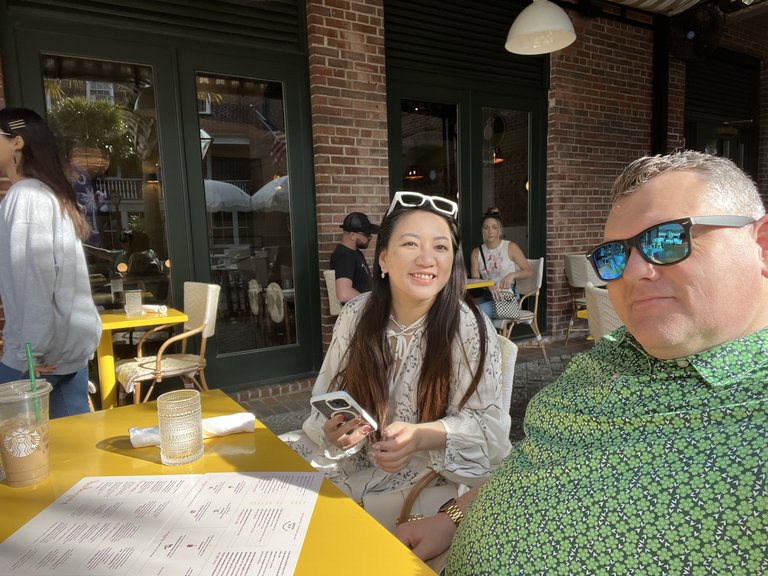
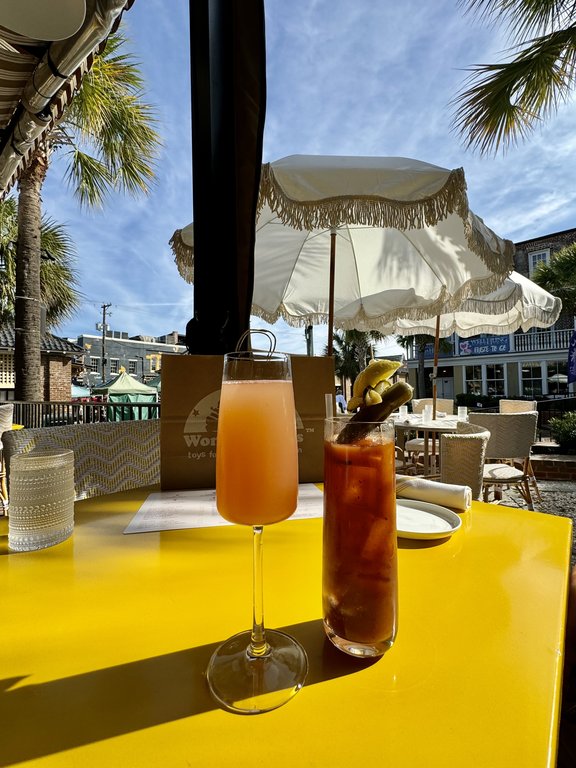
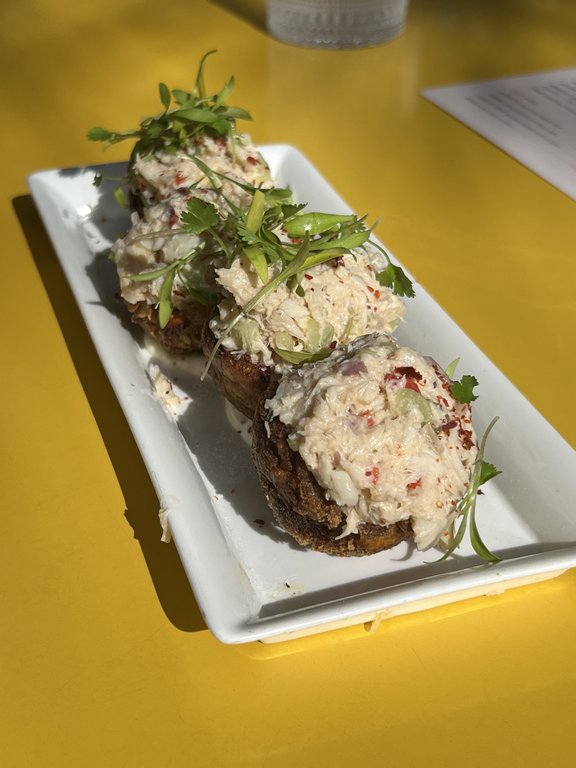
Sunday was St. Patrick's Day, and Charleston was wearing green. Charleston's Irish go back to the 1700s, and the city's Hibernian Society, founded in 1801, is one of the oldest Irish societies in the country. We went back to Gingerline for brunch in the courtyard, under white fringed umbrellas at bright yellow tables. A Bloody Mary piled with pickled vegetables, something pink in a flute, and a plate of crisp cakes heaped with seafood salad. I wore my green shirt. It seemed only right.
Waterfront Park
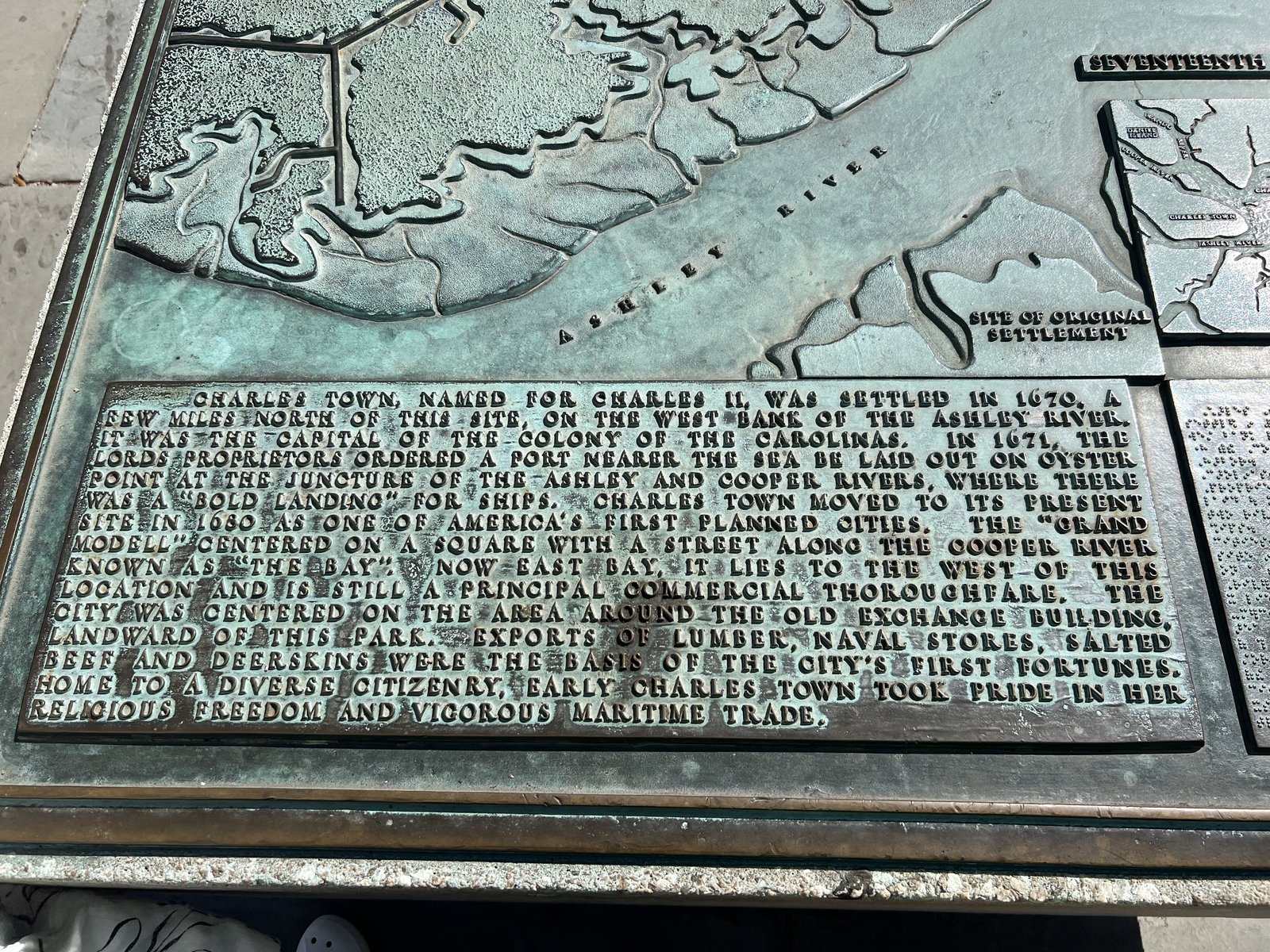
From brunch we walked back through the market and down to Waterfront Park, along the Cooper River. The park opened in 1990, built on what had been decaying wharves and parking lots. Bronze maps along the harbor walk tell the city's story. Charles Town, named for King Charles II, was settled in 1670 a few miles up the Ashley River, then moved to this peninsula in 1680 as one of America's first planned cities. For a few years in the early 1700s, it was a walled city. Exports of lumber, naval stores, salted beef and deerskins were the basis of its first fortunes.
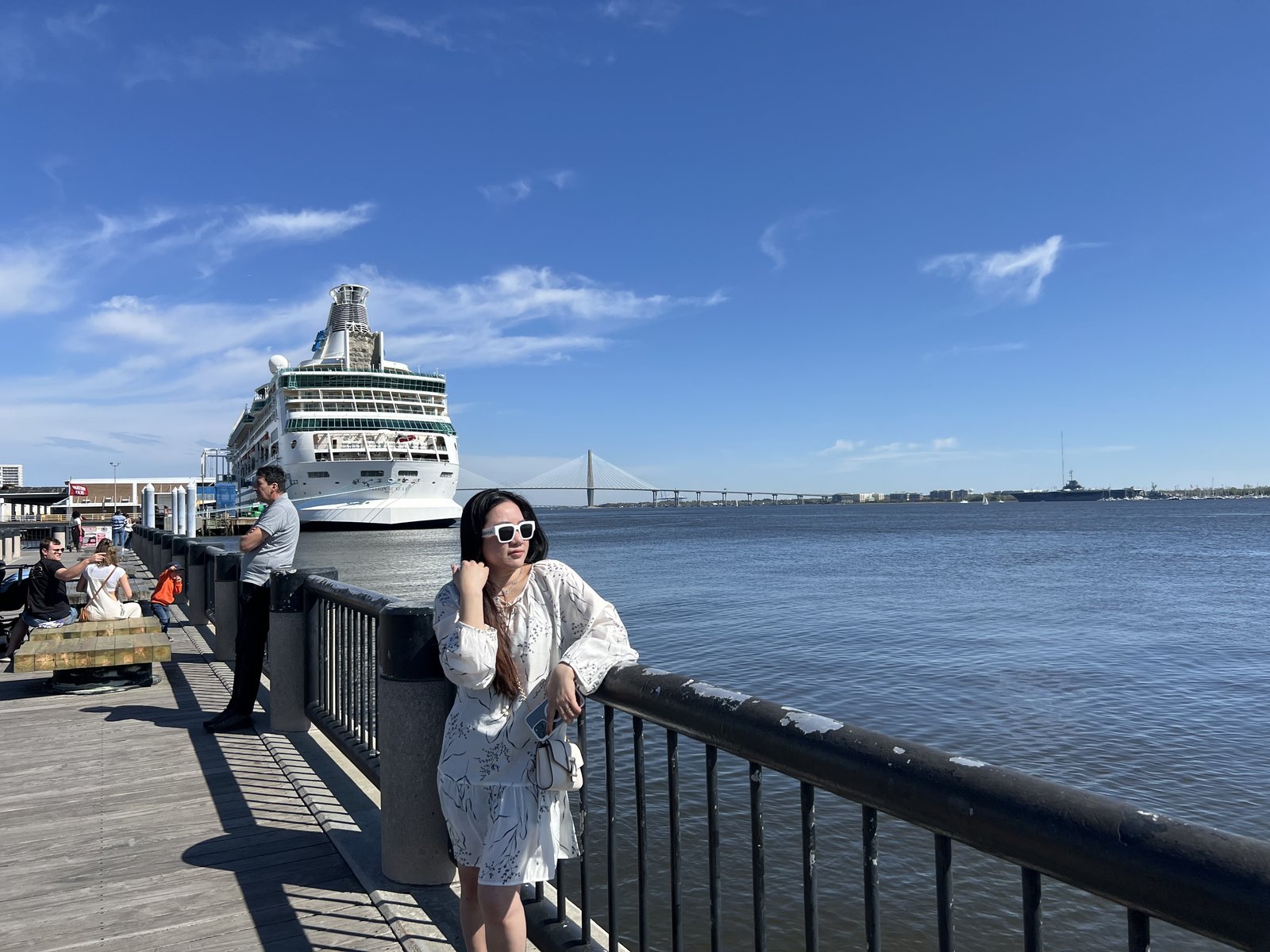
At the railing, a cruise ship sat at the dock and the Arthur Ravenel Jr. Bridge stretched across the river behind it. When it opened in 2005, the Ravenel had the longest cable-stayed span in the Western Hemisphere.
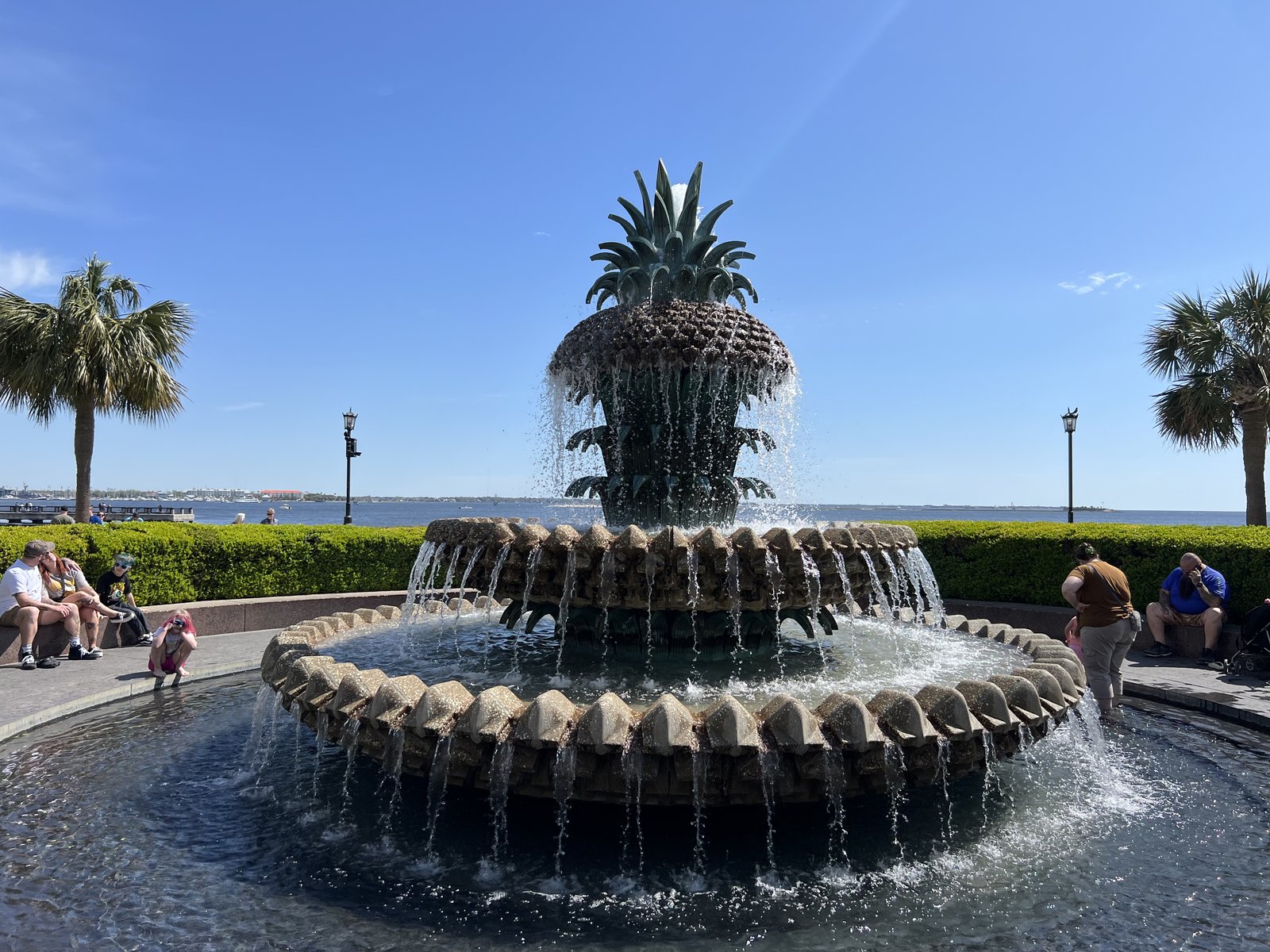
The Pineapple Fountain is the park's famous centerpiece. The pineapple has been the Southern symbol of hospitality since colonial days. As the story goes, a ship captain home from the Caribbean would set one out to let the neighbors know he was back and receiving guests. Nearby, a plaque honors Robert Smalls. Born into slavery in Beaufort in 1839, Smalls was a pilot on the Confederate steamer Planter. Before dawn on May 13, 1862, with the white officers ashore, he took the wheel, picked up his family and the families of the crew, sailed right past Fort Sumter giving the proper signals, and delivered the ship to the Union fleet. He went on to serve five terms in the United States House of Representatives. What a life.
As the story goes, a ship captain home from the Caribbean would set one out to let the neighbors know he was back and receiving guests.
Pink Bellies
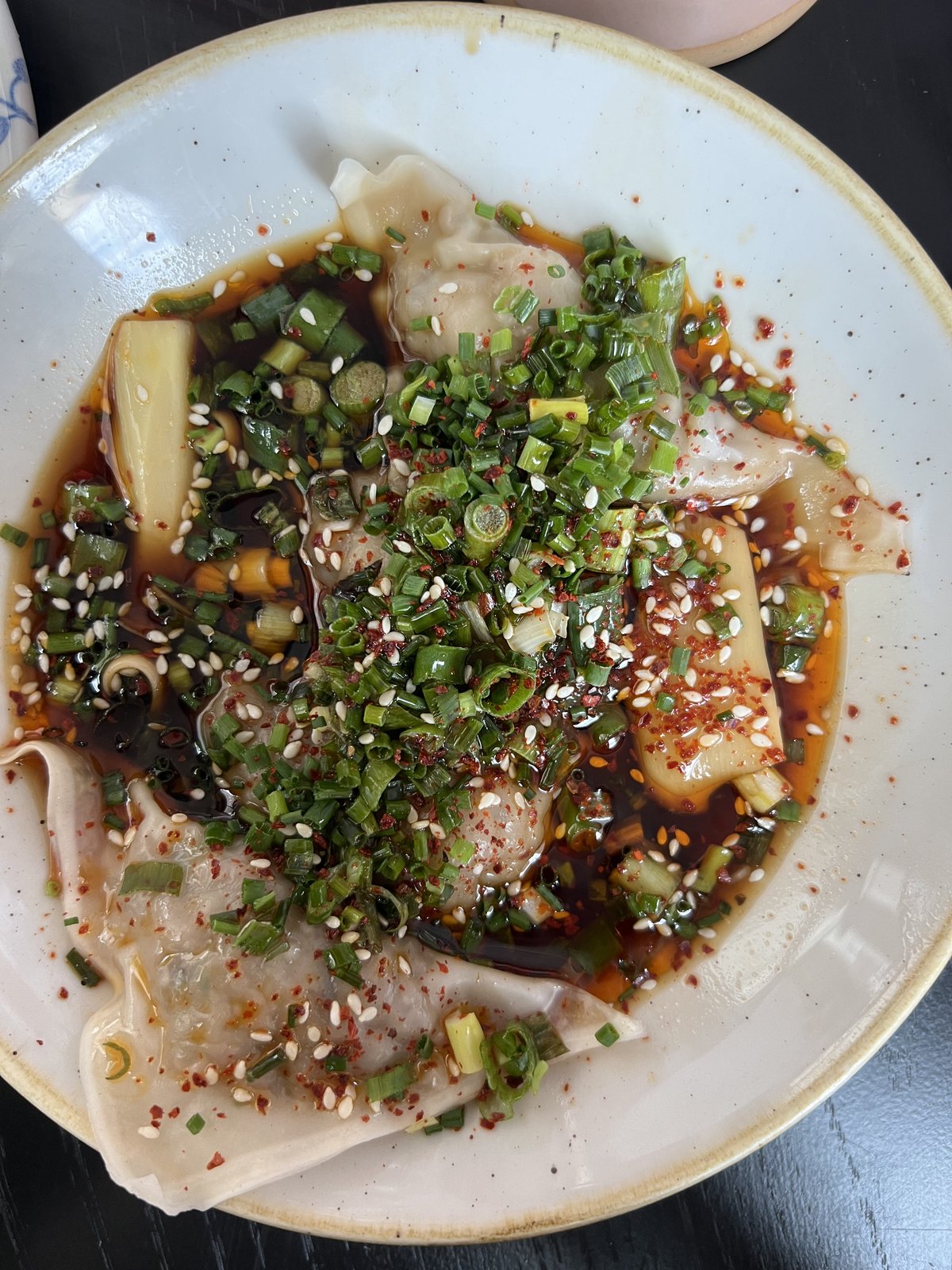
By early afternoon we were hungry again, of course, and we found our way to Pink Bellies on King Street, a Vietnamese-American spot whose menu reads like a conversation between Saigon and the South: sủi cảo dumplings in chili oil, Đà Lạt bánh tráng nướng potatoes, a phô mai burger, avocado fries, and OG garlic noodles. We had the dumplings in chili oil. It is always a treat to find a little Vietnam far from home.
White Point Garden and the Battery
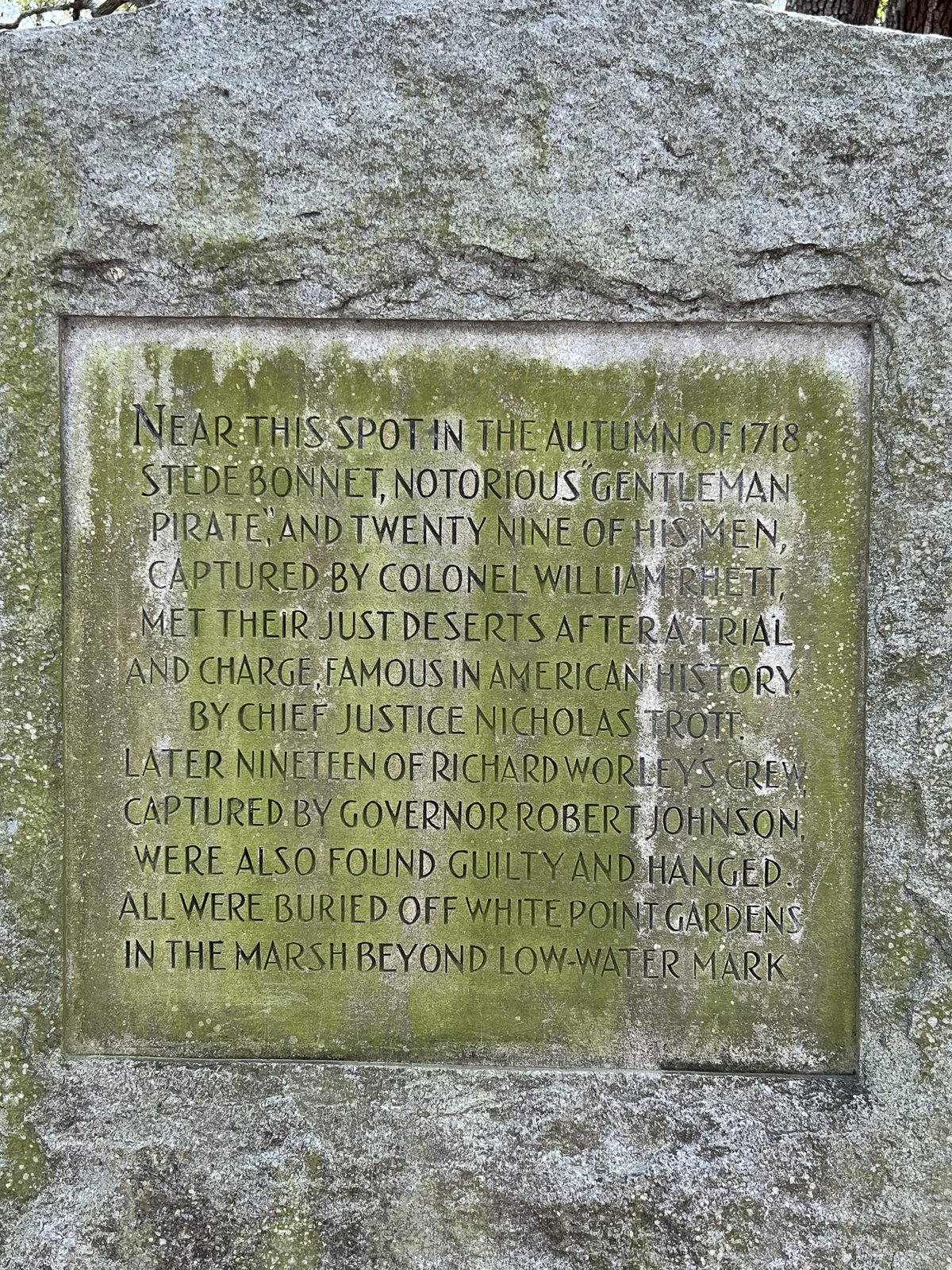
After lunch we made our way to the very tip of the peninsula, to White Point Garden, a park of cannons and live oaks where the Ashley and Cooper rivers meet. A weathered stone there marks the spot where, in the autumn of 1718, the "notorious gentleman pirate" Stede Bonnet and twenty-nine of his men "met their just deserts." They were hanged and buried in the marsh beyond the low water mark. Bonnet was a wealthy Barbados planter who bought a ship and took up piracy, sailed for a while with Blackbeard, and ended up here. Charleston was not a forgiving place for pirates.
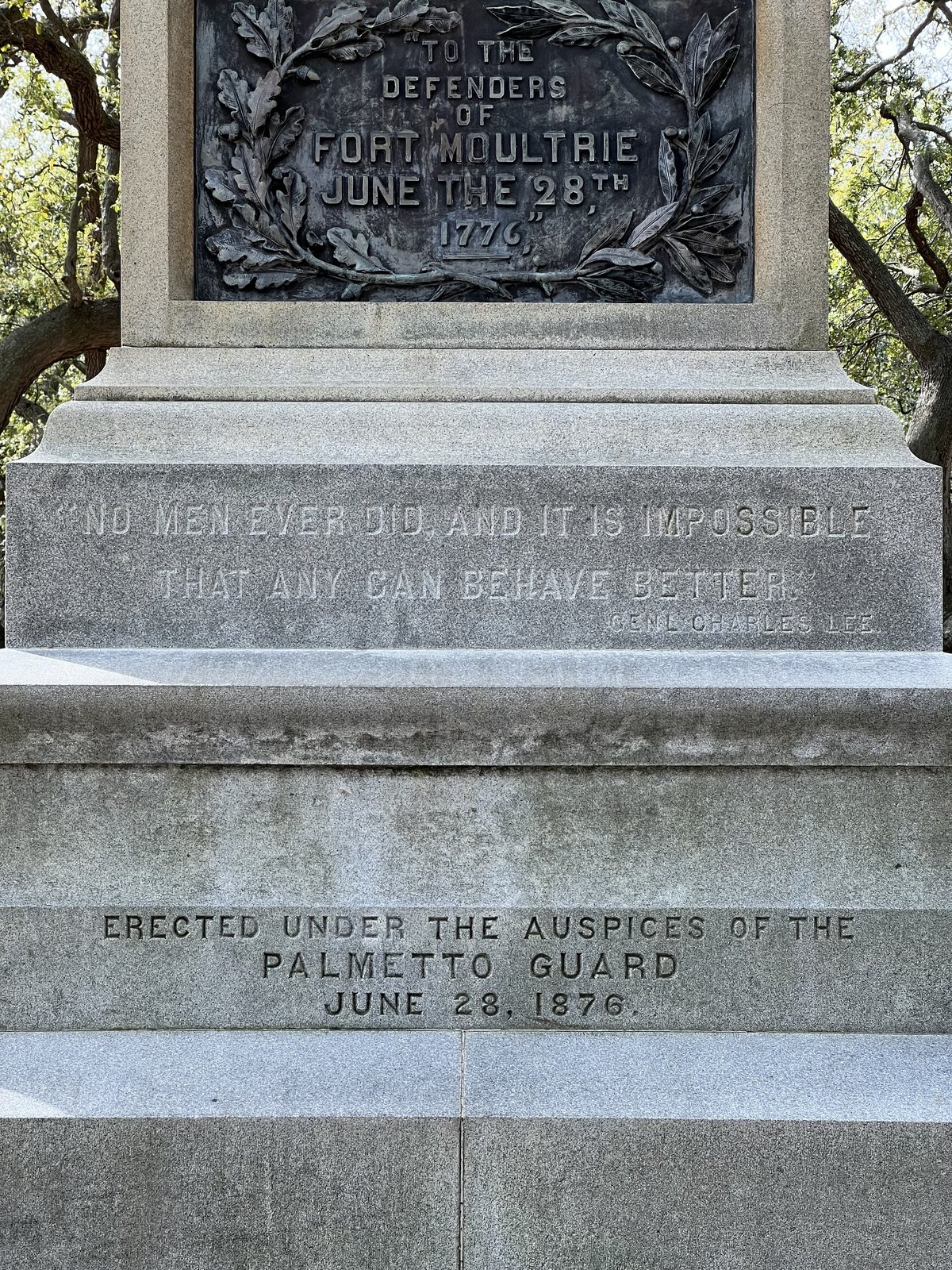
One of the garden's monuments is dedicated "To the Defenders of Fort Moultrie, June the 28th, 1776." On that day a small fort of palmetto logs and sand on Sullivan's Island, commanded by Colonel William Moultrie, held off a British fleet. The soft, spongy palmetto logs simply swallowed the British cannonballs. When a shot knocked down the fort's flag, Sergeant William Jasper jumped down into the open under fire to put it back up, shouting, "Don't let us fight without a flag." It was one of the first decisive American victories of the Revolution, and it is why there is a palmetto tree on the South Carolina flag today. The monument reads, "No men ever did, and it is impossible that any can behave better."
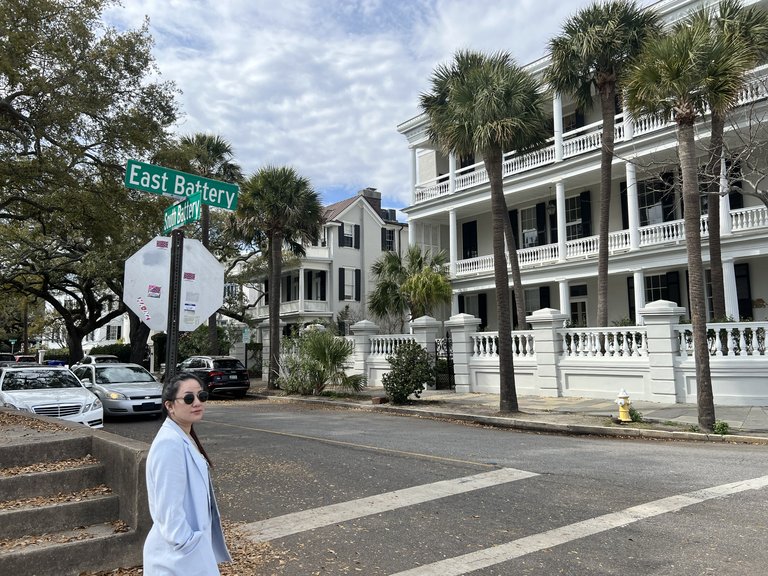
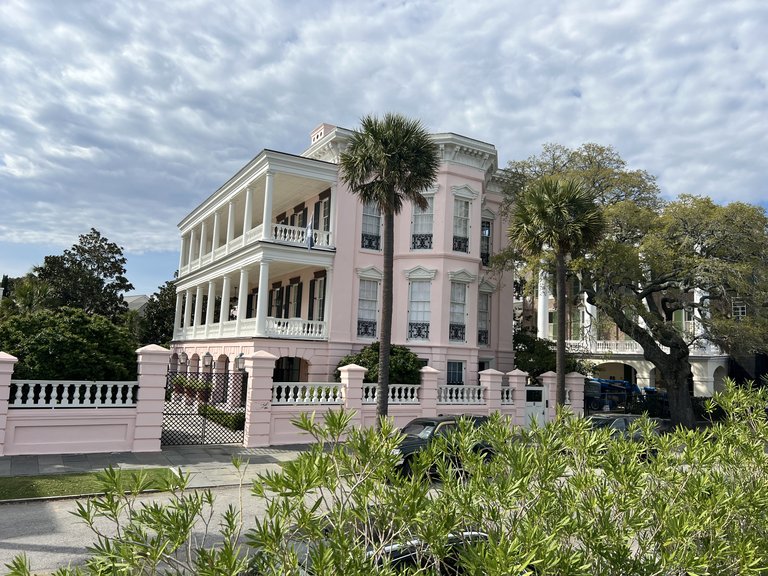
From the garden we followed East Battery along the seawall past the big houses with their stacked piazzas and palmettos, the grandest homes in the city, built by merchants and planters with their faces to the harbor and the sea breeze.
The Old Town
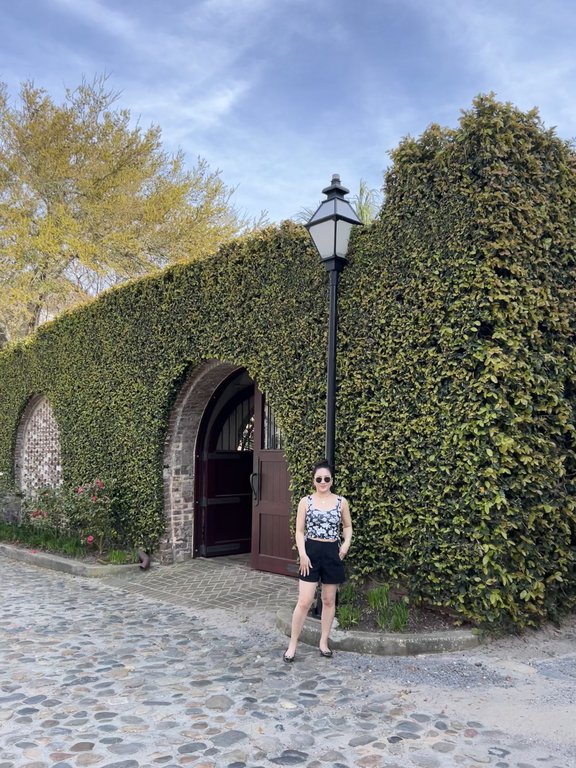
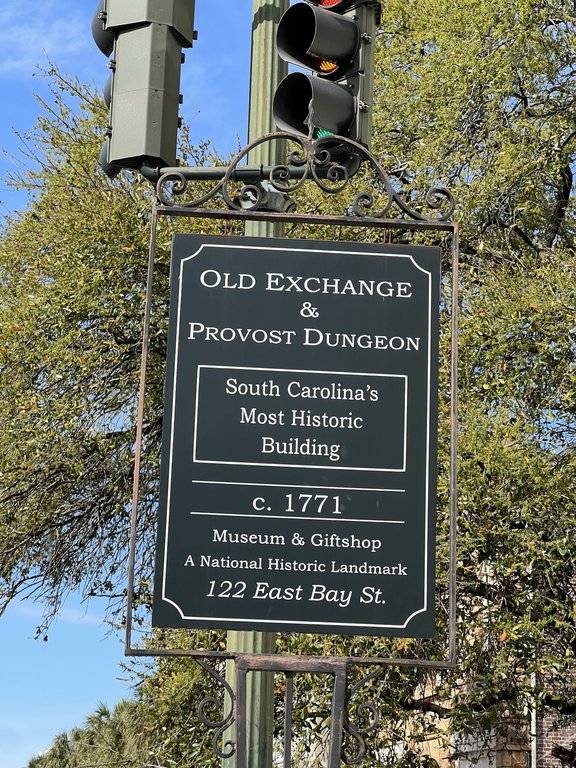
Then we wandered back up through the old town. Cobblestone streets and walls buried in ivy. The Old Exchange and Provost Dungeon, built under British colonial rule between 1767 and 1771 and billed, fairly, as South Carolina's most historic building. During the Revolution the British held American patriots prisoner in its cellar. In 1788 South Carolina ratified the United States Constitution in the building, and in 1791 George Washington was entertained in its great hall.
The pink French Huguenot Church is the third church on its site, built in 1845. The congregation dates to around 1681, when French Protestants fleeing persecution at home found a welcome in Charleston. It is the only independent Huguenot church in the United States. Down every street, one steeple after another. The Holy City lives up to its name.
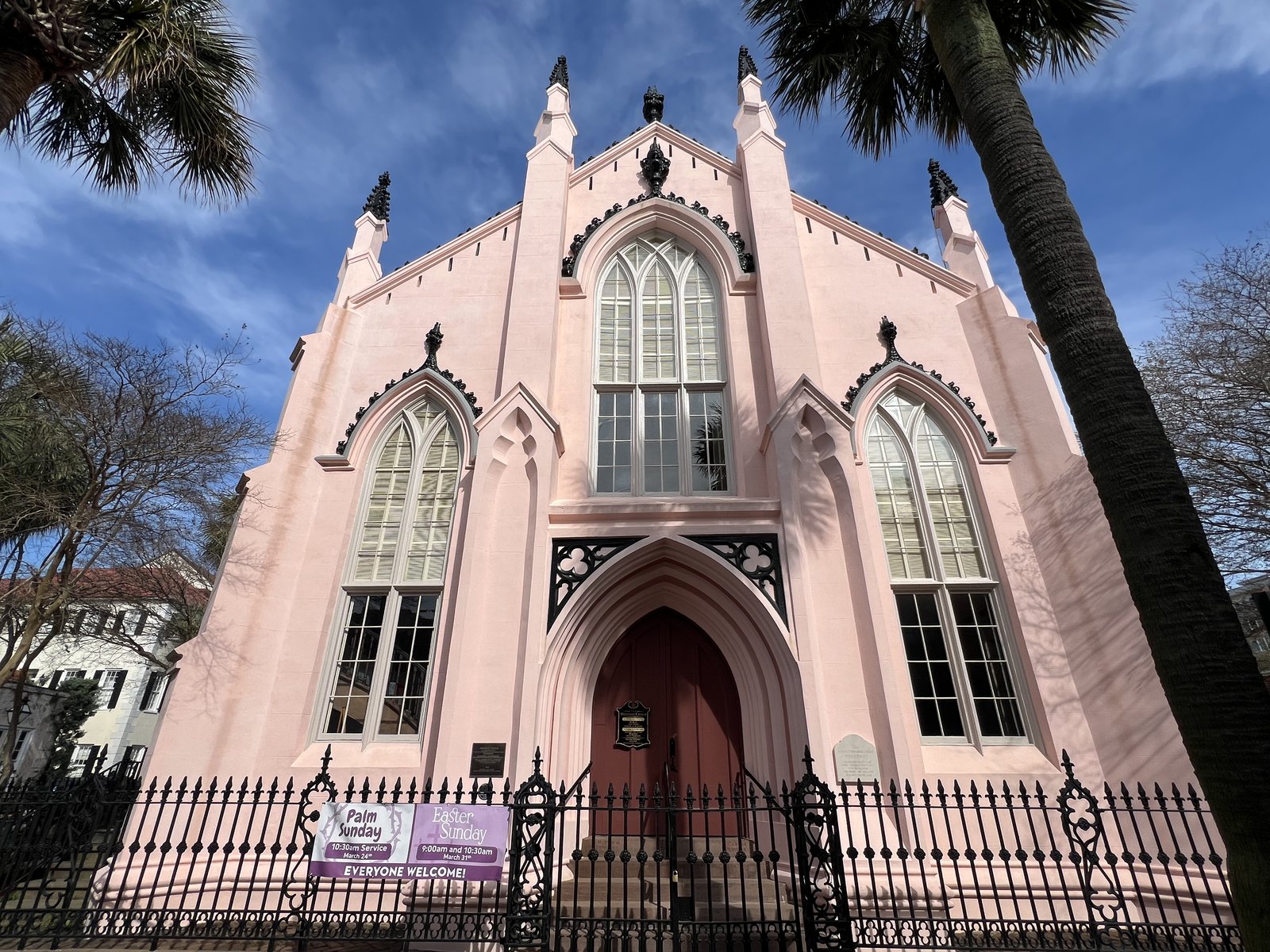
Charleston packs more history into a block than most cities manage in a mile. The city has burned, been shelled through a 545-day siege in the Civil War, been flattened by an earthquake in 1886, and been battered by Hurricane Hugo in 1989. As one of the bronze plaques by the harbor put it, none of it managed to kill her spirit.
That evening we finished with a seafood boil, and a last walk past the City Market sign.
The Angel Oak
We saved one stop for Monday, on the way out of town. That morning we passed the old Central Fire Station, built in 1887, and went up King Street for one last iced coffee, then drove out across the Stono River to Johns Island, to the Angel Oak.
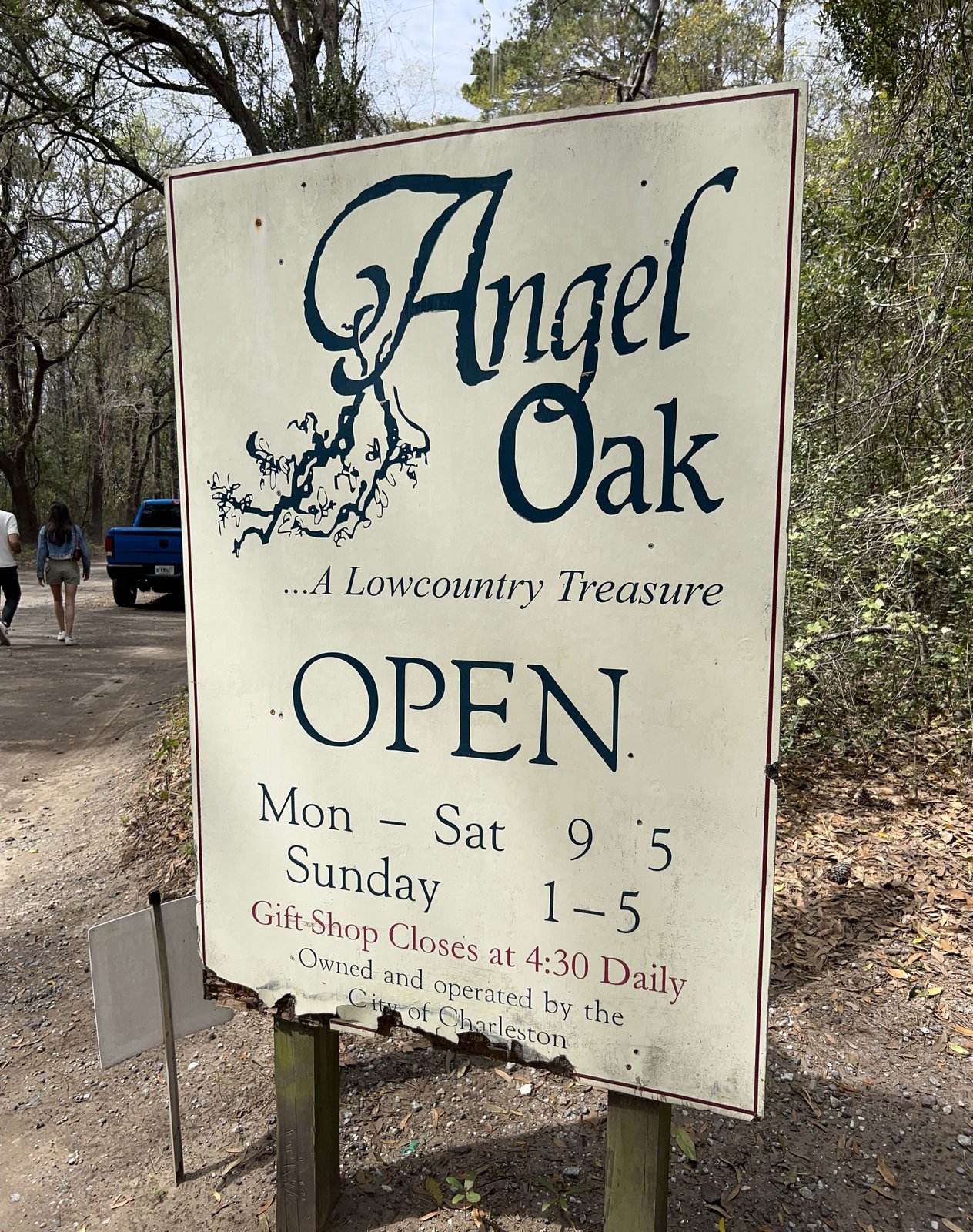
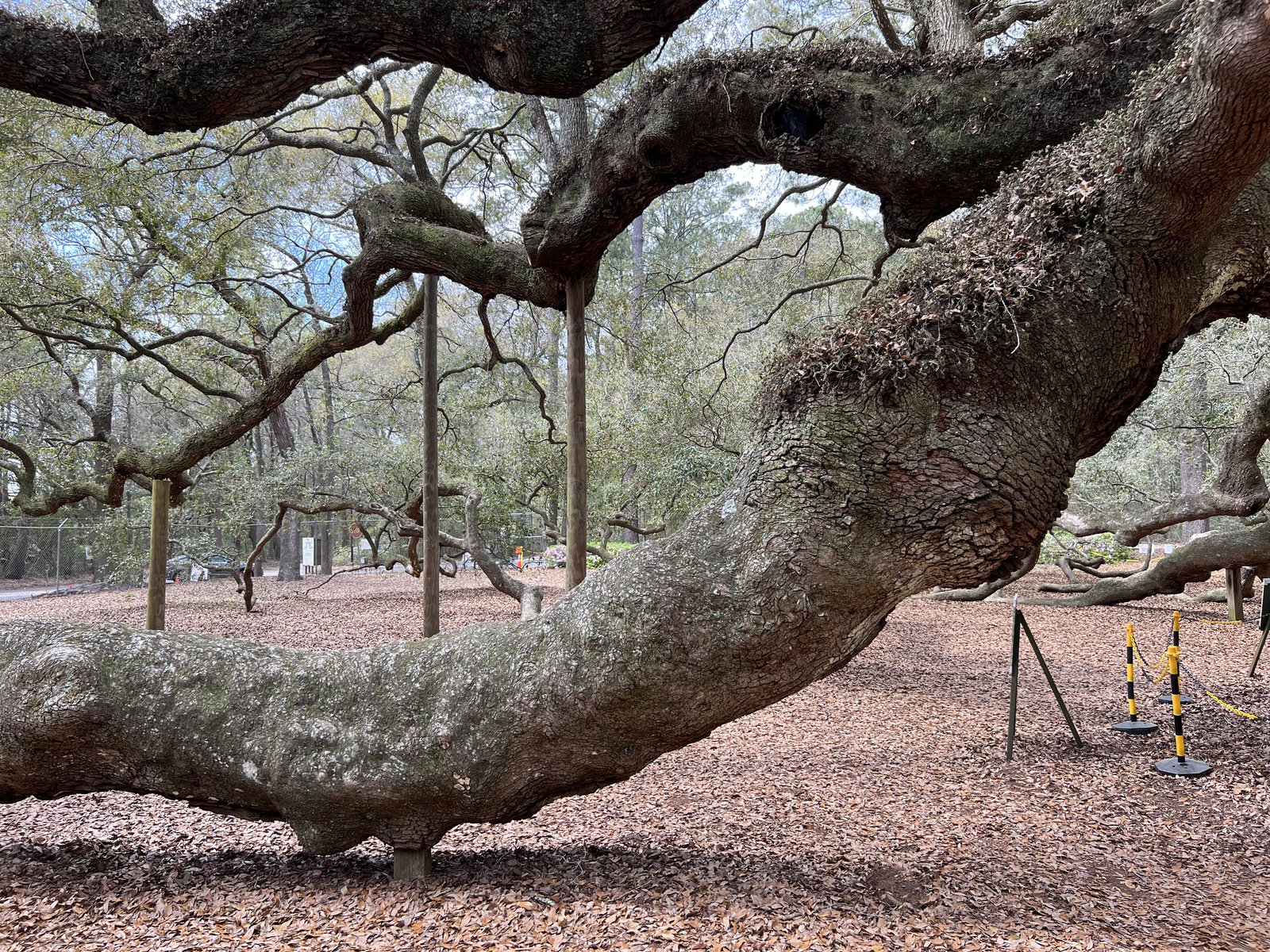
The sign at the tree says it is estimated to be over 400 years old. It stands 65 feet tall and throws 17,000 square feet of shade. Its longest limb is 89 feet long. When the City of Charleston bought the property in 1991, the trunk measured 25.5 feet around. Today it is 31.5. Those limbs grow out, then down, until they rest on the ground, and then they keep going. Standing under it, you lose track of where the tree ends.
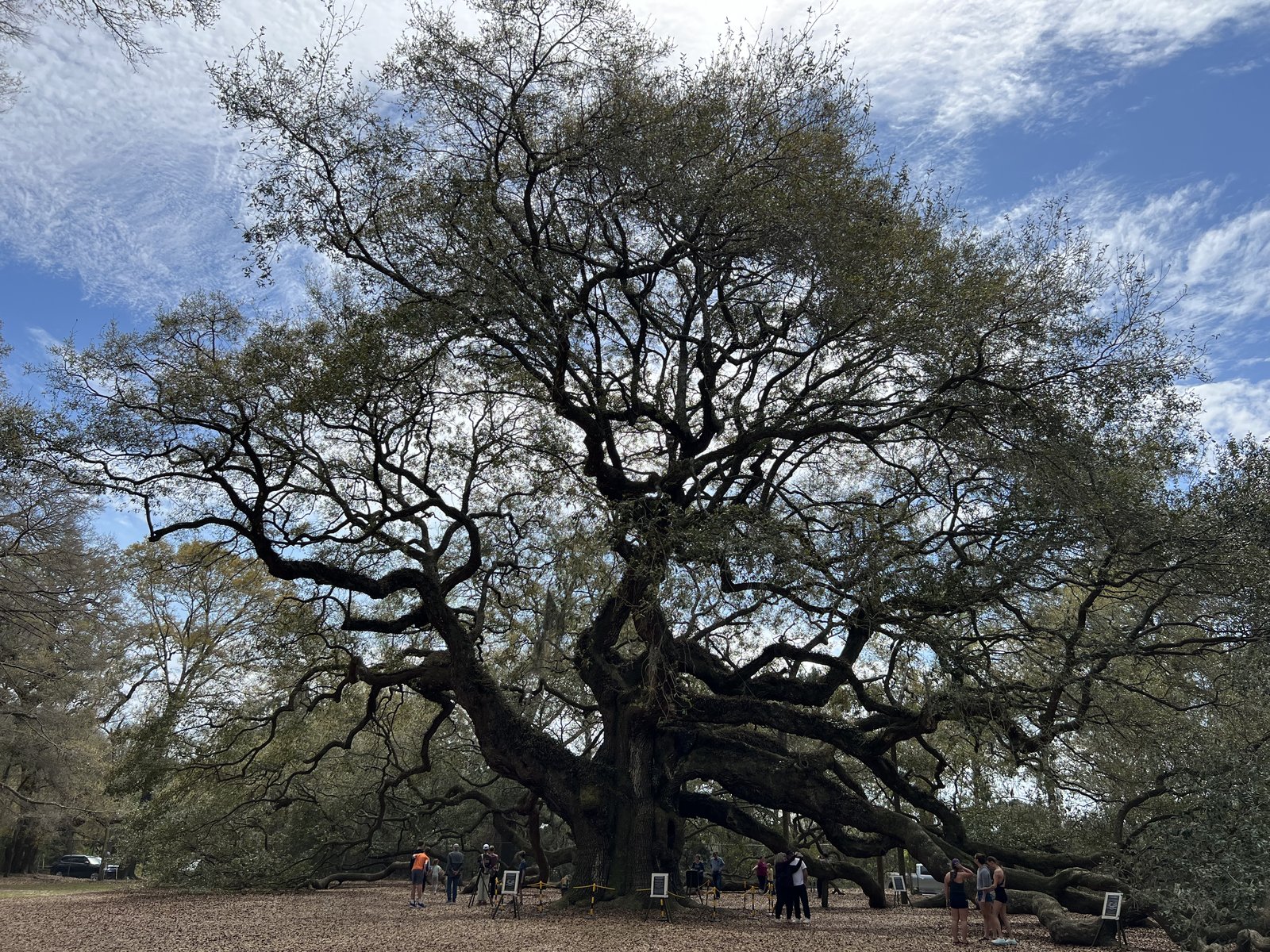
The tree takes its name from Justus and Martha Angel, who owned the land in the 1800s, though local stories have long held that the ghosts of the people once enslaved on the plantation appear around it as angels. Either way, it was already growing here before Charles Town was founded.
There is another sign, a list of rules. Do not sit on the tree. Do not sit under the tree. Do not stand on the limbs. And my favorite: no exercise, yoga or handstands. Somebody, somewhere, made that sign necessary.
Then it was back up the highway to Georgia. Three days, more oysters than any man should eat, three centuries of history, and a tree older than all of it. Not bad for a city that was only supposed to be the backup.
Previously: Beneath An Endless Sky - Day 15